

When people think about future Mars bases, they usually think of oxygen, water, and rocket fuel. But there is another, much more practical side to colonization: everyday technologies that make life self-sufficient. Aircapture and the craft brewery Almanac Beer Co. have unveiled Flow – Clean Air Edition, a beer they describe as the first commercially available beverage carbonated with CO₂ captured directly from the atmosphere using direct air capture (DAC) technology.
A brewery in Alameda has installed an Aircapture modular DAC system, which extracts carbon dioxide from the ambient air, purifies it to food-grade quality, and feeds it directly into the production process. The company claims that its CO₂ is 99.999% pure and that the system can be integrated into existing infrastructure in a matter of weeks, without the need to build a separate facility. The beer was officially launched on March 21, 2026, and is now available at the brewery itself and at more than 800 locations throughout California.
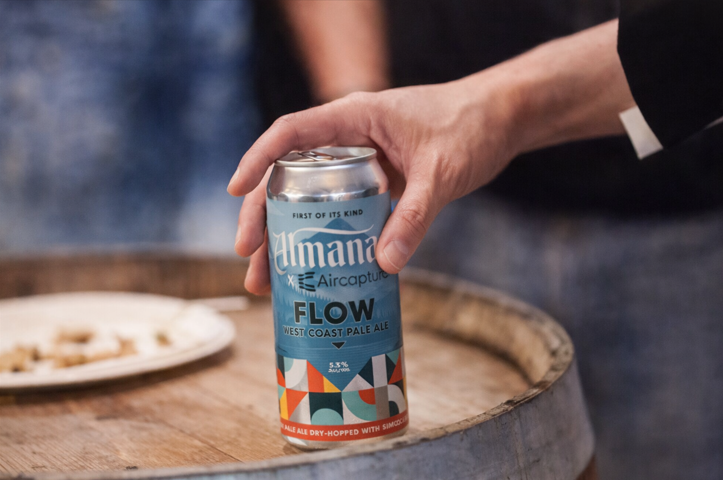
As for the space-related aspect, there’s another interesting point here: this story shows how CO₂ ceases to be waste and becomes a local resource. Mars’ atmosphere consists almost entirely of carbon dioxide, although it is very thin. In other words, the very idea of capturing CO₂ from the atmosphere and using it on the spot no longer sounds like a joke about Martian beer, but rather like a perfectly logical component of future self-sufficient infrastructure. However, CO₂ alone isn’t enough for a real Martian brewery: you also need water, grain, yeast, energy, and a sealed production environment.
How does it work? The system draws in ordinary air, extracts CO₂ molecules from it, filters the gas to a very high degree of purity, and then supplies it to the brewery as standard food-grade carbon dioxide for carbonating the beverage. In other words, instead of transporting CO₂ in cylinders or tanks, the brewery actually produces it on site—directly from the atmosphere.
Why is this important? This news is interesting not so much for the beer itself as for the ISRU approach—the use of local resources. NASA has already demonstrated a similar approach on Mars as part of the MOXIE project, which produced oxygen from the CO₂-rich Martian atmosphere. Following this logic, future bases could obtain not only breathing oxygen or fuel components from the local environment, but also industrial gases for food, chemical, or biotechnological processes. For remote research stations and off-Earth settlements, this means less reliance on supplies from Earth.

