

American astronomers have announced the discovery of a previously unknown black hole. It is hidden in the heart of a small galaxy located near the Milky Way.
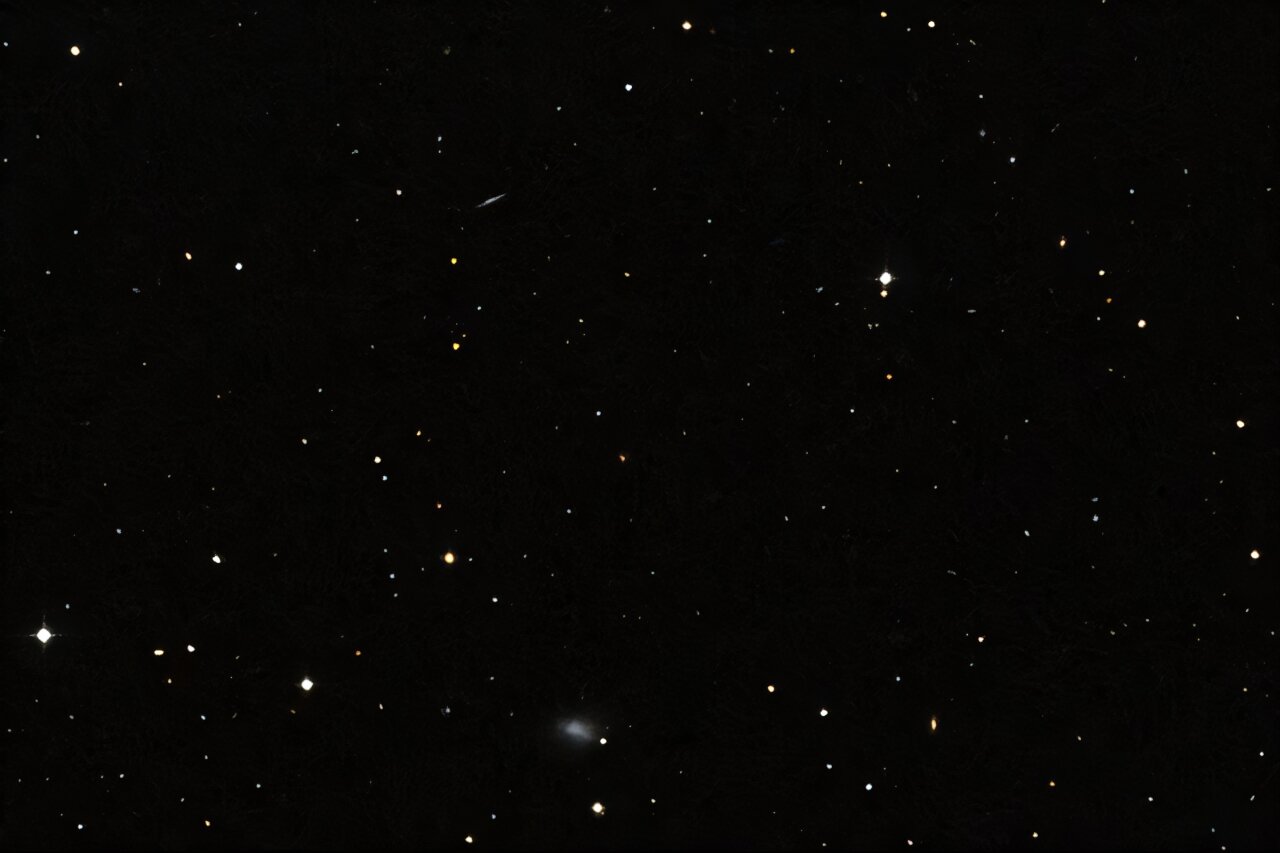
The discovery was made during a joint project between the University of Texas at Austin and the University of Texas at San Antonio. Its goal is to provide students with the opportunity to use advanced technologies and modeling techniques to study the effects of gravity on galaxies.
The subject of the study was Segue 1, one of the smallest and dimmest satellite galaxies of the Milky Way. It is located 75,000 light-years from Earth and is only 300 times brighter than the Sun. The galaxy is populated by old, dim stars that are more than 12 billion years old.
Until recently, it was believed that Segue 1 stars were held together by mysterious dark matter. However, the results of simulations conducted on supercomputers refute this assumption. Researchers used them to test the galaxy’s structure. They created hundreds of thousands of complex models, each of which displayed the predicted trajectories of the Segue 1 stars, taking into account various potential factors ranging from the distribution of dark matter to the presence of a black hole.
The researchers then filtered out stars on the outskirts of Segue 1, removing those that are influenced by the Milky Way. Next, the team mapped the speed and direction of the remaining stars and compared them with models. It soon became clear that the stars closer to the center were moving in fast, tight orbits — a clear sign of a black hole there. Models with a high proportion of dark matter or with dark matter and a black hole did not match the actual observed picture very well.
When researchers estimated the size of the black hole at the center of Segue, they found a big surprise. It is estimated to be 450,000 times more massive than our Sun and about 10 times more massive than all the stars in Segue 1 combined.
In most galaxies, the mass of the central black hole does not exceed the mass of stars. One possible explanation for this anomaly is that Segue 1 used to be a larger galaxy with many more stars. However, over time, the Milky Way stole most of its stars, leaving only a few behind.
Another possibility is that Segue 1 resembles a recently discovered class of galaxies called “small red dots,” which appear to have evolved with massive black holes and very few stars. These early galaxies, located in the most distant corners of the Universe, are difficult to study. With Segue 1, astronomers may now have the opportunity to explore a similar object.
Whatever the correct answer may be, Segue 1 presents an intriguing challenge to current ideas about dwarf galaxies. It proves once again that even such small and seemingly unremarkable objects can hide a lot of surprises.
According to Phys.org

