

For the first time in the history of astrophysics, researchers have measured the instantaneous (kinetic) power of black hole jets—and found that it is equivalent to the radiation output of more than 5,000 Suns. This was achieved thanks to an unexpected “tool”: the stellar wind from a massive companion star. The study was published in Nature Astronomy.
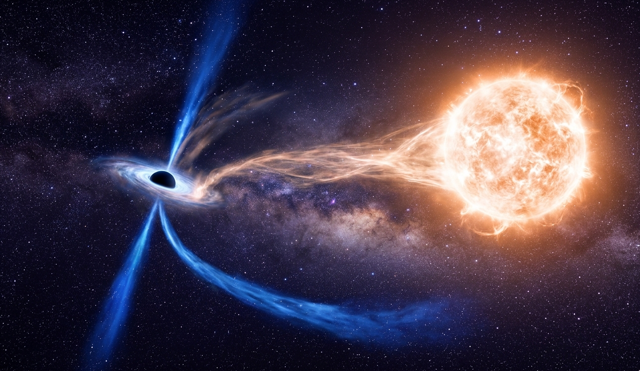
Cygnus X-1 is the first black hole ever discovered by humankind. It has a mass of about 21 times that of the Sun and is compressed into a volume with a diameter of approximately 100 kilometers. Nearby is a giant star with a mass of nearly 40 times that of the Sun. These two bodies orbit each other with an orbital period of 5.6 Earth days. For nearly 20,000 years, the black hole has been “feeding” on the stellar wind from its companion—and instead of falling beyond the event horizon, some of this material is transformed into jets traveling at speeds close to the speed of light.
Wind that bends the jets
The stellar wind from the massive star in the Cygnus X-1 system is remarkably intense: it loses 100 million times more mass per second than our Sun, and the particle velocity in this wind is three times higher than that of the solar wind. This turned out to be enough to literally deflect the black hole’s jets—much like how the wind on Earth scatters the spray from a fountain. As the black hole moves along its orbit, the direction of the jets changes in sync—they move in a majestic cosmic “dance.”
How the energy balance was measured
Astrophysicists from Curtin University (Australia) and the University of Oxford have obtained ultra-high-resolution images of jets by combining signals from telescopes separated by thousands of kilometers—using the same technique that was used to produce the first image of a black hole in the Event Horizon Telescope project (Event Horizon Telescope). By simulating the jets’ orbital “dance,” the team obtained a direct measurement of their instantaneous power for the first time.
The resulting value offers a new way to balance the “inflows” and “outflows” in a black hole’s energy budget: how much matter is absorbed—and how much energy is emitted in jets. For supermassive black holes at the centers of galaxies, jets can influence the evolution of entire galaxies and even larger structures in the universe. The new data will allow for more accurate calibration of computer simulations that model this process.
According to sciencealert.com

