

The life of a star is a balance between gravity, which compresses matter, and internal pressure, which is maintained by thermonuclear reactions. When a supermassive star runs out of fuel, this balance is disturbed and the core begins to collapse. According to the general theory of relativity, under certain conditions a black hole with an event horizon is formed, and classical equations predict the existence of a singularity inside it – a region of infinitely high density.
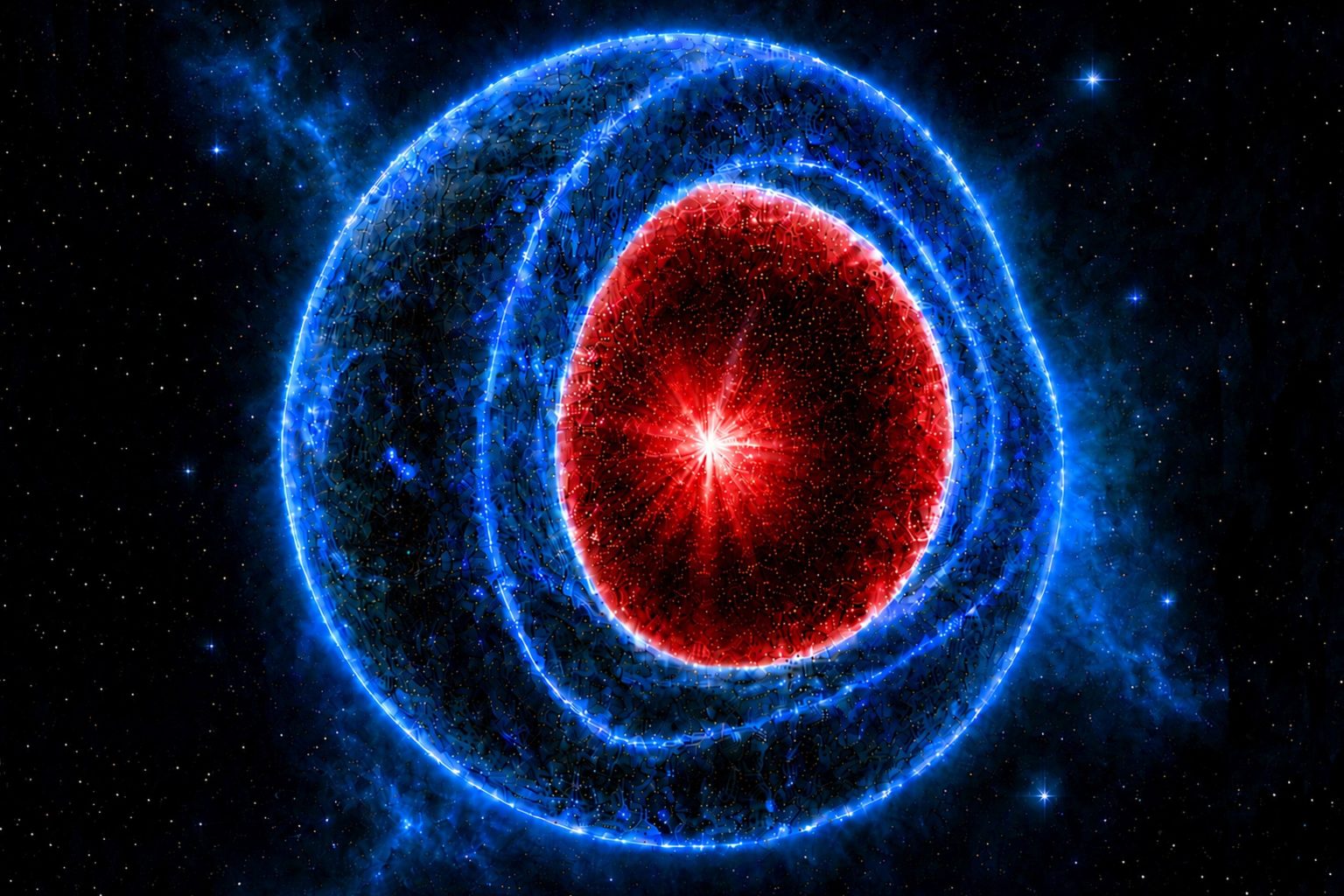
However, black holes remain one of science’s biggest headaches. How can billions of solar masses fit into a tiny dot? How can space and time be warped to infinity? At this point, the laws of physics break down., and the event horizon hides from us any information about what is happening inside.
Gravastars – a cauldron of dark energy
Because of these paradoxes, scientists are seeking alternative and exotic explanations. One of them is the existence of ultra-compact stars known as gravastars. On the outside, they are just as massive and invisible due to their super-powerful gravity as black holes. But they have neither an event horizon nor a problematic singularity.
Instead, the core of a gravastar is hypothetically filled with dark energy. It generates a powerful outward pressure that successfully counteracts gravity and prevents the outer layers of ordinary matter from collapsing completely. This concept fits much better with the laws of physics, yet it has remained a mystery: how can such objects form in the universe at all?
Birth of a mini-Universe
The answer was proposed by theoretical physicists Daniel Jampolski and Professor Luciano Rezzolla from Frankfurt. For the first time, the researchers developed a dynamical solution based on Einstein’s equations of general relativity that describes the process by which a collapsing star transforms into a gravastar.
According to their calculations, published in the journal Physical Review D, a kind of “mini-Universe” can form during the extreme compression of matter inside a star. This process bears some resemblance to the Big Bang. Like our universe, this internal space begins to expand due to dark energy. This expansion creates a perfect balance with the gravitational force of the collapsing matter, permanently halting the formation of a black hole and transforming the object into a stable graviton. In this way, physicists have solved a theoretical problem that scientists have been grappling with for a quarter of a century.
A space for new physics
According to Daniel Jampolski, who found a probable solution while working on his master’s thesis, such an internal Big Bang can occur at a very late stage of the collapse. By that point, matter is already so extremely compressed that its behavior goes beyond our usual understanding, leaving room for entirely new physical effects.
Professor Rezzolla emphasizes that classical black holes remain the simplest and most natural explanation for the end of massive stars’ lives. However, it is critically important for science to remain open to the unknown. Exploring exotic concepts, such as gravitars, allows us to push the boundaries of knowledge, as history has shown time and again that “fantastic” alternatives have ultimately turned out to be the only truth.
Earlier, we reported on the top 7 black holes closest to Earth.
According to phys.org

