

Astronomers have published the results of their study of the galaxy GS-10578, which we see only a few decades after the Big Bang and in which star formation has already ceased. It was “killed” by a black hole at its center, and now scientists know the details of how this happened.
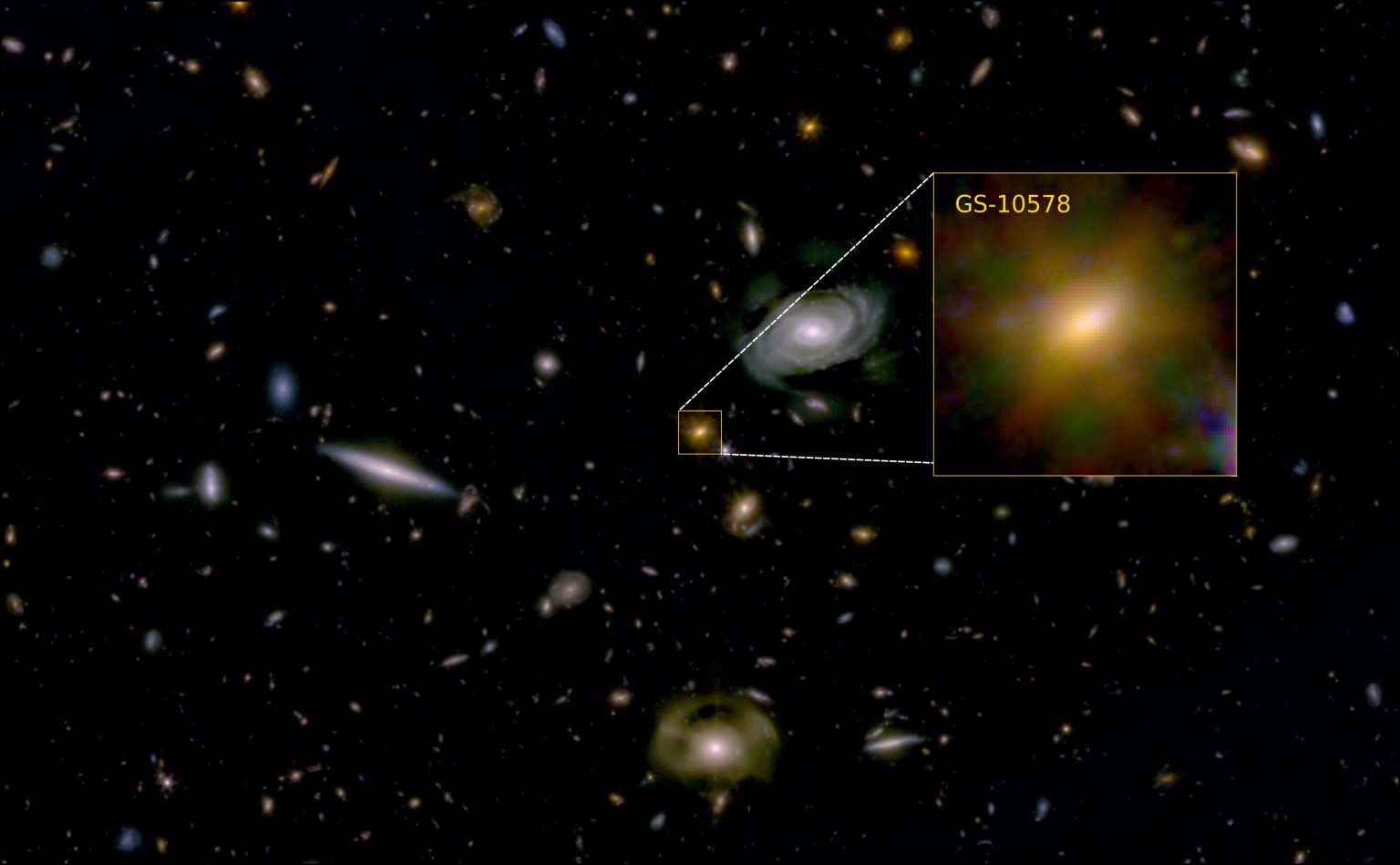
Galaxy GS-10578
GS-10578 is a spiral galaxy located 11.5-12 billion light-years away from us. This means that we see it as it was less than 2 billion years after the Big Bang. It is also very large for a star system that existed in those early times. Its mass is approximately 200 billion times greater than that of the Sun.
But in 2024, when it was discovered, GS-10578 surprised scientists not with this. The most incredible thing was that the star formation processes in it were clearly very active and had already come to the end. And now the galaxy has nothing left to do but slowly fade away, although this process could take billions of years.
The reason for this was clear even then — the galaxy lacks cold gas, which serves as material for the formation of new stars. And the suspect in its disappearance is also a supermassive black hole at the center.
Slow death
But how did the black hole condemn its galaxy to starvation? Scientists have been trying to figure this out for the past year. For this purpose, they used the James Webb Space Telescope and the American ALMA array for their observations. The first observes the sky in infrared, while the second observes it in the radio range.
After collecting data on each of them, scientists were finally able to see what was happening at GS-10578. More precisely, they did not see something — gas in its outer regions. But the black hole remains active and continues to eject 60 solar masses of gas annually.
It would seem that nothing is clear, but even this lack of observations allowed scientists to draw an important conclusion. There was no single event in history that removed all the gas in the galaxy’s history.
The black hole simply blew it out relatively slowly. There was never any inflow from outside or merger with another star system. So, in about 16-220 million years, the gas that should have been enough for billions of years of new star generations ran out. And this happened 400 million years ago.
According to phys.org

