
In the 1970s, the eminent physicist Stephen Hawking made a revolutionary discovery through his calculations: black holes are not completely black. He showed due to quantum effects near the event horizon, black holes should emit a weak amount of thermal energy. This so-called Hawking radiation causes them to lose their mass and energy extremely slowly, and may eventually lead to their complete evaporation. However, this process gives rise to the black hole information paradox, one of the greatest unsolved problems in modern physics.
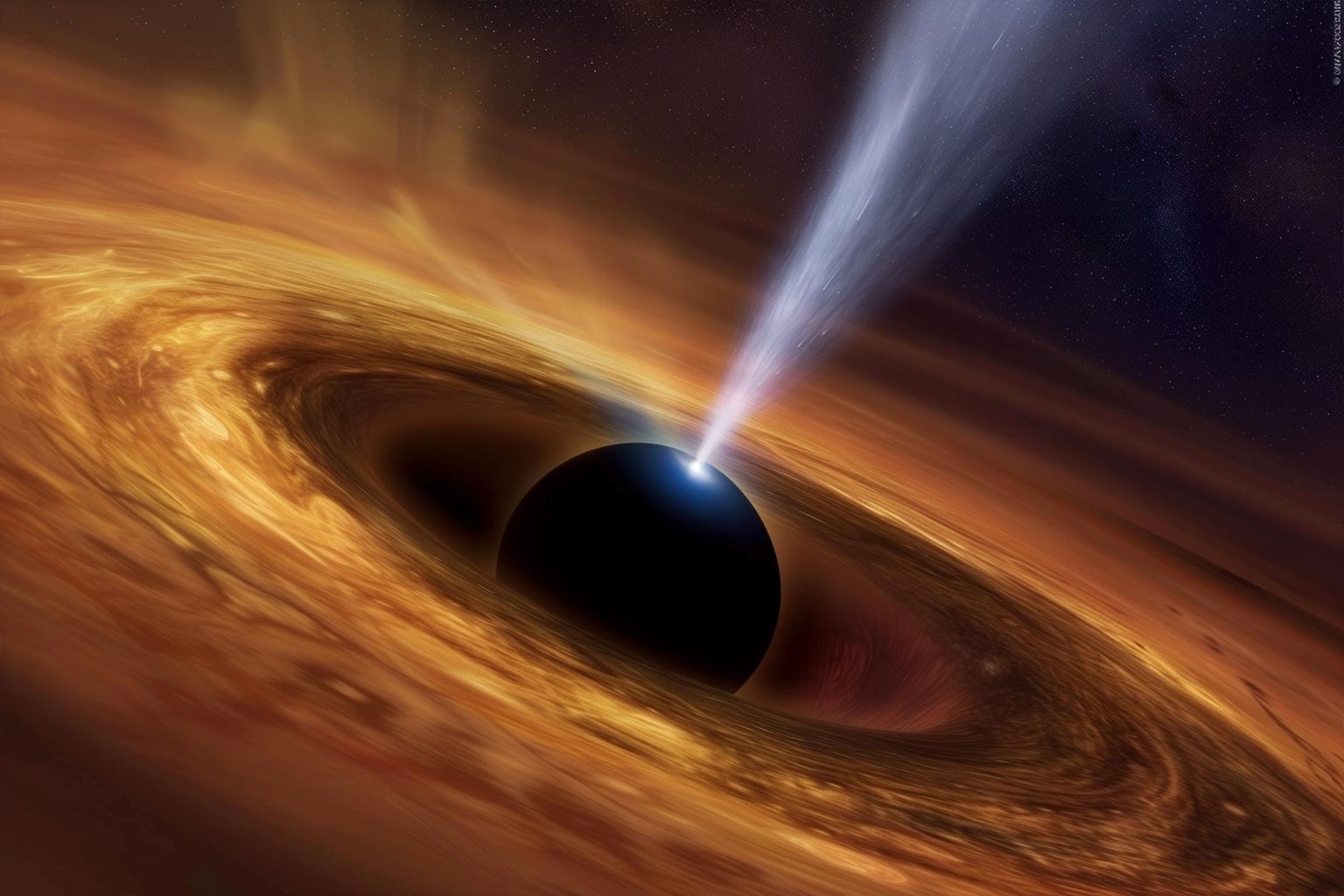
The core of the conflict lies in the fact that the disappearance of a black hole supposedly permanently erases all information about the matter that has ever fallen into it. Indeed, if a black hole disappears, what happens to the information about everything that has ever fallen into it? This question is one of the most important problems at the interface of quantum mechanics and gravity. This directly violates the principle of unitarity and the fundamental laws of quantum mechanics, which categorically state that quantum information cannot be destroyed.
Twisted Space
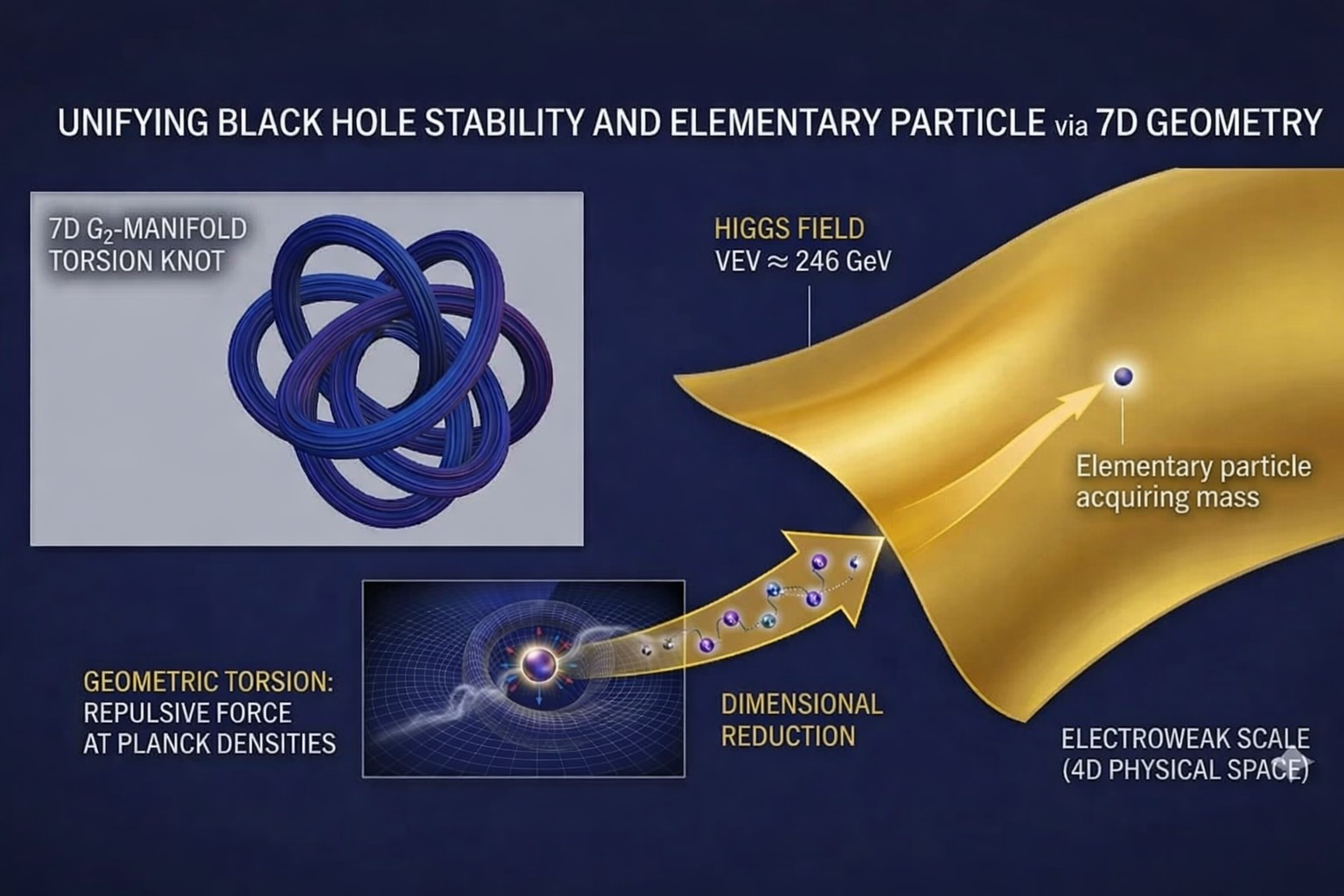
A team of scientists led by Richard Pinčák recently published a study in General Relativity and Gravitation that offers a one of the possible models for solving the information paradox. Their solution is based on the effects of the Einstein-Cartan gravitational model in a so-called seven-dimensional system—a mathematical structure known as G2-manifold with torsion.
Unlike the classical general theory of relativity, this model allows spacetime not only to be warped by mass, but also to literally “twist”. According to the theoretical conclusion of the model, this force counteracts gravitational collapse and can stop the final stage of Hawking evaporation. Researchers have found that at extreme densities on the Planck scale, this twisting generates a powerful repulsive force. As a result, the black hole does not disappear but transforms into a stable remnant with a mass of about 9 × 10⁻⁴¹ kg.
Quantum memory in relics
If a black hole leaves behind such a relic, a logical question arises: what happens to the information it absorbs? Scientists believe that this stable remnant functions as a kind of archive of the universe’s memory. Quantum information is physically encoded in the long-lasting “vibrations” of the torsion field.
According to the team’s calculations, a relic formed from a black hole with a mass equal to that of our Sun is capable of reliably storing an impressive amount of data—approximately 1.515 × 10⁷⁷ qubits. This storage capacity is more than sufficient to completely resolve the information paradox.
An unexpected connection to the Higgs field
The new physical model has implications not only for astrophysics but also for particle physics. The scientists found that mathematically “folding” of their seven-dimensional geometry into four dimensions naturally gives rise to an electroweak scale at about 246 GeV.
This scale is closely related to the Higgs field—the mechanism for the origin of the masses of many fundamental particles of the Standard Model. The vacuum expectation value of the torsion field is dynamically tied to this electroweak scale. Simply put: the very same geometric torsion effect that saves information from destruction in a black hole simultaneously offers a geometric explanation for the mass hierarchy problem in the quantum world.
How can we verify seven-dimensional reality?
Why, then, has modern science still not found any direct evidence of the existence of these hidden extra dimensions? The answer lies in the unreachable energy scales. Particles associated with these dimensions, known as Kaluza-Klein excitations, must have a colossal mass of about 8.6 × 10¹⁵ GeV. This is roughly seven orders of magnitude beyond the capabilities of the Large Hadron Collider.
However, the theory is not impossible to test, as it makes clear predictions:
- Stable black hole remnants could theoretically be one candidate for dark matter;
- Detecting of objects with properties consistent with the predicted black hole remnants would be an important argument in favor of this hypothesis;
- If such a geometry existed in the early Universe, it could potentially leave faint traces in the anisotropy of the cosmic microwave background radiation;
- Indicators of the theory may be hidden in the spectrum of primordial gravitational waves.
Although this model has not yet been experimentally confirmed, it demonstrates that the information paradox of black holes can potentially be explained without violating the laws of quantum mechanics. Instead, its solution may be related to the deeper geometric structure of space-time, which manifests itself only at Planck scales.
We previously shared some interesting facts about black holes.
According to scitechdaily.com

