

Scientists have proposed an incredible hypothesis: gas giants in the depths of space can suddenly turn into black holes. The reason for this apocalyptic scenario is mysterious dark matter, which can accumulate in the planet’s core and trigger a process of self-destruction from within.
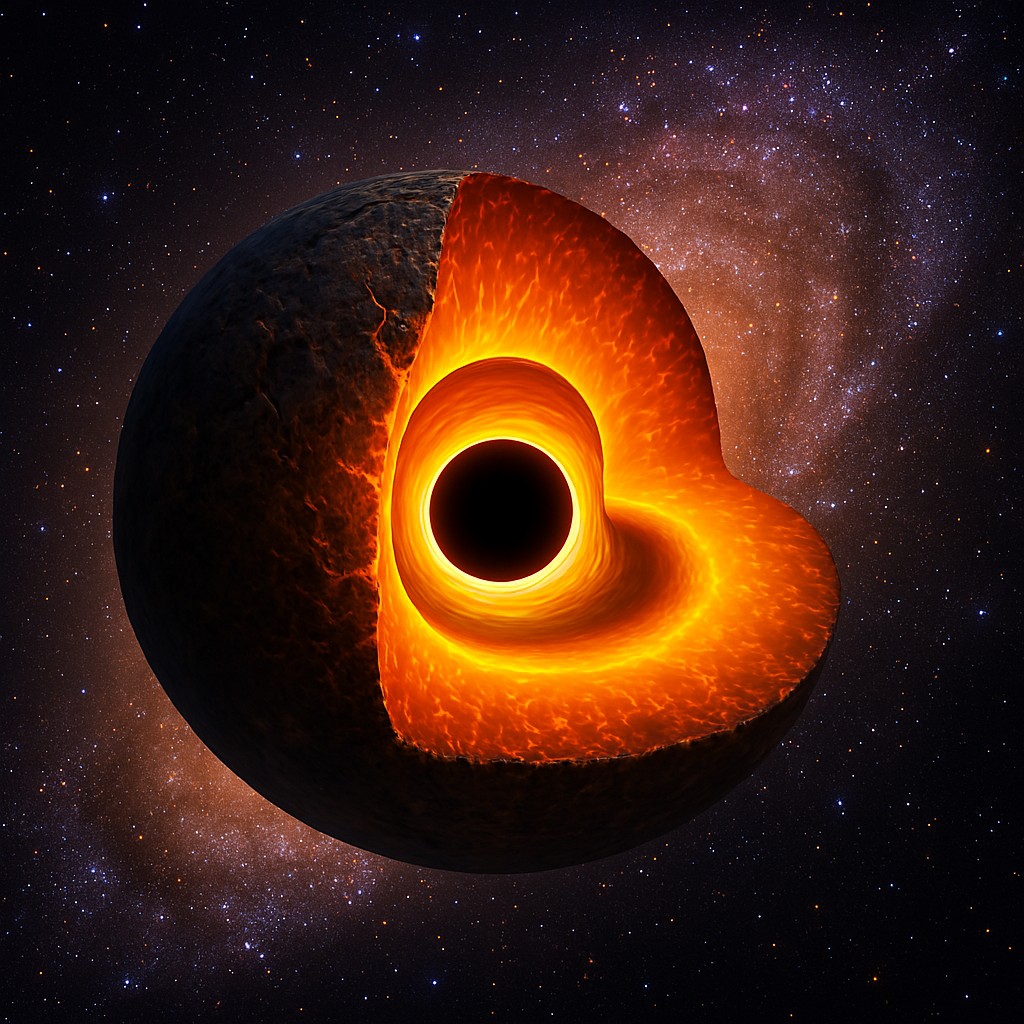
The study, published in the authoritative journal Physical Review D, is not intended to scare people, but rather to propose a new way of studying dark matter. This invisible substance makes up 85% of the mass of the Universe, but its nature remains one of the greatest mysteries of modern science. Astronomers from the University of California, Riverside, have suggested that giant exoplanets may be the key to understanding it.
Mechanism of cosmic metamorphosis
Contrary to the popular theory that dark matter consists of hypothetical WIMP particles that annihilate each other, the authors of the study consider a different scenario. Dark matter particles may be superheavy and not annihilate upon collision. In the cores of massive planets, where the concentration of ordinary matter is high, they can lose speed, condense, and reach critical density. This could lead to the instantaneous birth of a microscopic black hole in just a few months. A similar scenario is possible in regions rich in dark matter, such as the center of our galaxy.
However, not every such event means the inevitable destruction of the planet. The future fate depends on the initial mass of the black hole. If it is very small, it may simply “evaporate” due to Hawking radiation. There is even an intermediate mass, when a black hole neither grows nor disappears, but remains stable in the interior of the planet for a long time.
Hunting for unusual exoplanets
If such theoretical objects exist, they should be sought near the galactic center. Their discovery would have revolutionary consequences.
“The discovery of a black hole with the mass of a planet would be a major breakthrough,” notes Phoroutan-Mehr. “It would confirm our hypothesis and offer an alternative to the theory of primordial black holes formed only at the dawn of the Universe.”
However, finding them will not be easy. Such planets do not differ gravitationally from ordinary ones. The only clue may be their abnormally high temperature, which cannot be explained by normal processes. Detailed studies of exoplanets could become a powerful instrument for studying dark matter.
The good news for us is that Earth and other planets in the Solar System are not threatened by such a fate. We are too far from the galactic center with its high concentration of dark matter. This research opens up new horizons in understanding the most mysterious phenomena in the Universe, offering a path to unraveling its fundamental secrets.
We previously reported on how dark matter could have existed before the Big Bang.
According to ucr.edu

