

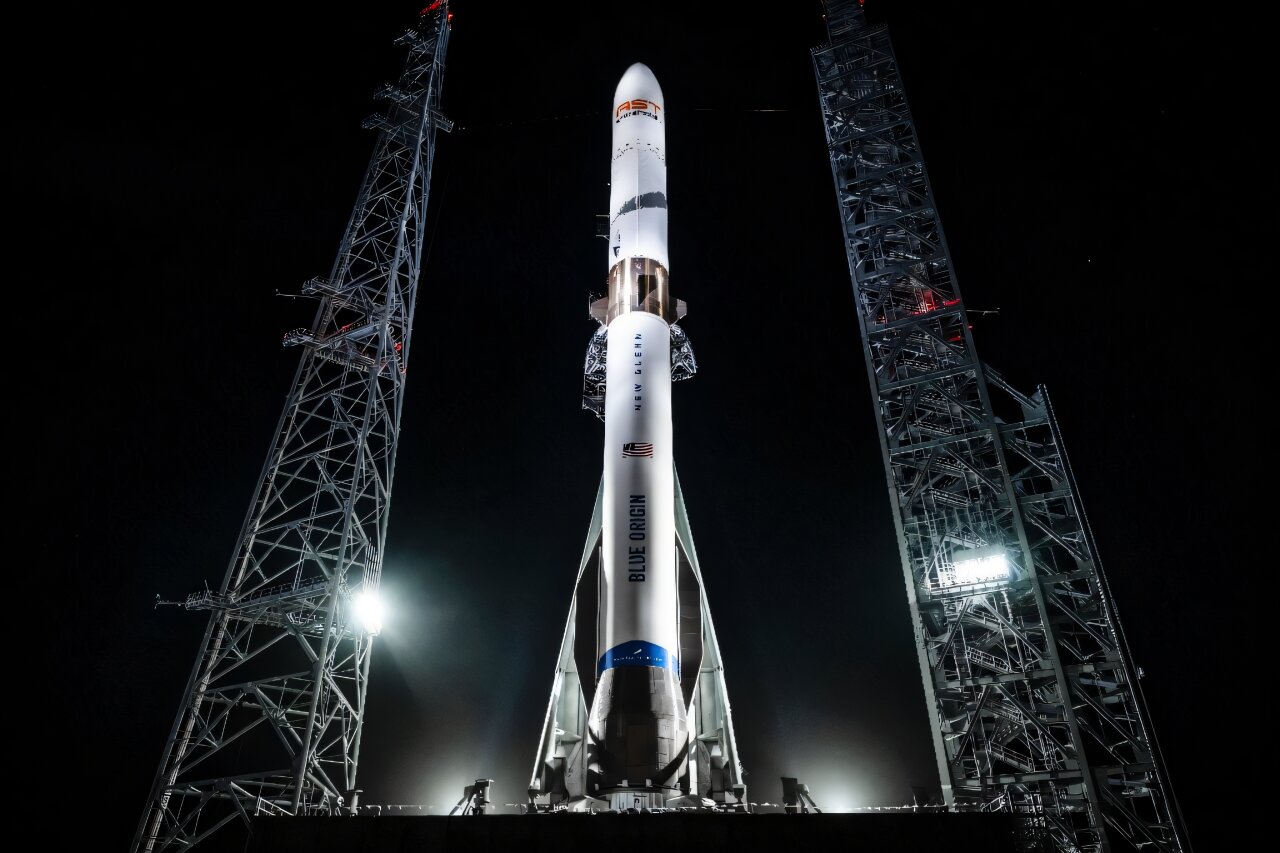
Blue Origin, the American space company founded by Amazon founder Jeff Bezos, successfully reused and landed the first stage of its New Glenn rocket on Sunday, demonstrating its mastery of this advanced technology, which could accelerate the pace of launches and intensify competition with SpaceX.
Reuse technology
The company has already launched the New Glenn rocket twice, but only with new rocket stages. Previously, it had launched its smaller New Shepard rocket—used primarily for suborbital space tourism—with reused components as part of an operation that did not involve such stringent technical requirements.
This innovative approach to reusability emerged amid fierce competition between Bezos’s company and SpaceX, the company owned by another tech giant, Elon Musk, which has also successfully recovered a rocket stage from a launch.
The 98-meter-tall (321-foot) New Glenn rocket lifted off from Cape Canaveral in Florida, along with a reused booster, at approximately 7:25 a.m. (11:25 GMT), carrying a communications satellite for AST SpaceMobile.
After the launch, the rocket’s two stages separated, and the upper stage continued on its path, carrying the satellite into space. The first stage successfully landed on a floating platform in the Atlantic Ocean approximately nine minutes and 30 seconds after launch.
Test launches and modifications to the rocket
In November, Blue Origin successfully recovered the first stage of its New Glenn rocket for the first time, accomplishing a complex technical feat that culminated in a controlled vertical landing on a floating platform.
A previous attempt to recover the rocket’s first stage, made in January 2025, failed because the engines were unable to reignite during descent.
The first stage used in Sunday’s launch had been repaired after its previous flight. For this first reuse, the company replaced all the engines and made a number of other modifications.
Competition in space
The New Glenn rocket is central to Bezos’s space ambitions as he competes with Musk in NASA’s Artemis lunar program: their space companies are developing lunar landers for the U.S. space agency.
The United States is intensifying its efforts to return astronauts to the Moon’s surface by 2028—before the end of President Donald Trump’s second term and before the deadline set by its Chinese rivals.
According to phys.org

