

Liquid water cannot exist on the surface of Mars. The only possible form of its existence there is brine, primarily perchlorates. However, it is not easy for them to form on the surface of the Red Planet.
Brines on Mars
If there is life on Mars, it can only exist there thanks to the presence of liquid water. Recently, Vincent Chevrier, associate professor at the Center for Space and Planetary Sciences at the University of Arkansas, proved that it can indeed exist there.
Pure water cannot exist in liquid form on Mars. The combination of cold climate and low atmospheric pressure causes it to transition directly from a solid state to a gaseous state. This is called sublimation. However, supersaturated salt solutions are quite capable of remaining liquid on Mars within a certain temperature range.
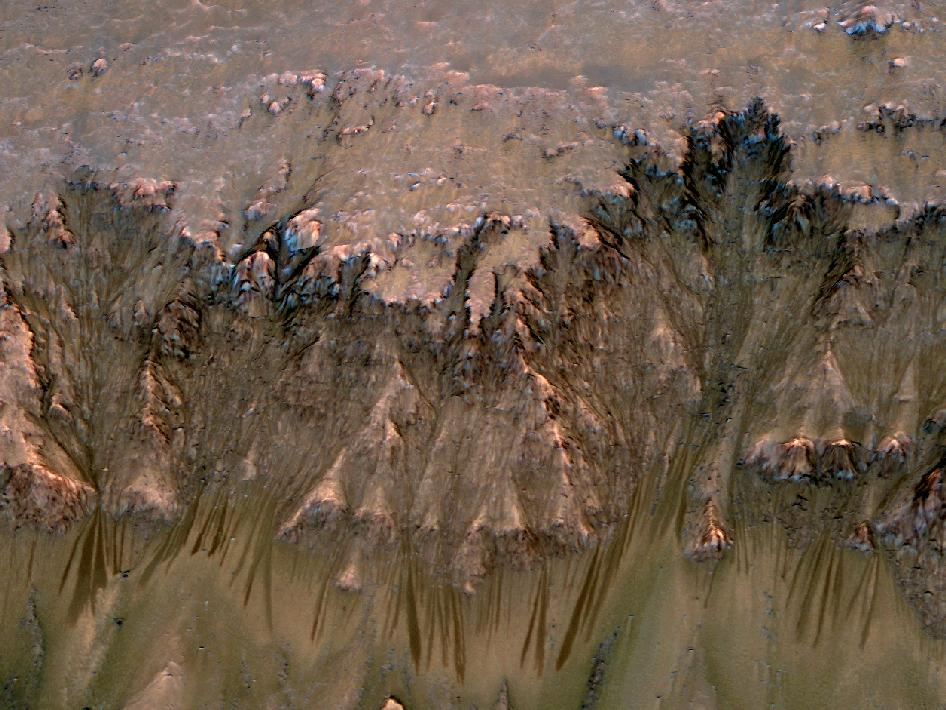
In fact, scientists have been observing something resembling dark streams on the walls of some craters for many years and suspect that these may be traces of brine. However, no one has yet conclusively proven that brines can indeed form on Mars.
Mechanism of formation
A recent article claims that the dark marks on the slopes of craters are not flows of liquid at all, but merely the play of wind and shadows. Perhaps it prompted Chevrier to put the end to the dispute over Martian brines.
The researcher took data collected by the Viking 2 mission many years ago and combined it with modern climate models of the planet. He established that the conditions for the formation of these physical and chemical systems occurred twice during the long Martian year — at the end of winter or the beginning of spring in the corresponding hemisphere.
Right then, Martian frost, the main form of water on the Red Planet’s surface, doesn’t sublimate like it usually does, but turns into liquid for a bit. And that is enough for the salts from the Martian soil to dissolve in the water and turn it into brine.
However, even during this period, it is only possible early in the morning or at the end of the day. At that time, the surface temperature fluctuates around -75°C. The author of the study also believes that although there is not much calcium perchlorate in Martian rocks, there is enough of it to form brines.
According to phys.org

