

For the first time, NASA is sending a team of three autonomous rovers to the Moon—they will explore the surface on their own, without direct commands from Earth.
The CADRE (Cooperative Autonomous Distributed Robotic Exploration) mission is scheduled for the second half of 2026 as part of NASA’s CLPS program—commercial cargo deliveries to the Moon.
What can rovers do?
Each of the three rovers is equipped with two stereo cameras, navigation sensors, and a radar for soil probing—it will create a three-dimensional map of the subsurface layers of regolith. Power is supplied by solar panels.
The rovers communicate with each other via a mesh radio network, and the base station on the landing module transmits the data to Earth. The plan is to conduct a series of experiments over the course of one lunar day—which is approximately 14 Earth days—in the Reiner Gamma region on the western edge of the Moon’s near side.
The key feature of CADRE isn’t the hardware, but the way it operates. The rovers select a “leader” on their own, assign tasks, and make decisions on the spot, receiving only high-level objectives from Earth, such as “explore this area.”
This is NASA’s first mission in which multiple rovers operate as a single autonomous system. Simultaneous measurements from different locations make it possible to collect data that a single rover could not physically obtain.
On the way to the Moon
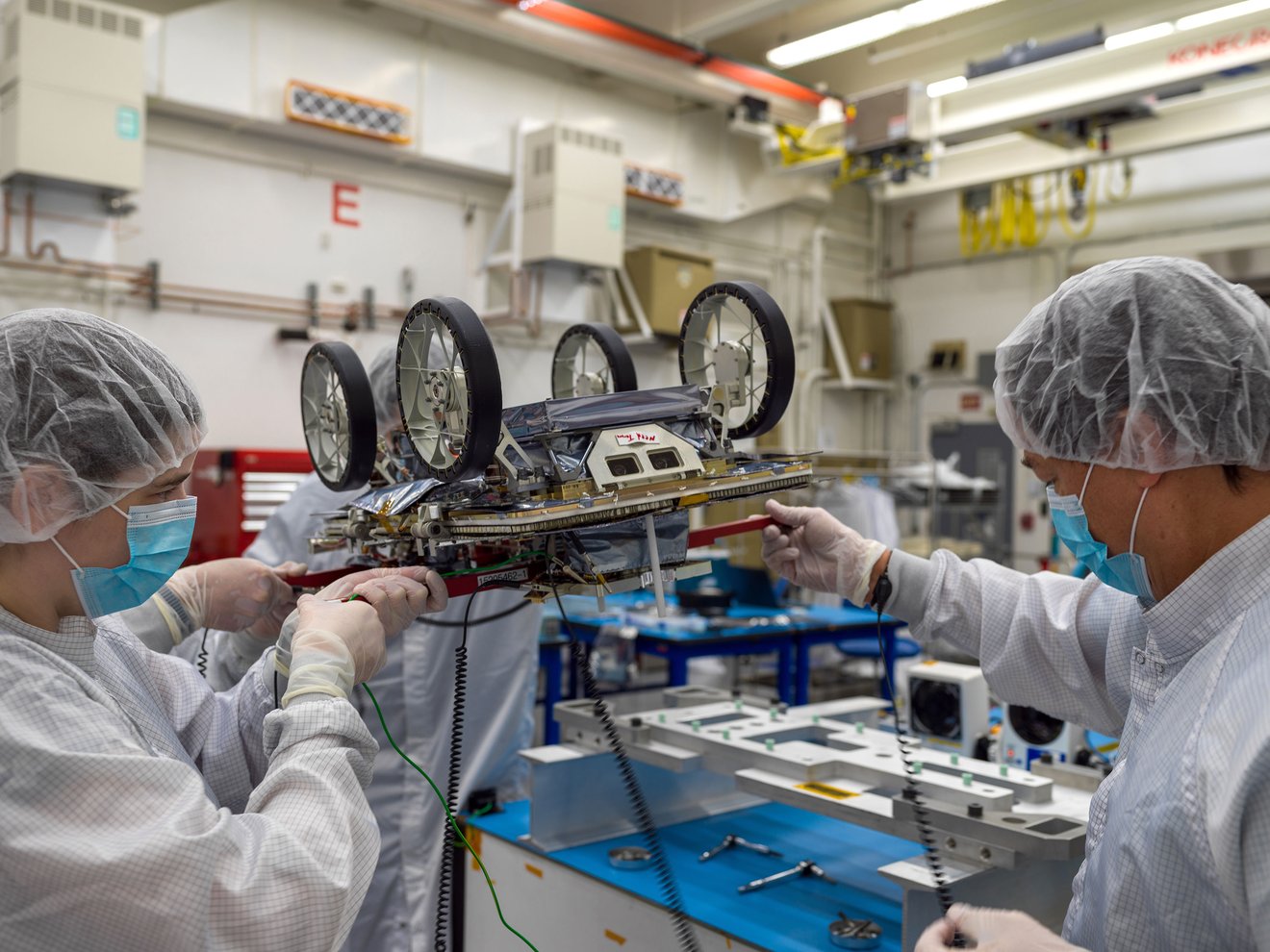
In February 2025, three rovers and a base station were packed up at JPL (Jet Propulsion Laboratory) and shipped to Houston—to Intuitive Machines, where they will be integrated with the Nova-C lander.
The mission is scheduled to launch on a SpaceX Falcon 9 rocket in the second half of 2026. The success of CADRE could pave the way for a new type of robotic mission—one in which a coordinated swarm of small vehicles explores the planet’s surface instead of a single large rover.
From origami to lunar suitcase
CADRE traces its origins to a completely different device. In 2015, NASA’s Jet Propulsion Laboratory (JPL) developed PUFFER—a palm-sized microrover whose body folded like a sheet of origami and could squeeze under an overhanging rock or roll into a pit. Then came the A-PUFFER—a standalone version equipped with its own computer and cameras.
In 2024, both projects were archived, but their main legacy—software for group autonomy—was transferred to CADRE. The size of the devices has grown to that of a carry-on suitcase, and the scope of the missions has expanded from field tests in the Mojave Desert to an actual lunar mission.
According to jpl.nasa.gov

