
Astronomers have discovered predicted but previously unobserved auroras on Jupiter. They are caused by its moon Callisto.
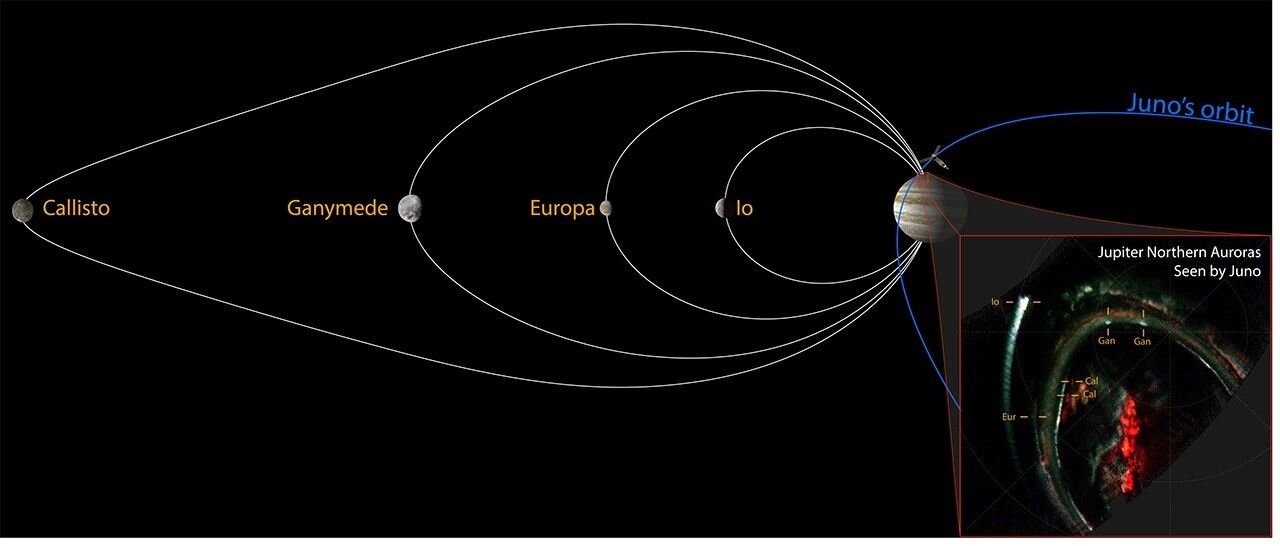
Jupiter has a powerful magnetosphere, whose strength exceeds that of Earth’s magnetic field by orders of magnitude. It is not surprising that the planet boasts the brightest and most impressive auroras in the Solar System. They are formed not only as a result of the interaction of the gas giant with the solar wind, but also by its large moons, which periodically sweep through its magnetic field.
These auroras caused by Jupiter’s moons, known as “satellite footprints,” are interesting to scientists because they show how each moon interacts with its local space environment. Before the Juno mission, it had been proven that at least three of Jupiter’s four largest moons (Io, Europa, and Ganymede) produce these characteristic auroras. But Callisto, the most distant of them, remained a mystery. Despite numerous attempts using the Hubble Space Telescope, Callisto’s footprint remained elusive. The reason for this was both its weakness and the fact that it most often overlapped the auroral oval — the area where bright polar lights are traditionally observed.
To solve this problem and capture Callisto’s footprint, scientists needed several conditions to coincide. First, the auroral oval should move to the side when photographing the polar region. Secondly, in order to use Juno’s arsenal of instruments to study the aurora, the spacecraft’s trajectory had to pass through the magnetic field line connecting Callisto and Jupiter.
These conditions coincided during Juno’s 22nd orbit around Jupiter in September 2019. Then a massive stream of high-density solar energy hit the gas giant, causing a shift in its auroral oval. This revealed a faint but distinct footprint associated with Callisto.
The discovery confirms for sure that all four of Jupiter’s biggest moons leave their mark on its atmosphere. In this respect, Callisto is no different from Io, Europa, and Ganymede.
Earlier, we reported on how the Perseverance rover photographed the auroras on Mars for the first time.
According to Phys.org

