

If you enjoy science fiction, you have probably wondered: what would happen if a tiny black hole passed through the human body? Would it turn you into cosmic spaghetti or just leave a small scar? The answer from physicist Robert Scherrer of Vanderbilt University in a new publication in the International Journal of Modern Physics D turned out to be quite unexpected.
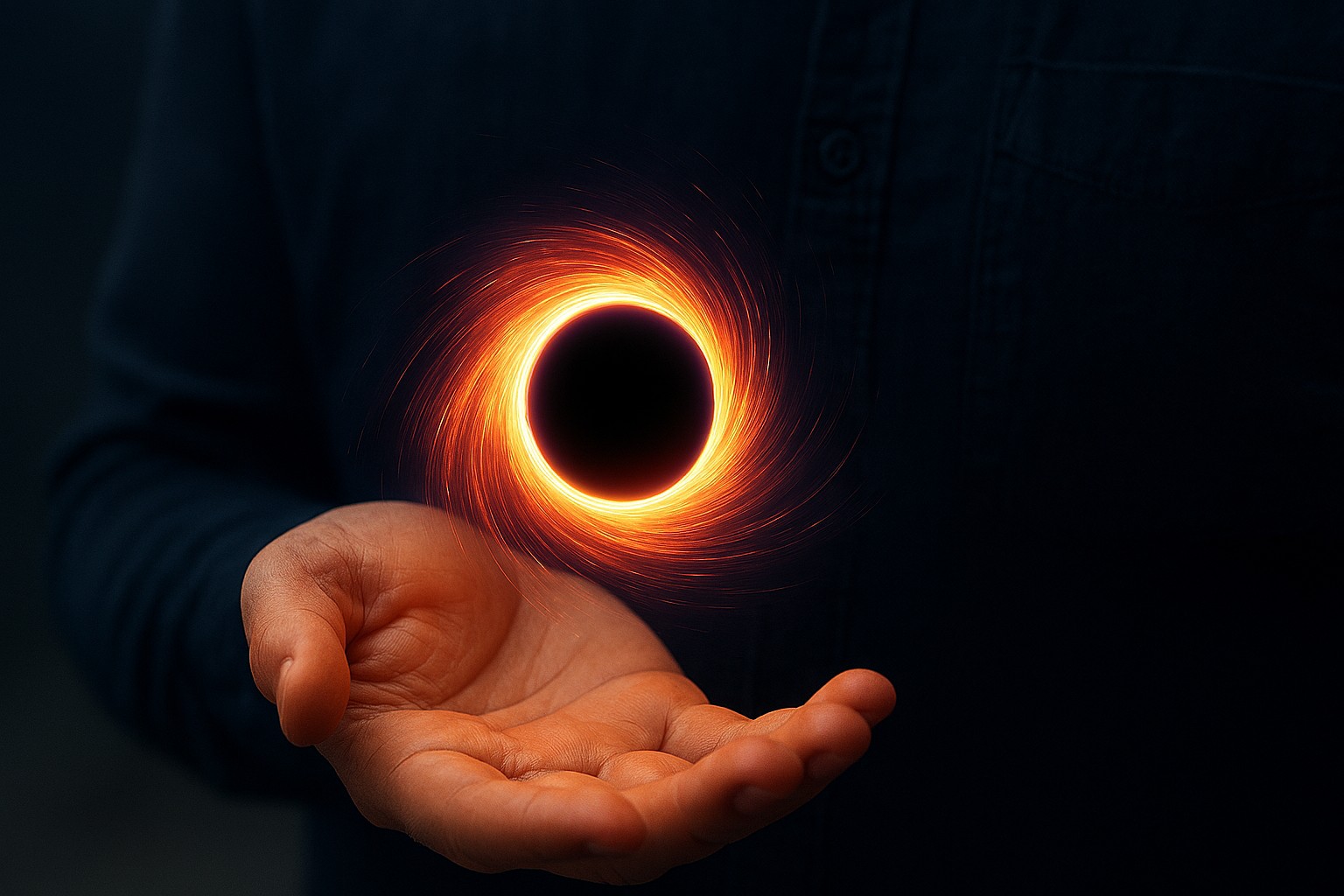
The main danger posed by a microscopic black hole is not its gravity at all. The greatest damage would be caused by the shock wave. According to Sherrer’s calculations, a black hole with a mass of 100 billion tons would cause less damage than a 5.56×42 mm bullet.
“I remembered reading a science fiction story in the 1970s in which someone died when a black hole passed through them. I wanted to see if that was even possible,” explains Robert Scherrer.
To even feel the passage of a black hole, its mass should be incredible—about 140 billion tons, which is seven times heavier than asteroid 4179 Toutatis. But even then, its size would be incredibly small—only 0.4 pm (picometers), which is hundreds of times smaller than a hydrogen atom.
Will it stretch a man like spaghetti?
In science fiction, black holes are often depicted as objects that stretch and tear apart any object before swallowing it up due to tidal forces—the “spaghettification” effect. However, for this force to start tearing your tissue apart, the black hole must be even more massive—at least 7 trillion tons—the mass of the asteroid 7 Iris. Only then will gravity be strong enough to seriously damage even the strongest cells in your brain. But even in this case, it is not gravity that will cause fatal damage, but the same powerful shock wave.
How realistic is that?
Is this something to be concerned about? Absolutely not. Even if hypothetical primordial black holes exist, their density in the Universe is extremely low. Sherrer estimated the probability of such a collision with a human being as 1:1,000,000,000,000,000,000. This is billions of times greater than the current age of our Universe.
“A sufficiently large black hole would act like a bullet,” concludes the scientist. “A smaller one could fly right through you, and you wouldn’t even notice it. However, such a collision will never actually happen.”
So you can be relaxed—the risk of becoming a target for a cosmic bullet from a black hole is practically zero.
Earlier, we reported on what would happen if the Sun collided with a miniature black hole.
According to sciencealert.com

