

Our closest neighbor, Mars, is a very small planet. However, its gravity is sufficient to slightly alter Earth’s orbit and cause ice ages. Scientists have recently discovered how it does this.
Does Mars affect Earth?
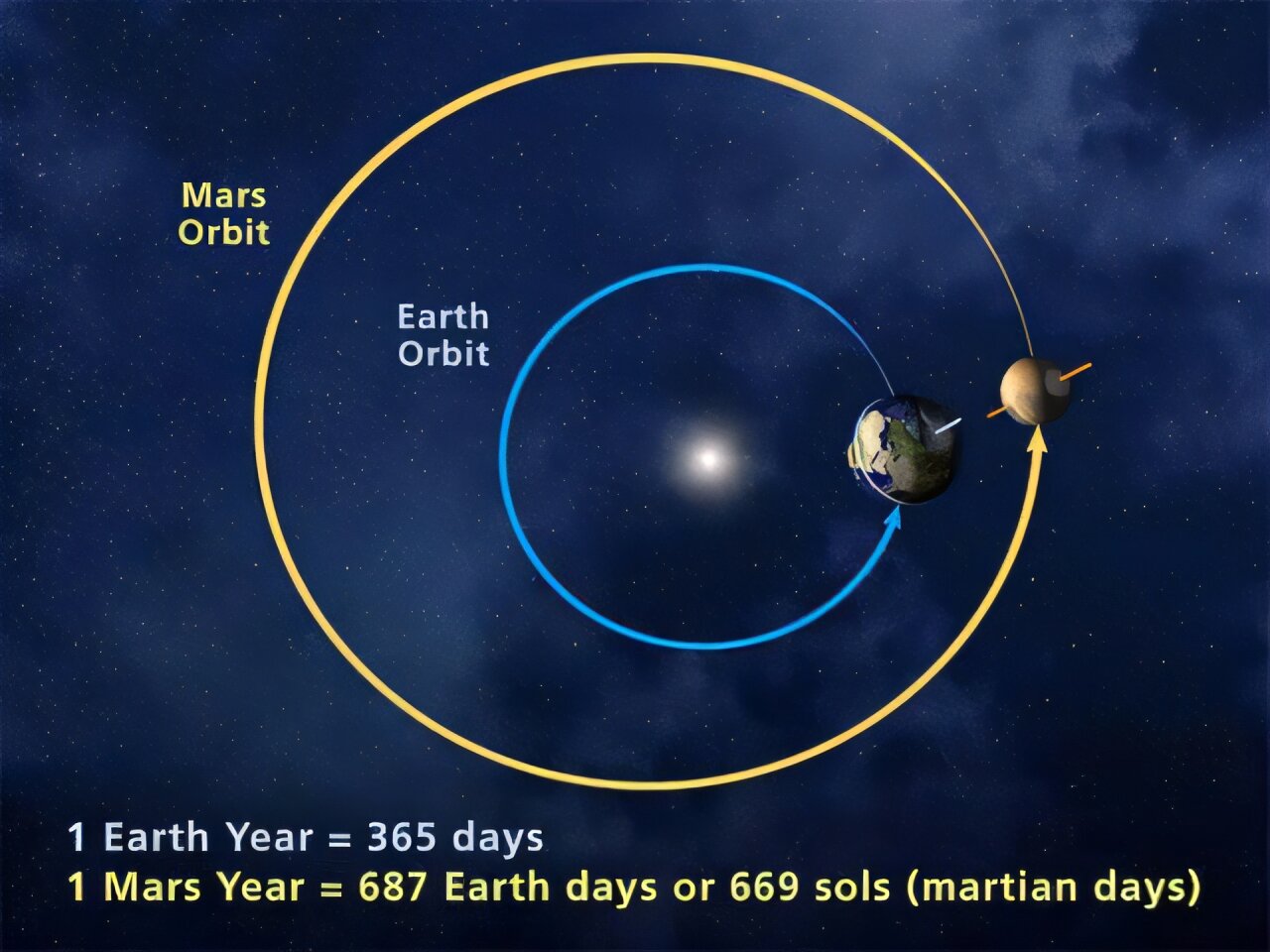
Thanks to its size, which is half that of Earth, and its mass, which is one-tenth that of Earth, Mars is a lightweight among the planets. However, new research shows how it quietly influences Earth’s orbit and generates cycles that determine long-term climatic epochs here, including ice ages.
Stephen Kane, a professor of planetary astrophysics at UC Riverside, began this project with doubts about recent studies linking ancient climate patterns on Earth to gravitational nudges from Mars. These studies suggest that layers of sedimentary deposits on the ocean floor reflect climate cycles influenced by the Red Planet, despite its distance from Earth and small size.
The scientist believed that Mars’ gravitational influence on Earth was very insignificant, but decided to test this assumption. To do this, Kane conducted computer simulations of the dynamics of the solar system and long-term fluctuations in Earth’s orbit and tilt, which determine how sunlight reaches its surface over tens of thousands and even millions of years.
Milankovitch cycles in computer simulations
These cycles of orbital and positional change, known as Milankovitch cycles, are key to understanding how and when ice ages begin and end. An ice age is a long period when permanent ice caps exist at the planet’s poles. Over its 4.5 billion-year history, Earth has experienced at least five major ice ages. The last one began about 2.6 million years ago and continues today.
One Milankovitch cycle is mainly caused by the gravitational influence of Venus and Jupiter and lasts 430,000 years. During this period, the Earth’s path around the Sun gradually changes from almost circular to more elongated and then returns to its original shape. This change in the shape of the orbit affects the amount of solar energy reaching the planet and can influence the onset or retreat of ice sheets.
This 430,000-year cycle remained unchanged in Kane’s simulations, regardless of whether Mars was present. But when Mars was removed, the other two major cycles — one lasting 100,000 years and another spanning 2.3 million years — disappeared completely.
These cycles affect how round or elongated Earth’s orbit is (its eccentricity), the time of Earth’s closest approach to the Sun, and the tilt of its axis of rotation (axial tilt). This determines how much sunlight different parts of Earth receive, which in turn influences ice age cycles and long-term climate patterns. Kane’s findings show that Mars plays a measurable role in both processes.
Mars’ influence on the Earth’s axial tilt
“The closer a planet is to the Sun, the stronger its gravitational pull. Since Mars is farther away, it has a greater gravitational influence on Earth than it would if it were closer. In fact, it exceeds its ‘capabilities,’” explains Kane.
One of the most unexpected results was how the mass of Mars affects the rate of change in the Earth’s axial tilt. Currently, the Earth is tilted at approximately 23.5 degrees, and this angle is slowly changing over time.
When the scientist increased Mars’ mass in his simulations, the rate of change in Earth’s tilt slowed down. From this, Kane concludes that an increase in Mars’ mass has a stabilizing effect on the tilt of our planet’s axis.
The study not only quantifies Mars’ influence on Earth’s orbit, but also hints at broader implications. Kane’s simulations suggest that even small outer planets in other Solar Systems may quietly shape the stability of worlds that could support life.
The findings raise broader questions about how Earth might have developed differently without Mars’ influence. Ice ages led to a reduction in forests and an expansion of grasslands, creating cycles that stimulated key evolutionary changes — in particular, upright walking, tool use, and the development of social cooperation.
According to phys.org

