

About 66 million years ago, a massive celestial object with a diameter of about 10 km struck the area of the modern-day Yucatán Peninsula. It is a proven scientific fact that this impact triggered a mass extinction and left behind the gigantic Chicxulub crater. This theory was convincingly substantiated as early as 1980 by Luis and Walter Alvarez, along with their colleagues.
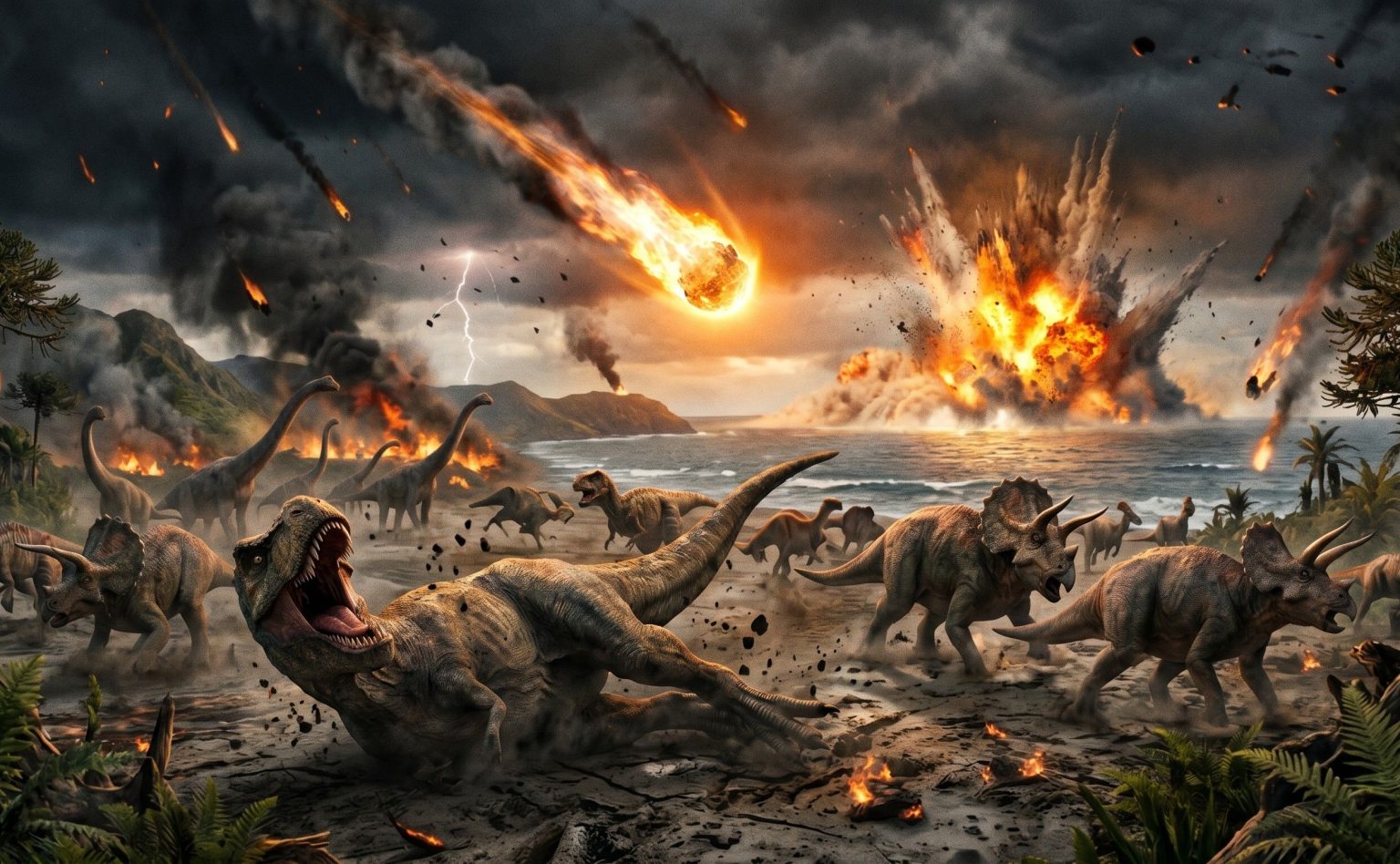
However, a study published in the prestigious journal Scientific Reports offers a new, somewhat provocative perspective. The authors of the paper, Kunio Kaiho of Tohoku University and Naga Oshima of the Japan Meteorological Research Institute, have put forward a bold hypothesis: the impact site played an absolutely decisive role in the extinction of the dinosaurs.
The fact is that the asteroid struck a shallow tropical sea, the seabed of which was covered with layered sulfur-rich rocks and vast deposits of buried hydrocarbons. Scientists believe that if an asteroid of the same size had struck most other parts of the globe, a mass extinction would not have occurred at all.
Climate shock
The researchers’ main argument is that it was not the explosion itself that wiped out the dinosaurs, but rather the sudden and devastating climate shock that followed the impact. The immense heat from the impact literally burned off the hydrocarbons in the shallow-water sediments. As a result, massive amounts of soot rose into the stratosphere, blocking sunlight for years.
This dense cloud cover triggered an extreme global cooling event. According to the model’s authors, the average global temperature dropped by 8–11 °C, with the decline being particularly pronounced on land and accompanied by a catastrophic decrease in precipitation.
Using a comprehensive climate model that combines data on the atmosphere and oceans, scientists sought to answer the question: How many places on Earth at that time could have triggered such a reaction? Their answer: only about 13% of the planet’s surface. Only coastal areas that were exceptionally rich in hydrocarbons (such as Chicxulub) could have released enough soot to cause a prolonged darkening of the sky and a deadly cooling. Most of the Earth, including the deep-sea ocean floor, contained significantly fewer of these compounds. Consequently, an impact in deeper regions of the planet would have caused only a moderate drop in temperature, which would not have been sufficient to bring about the end of the Age of Dinosaurs.
The worst-case scenario
The geological composition of the target is not the only factor in this perfect storm. In 2020, a team of scientists from Imperial College London, led by Gareth Collins, demonstrated that the geometry of the impact was equally significant. After carefully reconstructing the underground structure of the Chicxulub crater, they discovered that the space debris struck the Earth at an extremely steep angle—about 60°. According to their modeling, it is precisely this steep trajectory that ensures the release of the maximum amount of vaporized rock and climate-active gases into the atmosphere. Oblique or nearly vertical impacts would have had much milder consequences.
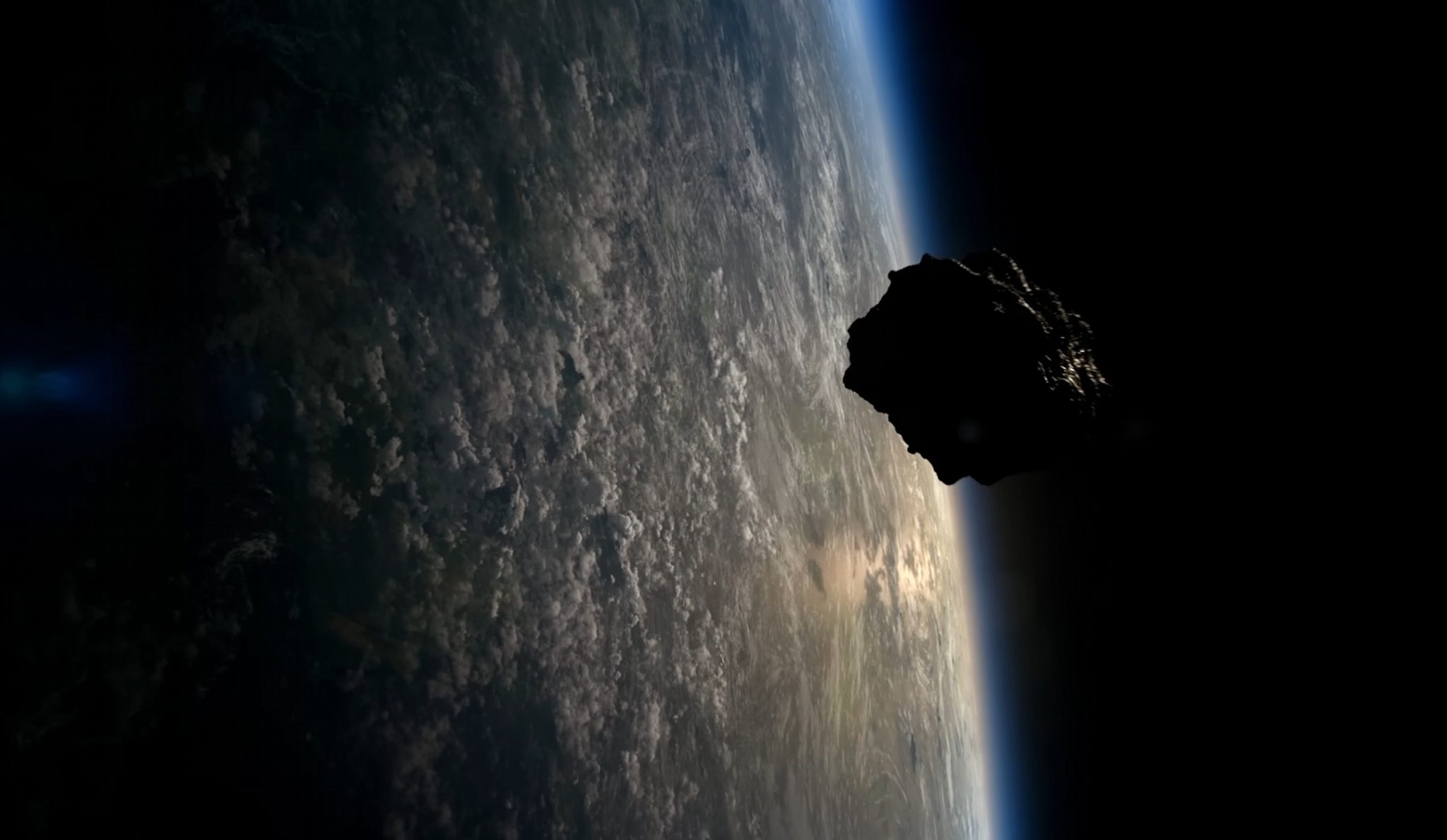
These two independent studies complement each other. One focuses on soil chemistry, while the other focuses on the angle of impact. Taken together, they indicate that the event on the Yucatán Peninsula resulted in the worst, most destructive set of consequences of all those mathematically possible.
Limitations of the hypothesis
Despite the soundness of the arguments, these conclusions are not considered definitively proven within the scientific community, and several important limitations should be taken into account.
First, the claim of an “unfortunate coincidence” cannot be verified in practice. We don’t have a second Earth on which to conduct an experiment, so the 13% probability is not a measurable fact, but merely a specific result of a computer model.
Second, the mechanism involving hydrocarbon soot is just one of the popular interpretations. Many scientists believe that sulfate aerosols formed from sulfur were the main factor behind the cooling. And in 2023, a significant study was published proving the crucial role of fine silicate dust in blocking sunlight.
In addition, there is still intense scientific debate surrounding the Deccan Traps—a period of incredibly massive volcanic eruptions in present-day India that occurred concurrently with the meteorite impact. The extent of their impact on Cretaceous ecosystems has not yet been fully determined.
Nevertheless, a 2017 article sheds light on an extremely interesting possibility. While it does not prove beyond a shadow of a doubt that dinosaurs would have survived under different circumstances, it clearly illustrates that the fate of the planet’s rulers depended on the composition of a few kilometers of rock in one specific corner of the world. The survival of entire biological species turns out to be much closer to a simple coin toss than one might have imagined. Whether this theory will gain traction in the future depends on the development of geological reconstructions and further evidence.
Previously, scientists reported that they had identified the origin of the asteroid that wiped out the dinosaurs.
According to spacedaily.com

