

Astronomers have attempted to find evidence that the supermassive black hole at the center of the Milky Way has undergone mergers in the past. For this purpose, they decided to check whether there were any stars ejected from the galactic halo.
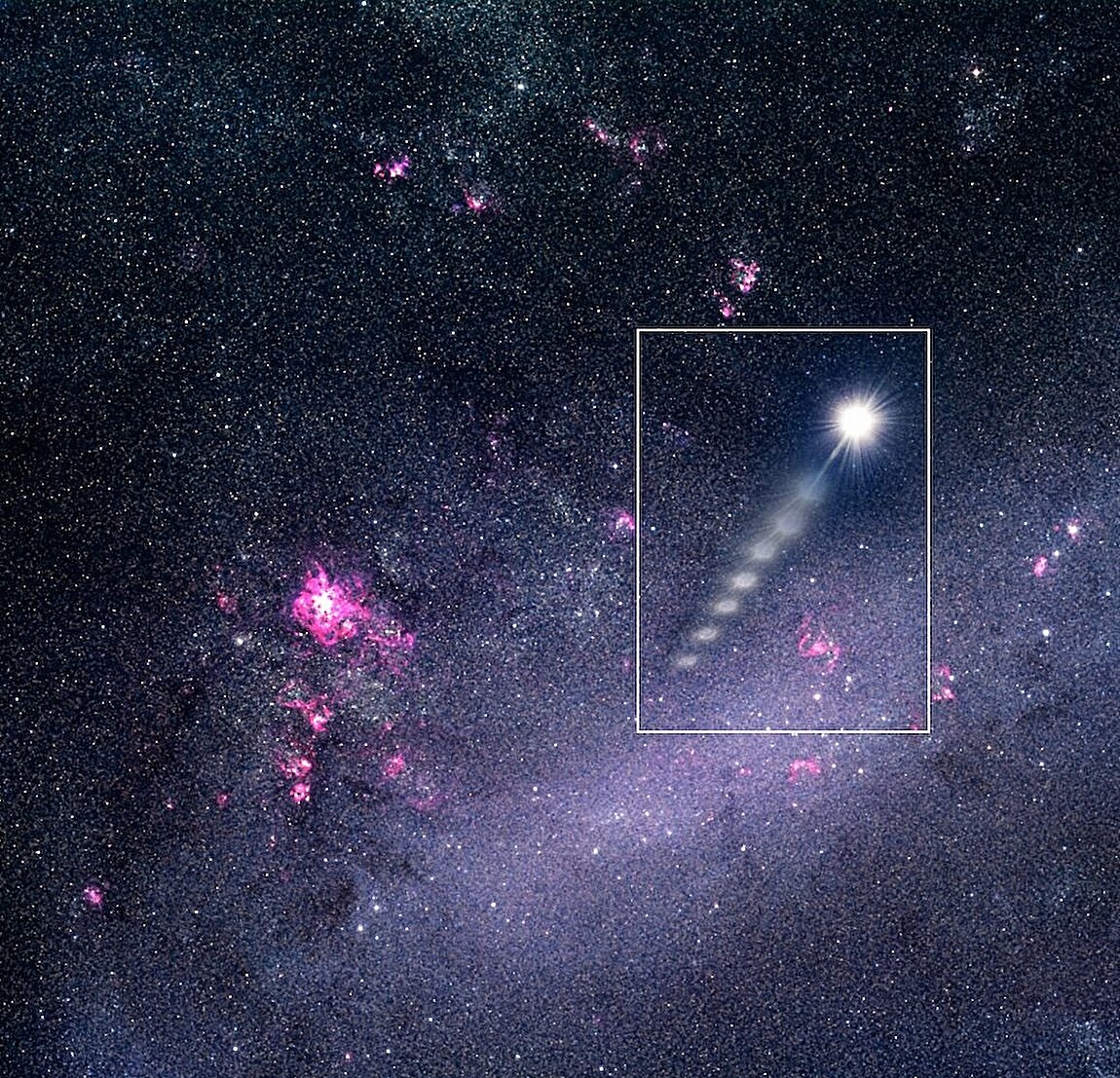
Growth of black holes and stars
A study devoted to the past of the supermassive black hole Sagittarius A* was recently published in Astronomy and Astrophysics. It is believed that this object, located at the center of the Milky Way, grew over billions of years through mergers with other large objects.
But if this were indeed the case, then this process would have been accompanied by gravitational disturbances, which would have led to the ejection of stars from the region around Sagittarius A*. These stars differ from the rest of the Galaxy’s population in their high metallicity and are now believed to be located somewhere in the halo, the spherical and most sparse subsystem of the Milky Way.
It is extremely difficult to observe them there because they mix in with other objects, but a few have been detected nonetheless. But there should be many more, so scientists decided to check for their presence using a database compiled by DESI.
Research with DESI
DESI is a spectroscopic instrument for studying dark energy, a telescopic instrument attached to the Mayall Telescope at the Kitt Peak Observatory in the United States. DESI is conducting a large-scale spectroscopic survey aimed at understanding the history of the expansion of the Universe and the role of dark energy physics in this process. A new study combines DESI data with Gaia data to study stellar populations in the halo, especially stars that have been ejected from the center of the Galaxy.
Astronomers know of many hypervelocity stars ejected from the center of the Galaxy as a result of interaction with the object Sgr A. They move at speeds ranging from hundreds to thousands of kilometers per second. But researchers wanted to find other stars ejected from the center of the Galaxy which move at a slower speed. They may be ejected during black hole mergers, and their presence in the stellar halo will provide clues about the merger history of Sgr A.
It is not easy to detect these stars in the halo. The stellar halo is the visible part of the galactic halo and is a complex region consisting of substructures such as the remnants of smaller galaxies that have been absorbed. Different stellar populations with different origins have different metallicities. Some of them also have different kinematics. Therefore, although the stellar halo contains clues about the history of the Milky Way, these clues are vague. The researchers searched for ejected stars, filtering them by velocity and metallicity.
Search for stars that were “spit out”
The researchers’ first step was to model the population of ejected GC stars. This enabled them to identify these stars in the DESI and Gaia data. Then they had to identify this population of stars, while understanding that other populations not associated with GC emissions also occupy part of the same parameter space. These are the stellar remnants of the dwarf galaxies Gaia-Sausage/Enceladus and Splash.
The team did not detect any stars in the halo that originated from past mergers of SMBHs with the object Sgr A. Although in many scientific studies, no detection is perceived as a failure, in this case, this is not so. The study aims to limit the population of these stars, and a zero result is a strong constraint.
“Our analysis gives a result of no detection, which we use to limit the GC emission rate during a time interval of ∼ 5 Gy,” the authors write. “In particular, we conclude that the average emission rate over the last ∼ 5 Gyr cannot exceed ∼ 2.8 × 10⁻³ yr-1.” But this speed corresponds to what is expected from stars destroyed only by the Hills mechanism.
“Our results can be used to constrain emission mechanisms; a particularly interesting application is to constrain the merger history of the star Sgr A,” the authors write. “We expect that our failure to detect a population of associated emissions limits the history of star mergers in Sgr A to a timescale of billions of years, about which we know very little,” the authors conclude.
According to phys.org

