

It has long been known that water and carbon exist on Ceres, the largest object in the main asteroid belt. Recently, scientists discovered that in the past, it may have had a chemical energy source that could have sustained life on it.
Data on organic molecules on Ceres
A new NASA study has shown that Ceres may have had a constant source of chemical energy: molecules necessary for the metabolism of certain microorganisms. Although there is no evidence that microorganisms ever existed on Ceres, this discovery supports theories that this interesting dwarf planet, which is the largest body in the main asteroid belt between Mars and Jupiter, may once have had conditions suitable for single-celled life forms.
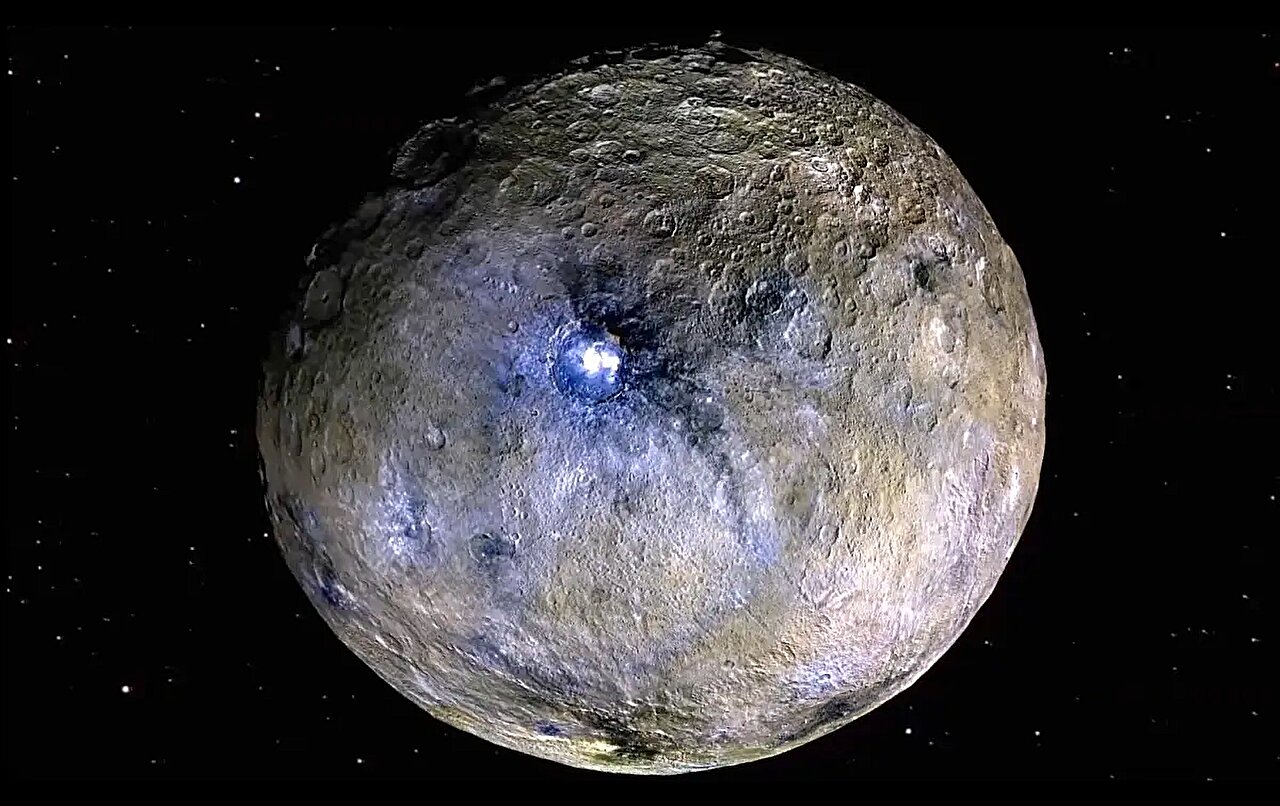
Scientific data from NASA’s Dawn mission, which ended in 2018, previously showed that the bright, reflective areas on Ceres’ surface are mainly composed of salts left behind by liquid that seeped up from underground. A later analysis in 2020 found that the source of this liquid was a huge deposit of brine, or salt water, beneath the surface. In other studies, the Dawn mission also found evidence that Ceres contains organic matter in the form of carbon molecules, which is necessary, though not sufficient on its own, to support microbial cells.
Hydrothermal sources on Ceres in the past
The presence of water and carbon molecules are two important pieces of the puzzle regarding Ceres’ suitability for life. New discoveries suggest a third element: a long-term source of chemical energy in Ceres’ distant past that could have sustained microorganisms. This result does not mean that there was life on Ceres, but rather that there was probably “food” that could have sustained life if it had ever arisen on Ceres.
In a study published in the journal Science Advances on August 20, scientists constructed thermal and chemical models simulating the temperature and composition of Ceres’ interior over time. They found that approximately 2.5 billion years ago, Ceres’ underground ocean may have had a stable source of hot water containing dissolved gases rising from metamorphosed rocks in the rocky core. The heat came from the decay of radioactive elements in the rocky inner layer of the dwarf planet when Ceres was young — an internal process that is believed to be common in our Solar System.
Suitability for life on the dwarf planet
The Ceres we know today is hardly suitable for life. It has become colder, with more ice and less water than in the past. Currently, radioactive decay inside Ceres does not produce enough heat to prevent water from freezing, and what remains of the liquid has turned into concentrated brine.
The period when Ceres was most likely habitable was between half a billion and 2 billion years after its formation (or approximately 2.5–4 billion years ago), when its rocky core reached its maximum temperature. At that time, warm liquids could have entered Ceres’ underground waters.
The dwarf planet also lacks the advantage of modern internal heating generated by the pull and push of a large planet, as occurs with Saturn’s moon Enceladus and Jupiter’s moon Europa. Thus, Ceres’ greatest potential for providing the energy necessary for life was in the past.
This result is also significant for water-rich objects throughout the outer Solar System. Many other icy moons and dwarf planets similar in size to Ceres (with a diameter of about 585 miles or 940 kilometers) and lacking significant internal heating from planetary gravitational pull may also have had a window of opportunity for life in the past.
According to phys.org

