

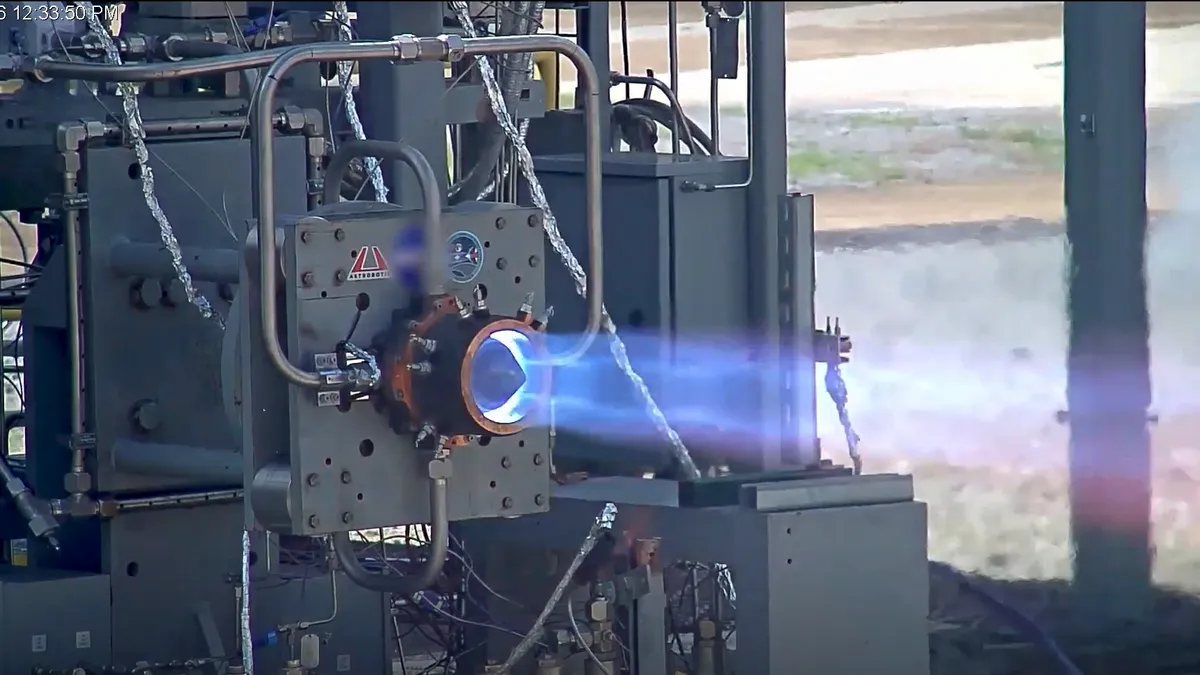
The American company Astrobotic has conducted a series of successful tests of the Chakram rocket engine prototype, achieving a record-breaking continuous burn time of 300 seconds. This new type of propulsion system could significantly improve the efficiency of spacecraft while reducing fuel consumption.
How it works
Conventional rocket engines burn fuel evenly and continuously in the combustion chamber. The Rotating Detonation Rocket Engine (RDRE) operates differently: a continuous circular detonation wave propagates inside a ring-shaped chamber, generating higher pressure and enabling greater thrust with lower fuel consumption.
The theoretical efficiency gain ranges from 10 to 15 percent, along with a reduction in the engine’s size and weight. However, putting these advantages into practice has so far proven difficult.
Record at NASA stand
The tests were conducted at NASA’s Marshall Space Flight Center in Huntsville, Alabama. The two Chakram prototypes have collectively operated for over 470 seconds across several test runs, with one of the engines running continuously for 300 seconds.
After that, the experts found no visible damage to the structure. Each of the prototypes generated a thrust of over 1,800 kilograms and reached a stable thermal regime—indicators of normal sustained operation.
What does this mean for future missions?
Astrobotic views Chakram as the foundation for several promising projects—including advanced versions of the Griffin lunar lander, reusable rockets, and an orbital tug for operations in lunar orbit. The work is being carried out with support from NASA SBIR (Small Business Innovation Research) grant contracts and a cooperation agreement with the Marshall Space Flight Center.
The data collected during the campaign should help improve thrust control and the cooling system, as well as reduce the overall weight of the system as we move toward the flight-ready version.
Not the first, nor the last
Astrobotic is not the only company developing this technology. Last year, Venus Aerospace conducted the first successful flight test of its own detonation engine, becoming the first company in the U.S. to get an RDRE in the air.
Chakram is still just a stand prototype, but a 300-second continuous burn puts it in a whole different league.
According to Space.com

