

Astronomers have found the answer to a long-standing mystery in astrophysics: why do supermassive black holes grow much more slowly today than in the past? A study using NASA’s Chandra X-ray Observatory and other X-ray telescopes has shown that supermassive black holes cannot consume matter as quickly as in the distant past.
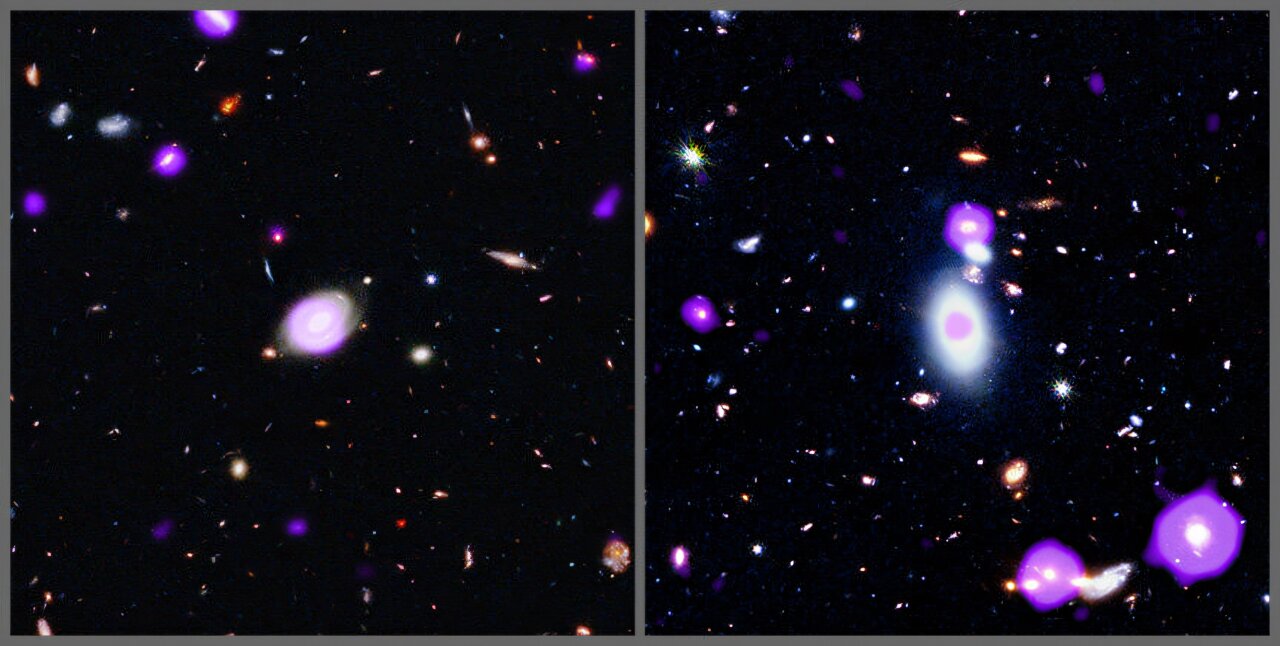
Slowing growth after the “cosmic noon”
Ten billion years ago, there was a period that astronomers call “cosmic noon,” when the growth of supermassive black holes (with masses ranging from millions to billions of times that of the Sun) reached its peak in the history of the Universe. However, between cosmic noon and today, astronomers have observed a significant slowdown in the growth rates of black holes.
The reason for this slowdown remained a mystery for a long time. Using new X-ray data and additional observations at other wavelengths, scientists can test various hypotheses and narrow down the possible explanations.
When gas falls into a supermassive black hole, it heats up and emits large amounts of radiation, including X-rays. For decades, Chandra and other X-ray telescopes have shown a decrease in the growth of black holes by observing them at various distances throughout the Universe. It is important to note that fast black holes produce more X-rays.
By analyzing observations of approximately 1.3 million galaxies and 8,000 growing supermassive black holes using data from Chandra, ESA’s XMM-Newton, and eROSITA (Extended ROentgen Survey with an Imaging Telescope Array, a German and Russian mission), the team was able to pinpoint the “why.”
In this study, scientists determined the luminosity and mass of black holes, as well as the number of galaxies in the study with X-ray sources, indicating the presence of growing supermassive black holes within them. The team used a combination of surveys—ranging from shallow surveys of large sections of the sky to very long observations of small areas. This arrangement is often visualized as multiple tiers that make up the design of a wedding cake.
Layered telescope data forms a picture
The XMM-Newton and eROSITA observations provided broader but shallower coverage of the middle and lower levels. Meanwhile, Chandra provided high-resolution, deep observations of a relatively small region, enabling the detection of fainter and more distant growing black holes.
“By combining these data from different X-ray telescopes, we can construct a better picture of how these black holes are growing than any one telescope could do alone,” said co-author Fan Zou of the University of Michigan. “We can find out why over ten billion years the growth of supermassive black holes has gone from hectic to leisurely to glacial.”
Possible explanations for the deceleration of black holes
The team conducted tests on the three main possible scenarios which are considered to be the causes of the deceleration in black hole growth. The possibilities were as follows: Could the slowdown in black hole growth rates be due to less efficient accretion rates, smaller typical black hole masses, or a smaller number of actively growing black holes?
Their analysis of data spanning billions of years of cosmic history led them to conclude that black holes actually absorb matter more slowly the later they appear after the Big Bang. Researchers expect this trend of slowing growth in black holes to continue in the future.
A key finding of this study is that both more massive black holes and faster-growing black holes produce brighter X-ray emissions. Observations at other wavelengths, including optical and infrared data, were used to estimate the masses of black holes and to distinguish between these two factors.
According to phys.org

