

NASA’s TESS space telescope has discovered a system of three exoplanets that behaves quite differently from other known systems. They attract each other with such force that their orbits change right before our eyes—and in just 200 years, neither of them will cross the disk of its star.
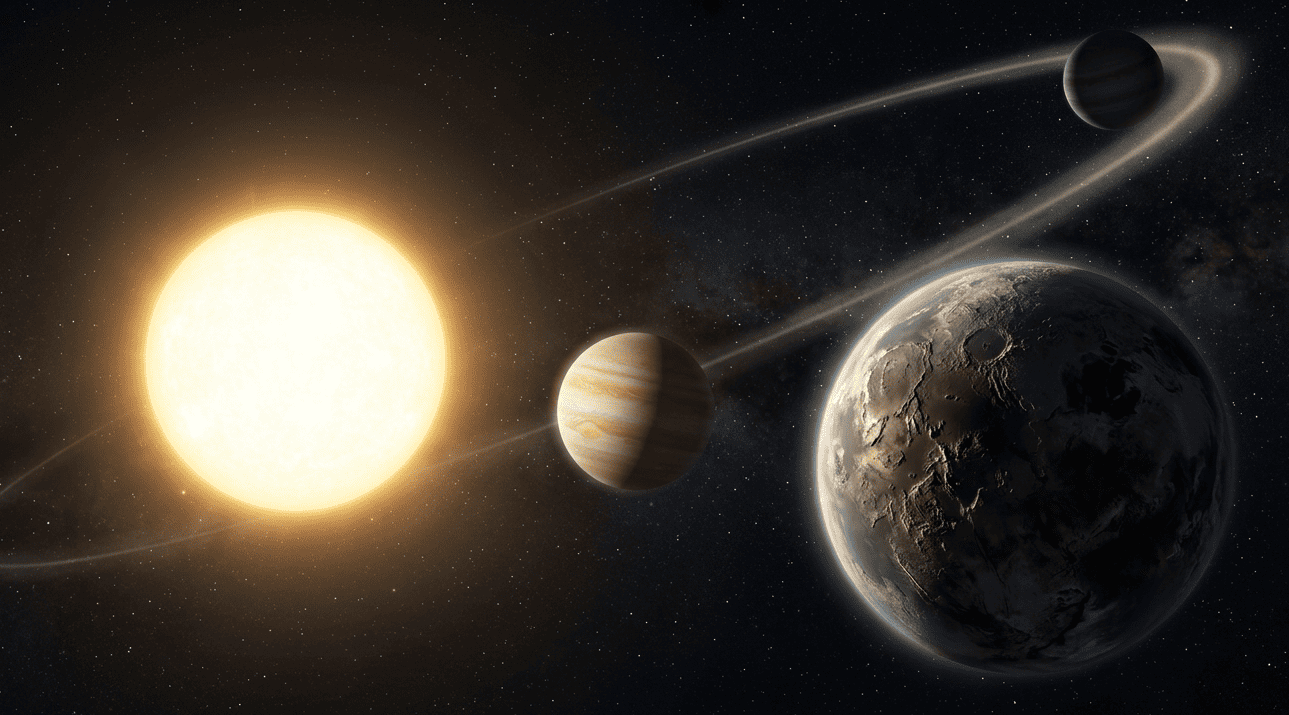
Three completely different worlds
Researchers using data from the TESS (Transiting Exoplanet Survey Satellite) telescope have determined that three distinct objects orbit the star TOI-201, located 370 light-years from Earth.
The first is a rocky super-Earth (a planet larger than Earth but smaller than the gas giants), six times more massive than ours: it completes a full orbit in 5.8 days. The second is a gas giant with half the mass of Jupiter, orbiting the star every 53 days. The third is a massive outer giant with sixteen times the mass of Jupiter, which takes nearly eight Earth years to complete one full orbit.
“Most planetary systems appear as ‘peas in a pod,’ meaning the planets have a similar range of parameters and share a similar orbital plane,” noted Amaury Triaud, a member of the team from the University of Birmingham.
Shifting orbits
The outer giant orbits in an elongated, inclined path—its gravity disrupts the inner planets, altering the angles of their orbits around the star. TESS has detected transit delays—moments when a celestial body passes in front of a star’s disk.
“Normally, each transit occurs exactly one orbital period apart. But TOI-201b suddenly started occurring about half an hour late,” Triaud explained.
Window into the past
According to Tristan Guillot, an astronomer at the Côte d’Azur Observatory and principal investigator of the ASTEP project (Antarctic Search for Transiting Exoplanets), this behavior indicates active orbital rearrangement within the system.
“This allows us to see what happens immediately after planetary systems form,” he explained. The ASTEP telescope is located at the Concordia Antarctic Station—in the middle of an icy plateau where the glacier is more than three kilometers deep. It is precisely these long polar nights that make it possible to observe worlds with long orbital periods. The results of the study were published in the journal Science in April 2026.
According to space.com

