
The era of artificial intelligence has begun, and its development is rapidly advancing. AI now helps people in many areas, and the results of its work are often impressive. For example, they help astronomers detect dangerous asteroids. But can artificial intelligence be adapted to control the most complex machines ever created by humans? There was a recent contest to find the best AI pilot for spacecraft, using different language models. The results show that the era of fully autonomous space flights without direct involvement of operators on Earth or on board may begin much sooner than we expected. The key to success turned out to be effective models similar to the well-known ChatGPT.
Space challenge for AI
During the competition, the stage was virtual, but the task was as real as possible. The Kerbal Space Program Differential Game Challenge has been launched on a platform based on the popular space simulator Kerbal Space Program. Its goal is to stimulate the development of autonomous systems for controlling satellites and spacecraft. Why is this so important? The future of astronautics lies in thousands of satellites that cannot be controlled manually and missions into deep space, where signal delays due to distance make direct control from Earth impossible. Robots have to learn to make decisions on their own. The competition featured various scenarios, such as satellite interception or a mission to avoid detection.
Unexpected leader
For the competition, researchers prepared traditional algorithms that required multiple training cycles and refinements. But one international team decided to try a radically new approach. According to Arxiv, which is preparing for publication in the Journal of Advances in Space Research, they presented a commercially available large language model (LLM) – ChatGPT – for competition.
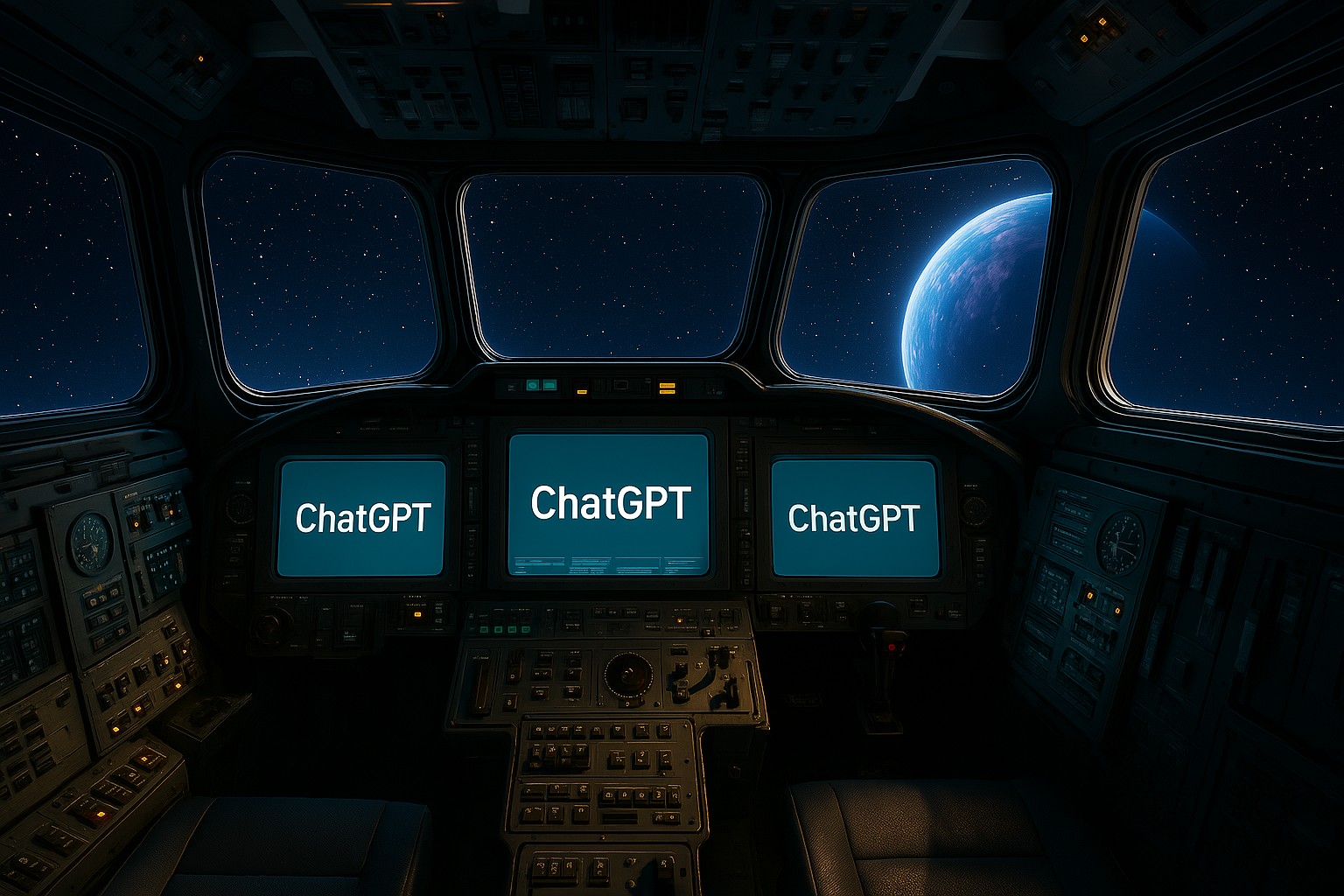
The primary task for AI was as follows: “You act as an autonomous agent controlling a pursuit spacecraft.” The result impressed everyone: ChatGPT performed really well, placing second overall in autonomous modeling. This caused a real sensation among specialists.
The power of knowledge, not training
Why did a language model designed to work with text perform so well at controlling a complex physical object in virtual space? The secret lies in its power and training. LLMs are trained on enormous amounts of human knowledge, including scientific texts, descriptions of physical laws, technical documentation, and even science fiction. This means that they know about orbital mechanics, acceleration, thrust vectors, and pursuit strategies.
Unlike specialized algorithms, which require lengthy training on a specific task, LLM often only needs a clear description of the context and task (known as “query engineering”). They can quickly “understand” the situation and propose a strategy based on their internal perceptions of the world, formed during their training. They don’t need thousands of simulations and years of calculations to improve — often, a few attempts are enough.
Discovering new horizons
ChatGPT’s success in the Kerbal competition is not just an interesting experiment. It is a powerful signal for the future of space exploration. It shows that large language models, which are already changing our world on Earth, have enormous potential beyond it. Their ability to quickly adapt to new tasks based on accumulated knowledge makes them ideal candidates for creating a new generation of “smart” autonomous systems for satellites, interplanetary probes, and possibly even manned spacecraft.
The era when spacecraft will truly be able to make complex decisions independently in real time is approaching at an incredible speed thanks to unexpected “pilots” such as ChatGPT.
According to Space

