

On Earth, vacuuming is a routine task. But on the International Space Station (ISS), this simple household activity becomes an unusual experiment. Robot cleaners do not assist astronauts in this task — the crew does it themselves. And, as it turns out, it can even be fun. Recently, NASA astronaut Jonny Kim shared a unique video showing the process of cleaning in Earth orbit.
How do we clean in space? Similar to how we clean on Earth, but weightlessness has some extra challenges. pic.twitter.com/MOLXm3P7k6
— Jonny Kim (@JonnyKimUSA) July 11, 2025
Vacuum ballet in zero gravity
Microgravity radically changes the process. Astronauts do not need to push or pull a heavy vacuum cleaner. Instead, as Kim demonstrates, the device is simply attached to a belt behind the back. Then it literally floats through the station modules, performing the dirty but extremely important task of maintaining cleanliness.
But the question arises: how can you vacuum when the dust is not on the floor but constantly floating in the air?
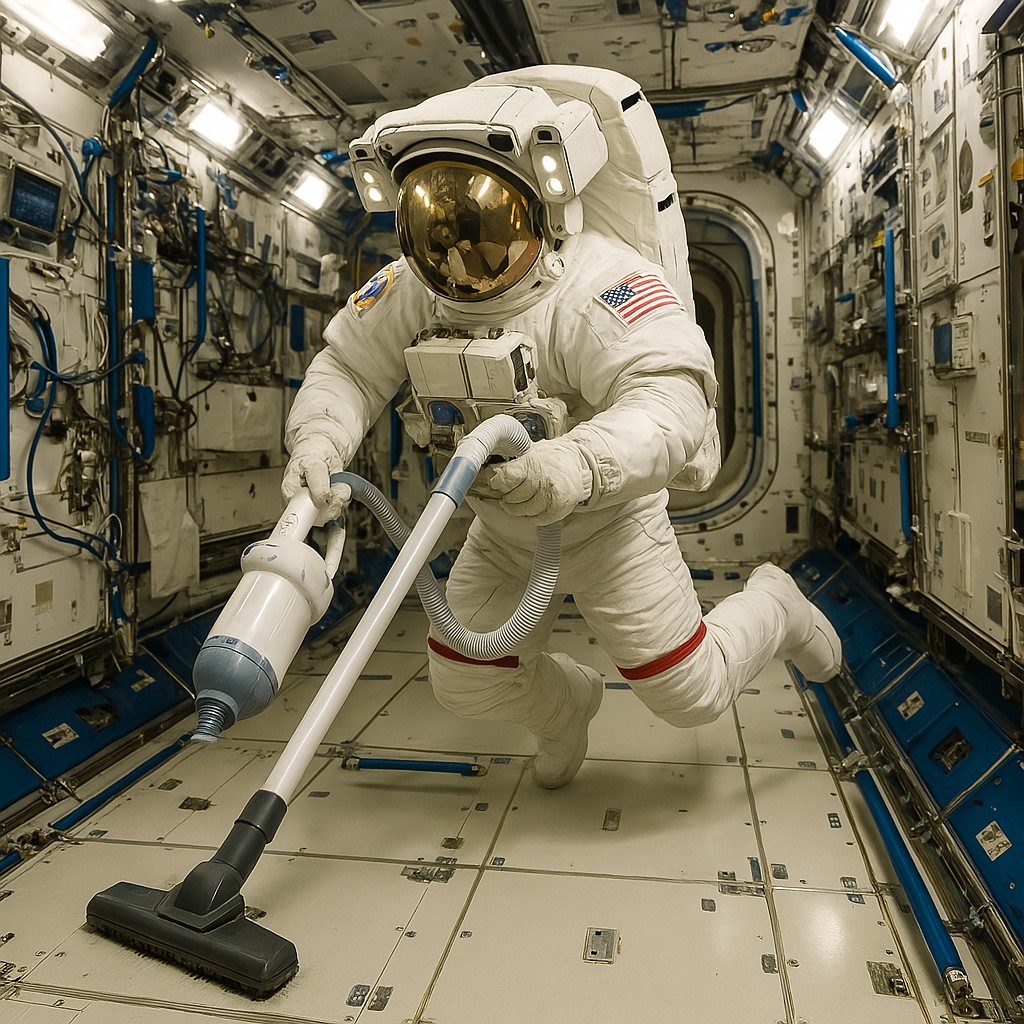
“We use a fairly standard earth vacuum cleaner,” explains Kim. “But fortunately, our environmental control system has fans, diffusers, and powerful HEPA filters.” They are the main “traps” for cosmic dust. Instead of trying to catch dust particles in the air, astronauts just vacuum the filters and vents where dust accumulates. It’s super effective and saves time.
Why isn’t the vacuum cleaner cordless?
In the comments, Kim was asked: why do you use a corded vacuum cleaner instead of a modern cordless one? The astronaut revealed the details: there are wireless models on the ISS, but their lithium-ion batteries are not enough to clean the entire huge station. A standard corded vacuum cleaner is more reliable for long-term use.
Cleanliness is the key to health
“The ISS is not only a laboratory, but also our home for a long time. As in any home, order is needed here,” Kim emphasizes.
Vacuuming is just one of the tasks that the crew divides among themselves to maintain a healthy and safe environment in orbit.
Earlier, we reported on how the ISS crew enjoyed during orbital maneuvers.
According to Digital Trends

