

The Perseverance mission team took advantage of a rare opportunity to capture one of the clearest panoramas of Mars in history. It shows objects located up to 65 km away from the rover.
The clearest panorama of Mars in history
Mars is a very dusty place. Dust gives its surface and sky a distinctive appearance and also limits visibility. However, sometimes there are periods of calm on the Red Planet when the sky clears of dust. This is exactly what happened on May 26, 2025.
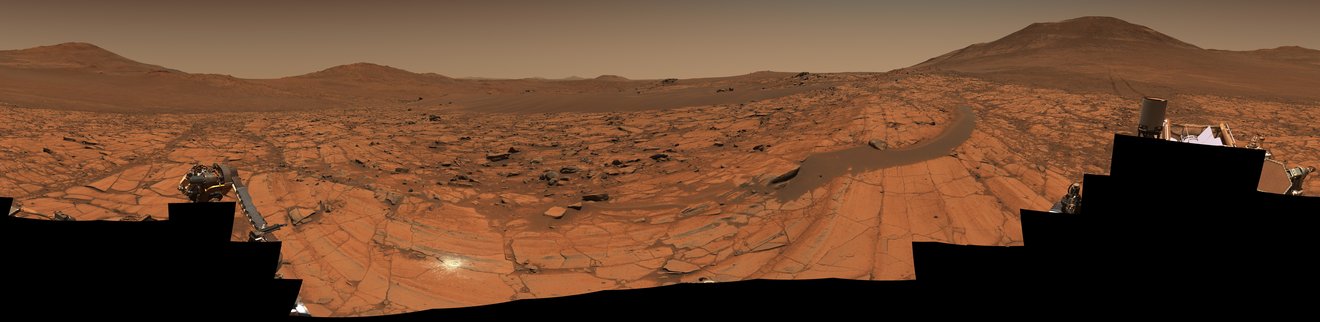
NASA specialists took advantage of a rare opportunity to obtain a panorama of Mars. Inside the Jezero crater, the Perseverance rover took 96 photos, which were then combined into a single image. According to experts, this is the clearest panorama of Mars ever taken. It shows hills located 65 km away from the rover.
A total of two versions of the image were published: one in natural colors, where the Martian sky has a reddish hue, and one in enhanced colors, where it looks surprisingly clear and deceptively blue.
Floating boulder
One of the details that caught the attention of the research team is a large rock that appears to be lying on a dark sand dune in the shape of a crescent to the right of the center of the mosaic, approximately 4.4 meters from the rover. Geologists call this type of rock a “floating rock” because it most likely formed elsewhere and was transported to its current location. It is unknown whether it arrived there by landslide, water, or wind, but the scientific team assumed that it was there before the dune was formed.
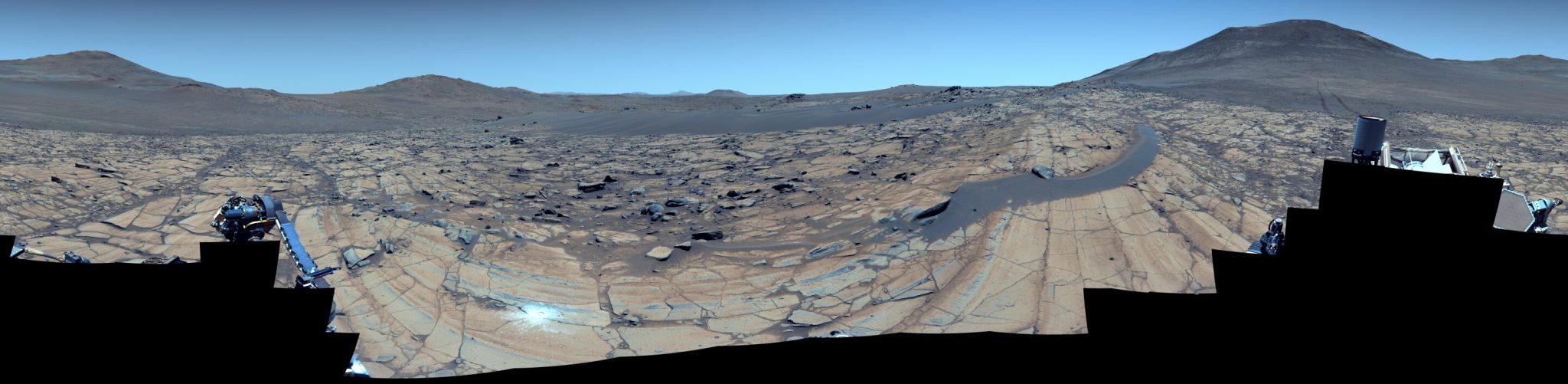
The bright white circle to the left of the center and at the bottom of the image was created by Perseverance using a drill. Thanks to this, the scientific team was able to see what was beneath the weathered, dusty surface of the rock before deciding to take a sample, which would be stored in one of the mission’s titanium tubes.
The rover left this track on May 22, and two days later, using instruments mounted on its manipulator, conducted a detailed analysis of Martian rocks. The scientific team wanted to study this area because it is located in one of the oldest regions Perseverance has ever explored — possibly even older than Jezero Crater.
Traces of the rover’s movement to this location can be seen on the right edge of the mosaic. About 90 meters away from it, they turn left and disappear from view at the previous rover stop.
Just over halfway across the mosaic, from one edge to the other, there is a transition from lighter to darker rocks. This is the boundary, or contact, between two geological zones. The flat, lighter-colored rocks closer to the rover are rich in the mineral olivine, while the darker rocks farther away appear to be much older clay rocks.
According to NASA

