

Astronomers have studied the protoplanetary disk around the young star HD 131488. In it, they discovered a ring consisting of hot carbon monoxide. Or, to put it simply, carbon monoxide gas. They believe that it is the result of collisions between comets.
Carbon monoxide
Carbon monoxide is a chemical compound consisting of one carbon atom and one oxygen atom. Although it is poisonous to humans, it is also considered an important organic substance. Wherever it is found in space, scientists search for life, and recently, one such location was explored using the James Webb Space Telescope.
We are talking about the young star HD 131488, located 500 light-years away from us in the direction of the constellations Centaurus and Lupus. Previous studies have shown that it is about 15 million years old and is surrounded by a disk of dust and gas in which planets are born.
It was on this disk that scientists discovered a thin ring consisting of carbon monoxide gas. The disk itself has a diameter of 30 to 100 AU, and the carbon monoxide ring is concentrated between 0.5 and 10 AU, and it is significantly heated.
Different temperatures of the same molecule
The most interesting thing about this gas ring is that the molecules that make it up have different rotational and vibrational temperatures. This sounds rather strange from the point of view of everyday logic, because heat is heat. However, from the point of view of physics, it is a derivative of the kinetic motion of molecules, and they can move in different ways.
So, there is an oscillatory temperature of molecules, which is associated with the oscillation of atoms inside them, and a rotational temperature, which reflects their own movement in space. Usually, in any substance, they are quite close, but not in the case of carbon monoxide in the accretion disk of HD 131488.
The second reaches only 450 K (sometimes dropping to 150 K), while the first reaches 8800 K. This is very surprising, because after a certain amount of time, the imbalance should have disappeared in one way or another. This means that the event occurred relatively recently.
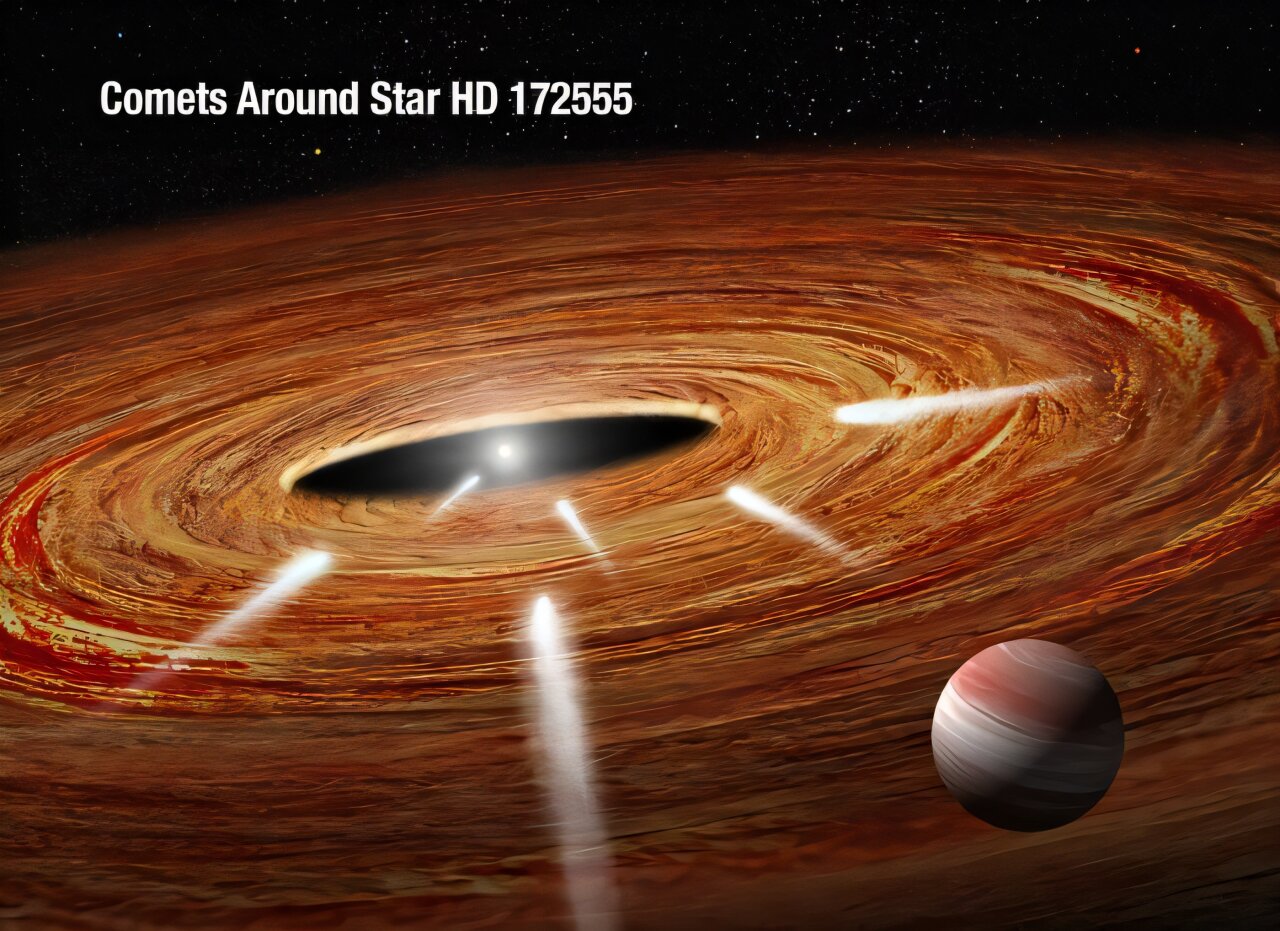
Scientists have two theories about what this could be: the collapse of a newborn planet or the result of a collision between comets. They lean toward the second option. Since there was a significant amount of carbon and oxygen in this “terrestrial zone” of the disk, as well as a lack of hydrogen, any planet that formed there would have a high “metallicity” (i.e., elements other than hydrogen). This would distinguish them from hydrogen-rich protoplanetary nebulae.
Provided by phys.org

