

The European Comet Interceptor mission, designed to study comets, may be launched earlier than originally planned. This is due to the unreadiness of another spacecraft intended to be launched alongside it.
Spacecraft for studying long-period comets
All comets in the Solar System are divided into short-period and long-period comets. The former have an orbital period of less than 200 years and their orbits lie in the inner part of the Solar System. Long-period comets come from the Oort Cloud, a huge reservoir of icy objects left over from the formation of the Sun and planets. They are interesting because they consist of “primordial” matter. Studying this matter can shed light on the formation of the Solar System and the origin of life on Earth.

The problem is that long-period comets are usually discovered only a few months before they pass through the inner Solar System. This is not enough time to plan and launch a mission. This is where Comet Interceptor comes in. This spacecraft will be launched into a halo orbit around the Sun-Earth L2 Lagrange point, where it will wait until astronomers find a suitable comet to which it can be directed.
Change in launch dates
Until recently, the launch of Comet Interceptor was scheduled for the second half of 2029. It was planned to be launched together with the Ariel telescope. But now the situation has changed. At a meeting of NASA’s Small Body Assessment Group on January 14, Michael Kueppers, a researcher at ESA working on the Comet Interceptor project, announced that Ariel’s launch date had recently been pushed back to the second half of 2031.
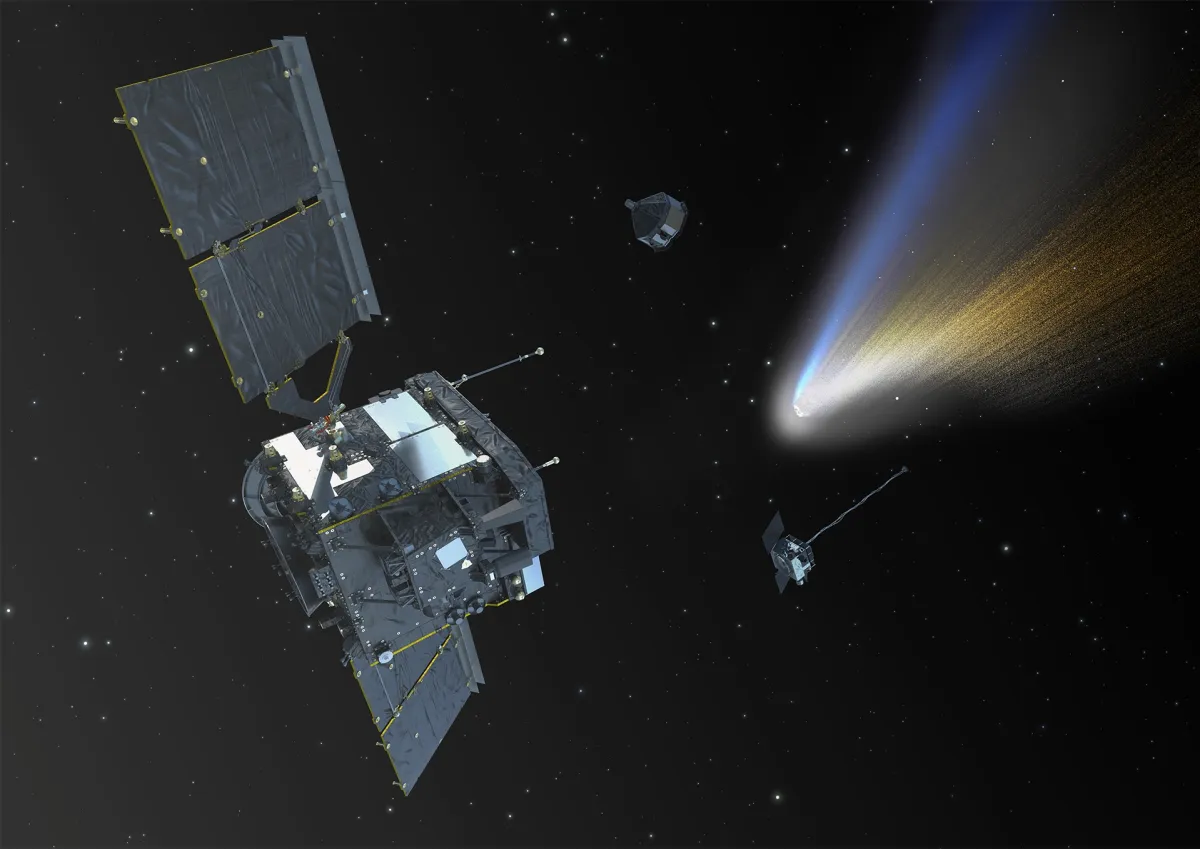
“As a result, Comet Interceptor will have to be stored for three years, which will entail corresponding costs,” said Kueppers. “In addition, it is difficult to retain teams for three years when nothing special is happening.”
Therefore, mission management has explored alternative launch options. The preferred option is to launch on an Ariane 64 rocket as a secondary payload with a commercial communications satellite heading for geostationary orbit. After deploying the satellite, the Ariane upper stage will send the Comet Interceptor to Lagrange point L1, from where it will then head to point L2.
Kueppers said that an alternative launch plan was approved by the ESA Science Program Committee in December. The agency is now working with Arianespace to determine the possibility of a launch between August 2028 and July 2029.
One advantage of this launch is that the spacecraft will be able to carry more fuel. This will increase the velocity change (delta-v) available to Comet Interceptor for pursuing comets from approximately 600 m/s to 1000 m/s. In turn, a higher delta-v increases the probability of intercepting a suitable long-period comet. Kueppers said that the probability of not finding such a target during a six-year mission would decrease from approximately 20% to less than 10%.
According to Spacenews

