

Scientists have collected a huge number of meteorites from various collisions with Earth over time. Inside them, they found microspheres that formed upon contact with Earth’s atmosphere. Their chemical composition gave a clue as to what the atmosphere was like at the time when they flew through it.
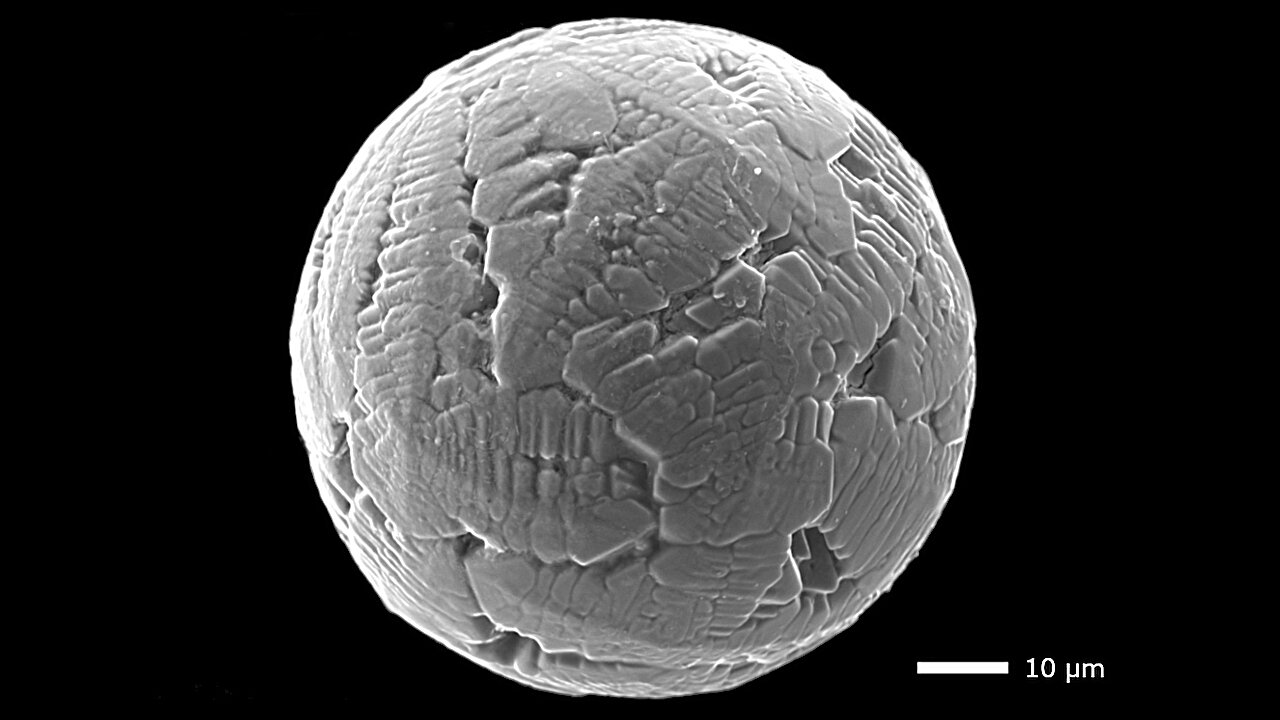
Cosmic dust and Earth’s atmosphere
Meteorites are usually regarded as a window into outer space. Their chemical composition can tell us about the past of the Solar System. However, a group of scientists from several European universities recently published a study in Communications Earth & Environment showing that they can tell us a lot about Earth’s past.
To be more precise, we are talking about the atmosphere of our planet. When a space rock hits it, it goes through something like a grinding machine or sandblaster. As a result, it may be completely destroyed.
However, if cosmic dust survives contact with the atmosphere and reaches Earth, it remains there for millions of years, retaining information about the composition of our planet’s gas envelope, which it encountered for the first time.
Microscopic spheres
The fact is that under conditions of intense heating and friction, the surface of the meteorite undergoes chemical interaction with oxygen in the atmosphere. As a result, microscopic spherical structures form on its surface. They consist of various oxides.
Recently, scientists have developed a new method for determining the isotopes present in the Earth’s atmosphere based on the composition of these structures. In addition, they were able to determine how much carbon dioxide it contained at different times and which carbon isotopes were present. And thanks to the latter, we were able to understand the long-term changes in biomass on Earth.
Micrometeorites are interesting because there are so many of them and they have been preserved from different periods, millions of years ago. Therefore, they allow us to construct graphs of such changes over time. However, it is important to take into account the effects of geological processes that acted on the cosmic stones during their time underground.
According to phys.org

