

The South African MeerKAT radio telescope has spotted a stream of gas and light far out in space, a kind of cosmic rope. It is 5.5 million light-years long and connects 14 galaxies.
Space rope
Researchers from the University of Cambridge have published a study on an amazing “cosmic rope” that they observed using the South African MeerKAT radio telescope. An article on this subject is available on the arXiv preprint server.
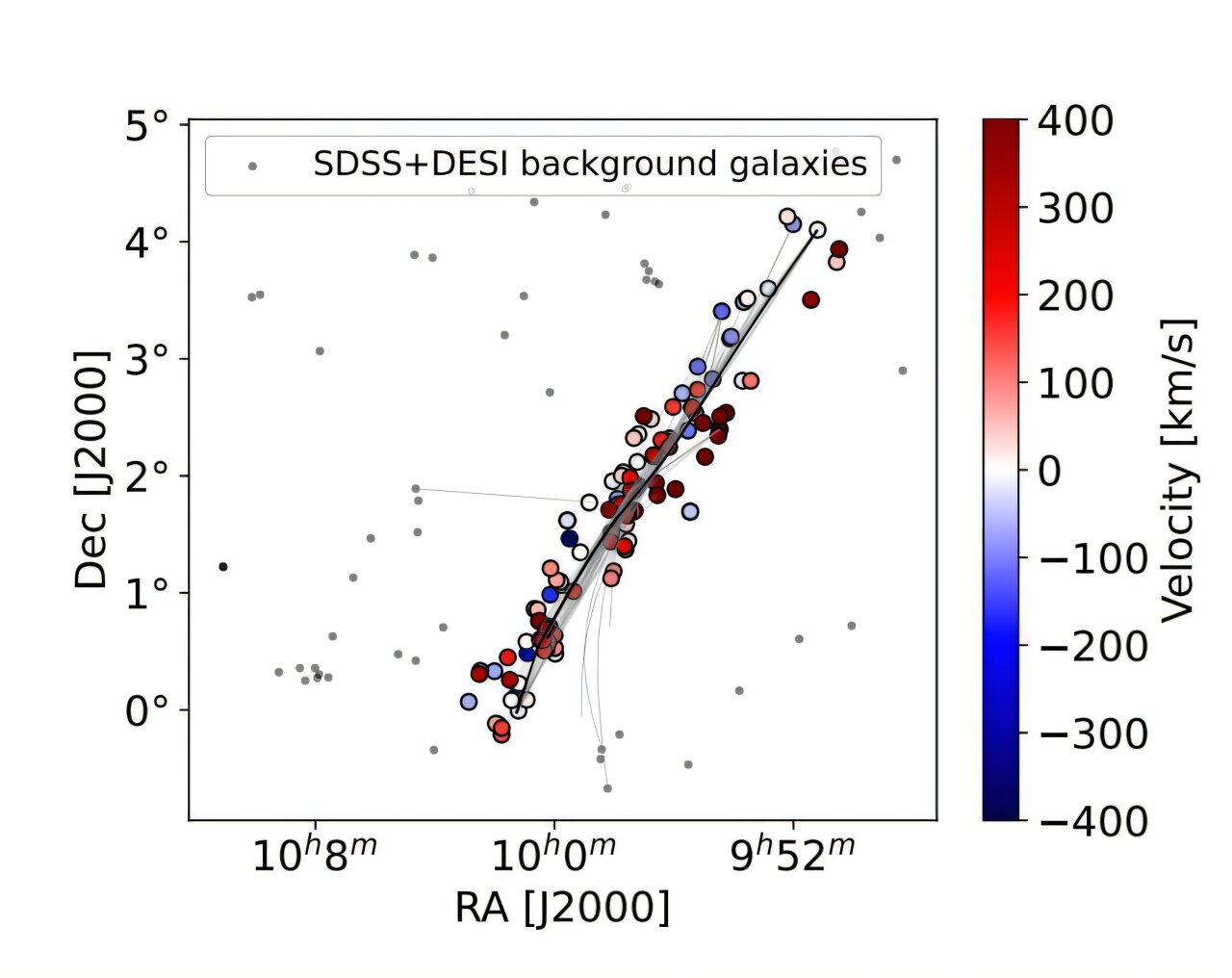
The cosmic rope belongs to the so-called cosmic filaments — giant structures connecting the ring of galaxies. It was discovered thanks to observations in the MIGHTEE-HI megahertz range. Precisely this made it possible to detect radiation from atomic hydrogen HI, of which it mainly consists.
In total, the structure stretches across 5.5 million light-years and connects 14 galaxies. All of them are within a very small range of distances, with speeds ranging from 9,230 to 9,700 km/s (with a speed dispersion of about 140 km/s). They form a linear structure approximately 30 degrees west of north on the celestial sphere, approximately 5.5 million light-years long and about 117,000 light-years wide.
“Cosmic Web”
Moreover, observations indicate that this filament of galaxies is embedded in a much larger cosmic web structure, measuring at least 49 million light-years across. This cosmic web filament appears to be between 2.6 and 3.3 million light-years thick.
Observations have shown that the 14 HI galaxies reported are significantly more aligned with the cosmic web. Consequently, this indicates that the angular momentum of galaxies is closely related to large-scale filamentary structures.
In addition, after analyzing the collected data, astronomers found compelling evidence of galaxies rotating around the axis of the filament. This discovery makes the recently detected galactic filament the longest and one of the largest rotating structures discovered to date.
The results obtained allowed the team of scientists to gain more information about the stage of evolution of the galactic filament. Scientists have discovered that the large number of HI galaxies along the filament and the low dynamic temperature of the galaxies in the filament indicate that this filament is in an early stage of evolution, when the influence of cosmic matter flow on galaxies has been preserved for a long time.
According to phys.org

