

An international team of astrophysicists has released one of the world’s largest collections of cosmological simulations—over 2.5 petabytes of data, equivalent to roughly half a million HD-quality movies. The dataset allows us to study how matter in the Universe has been distributed and has changed from the Big Bang to the present day.
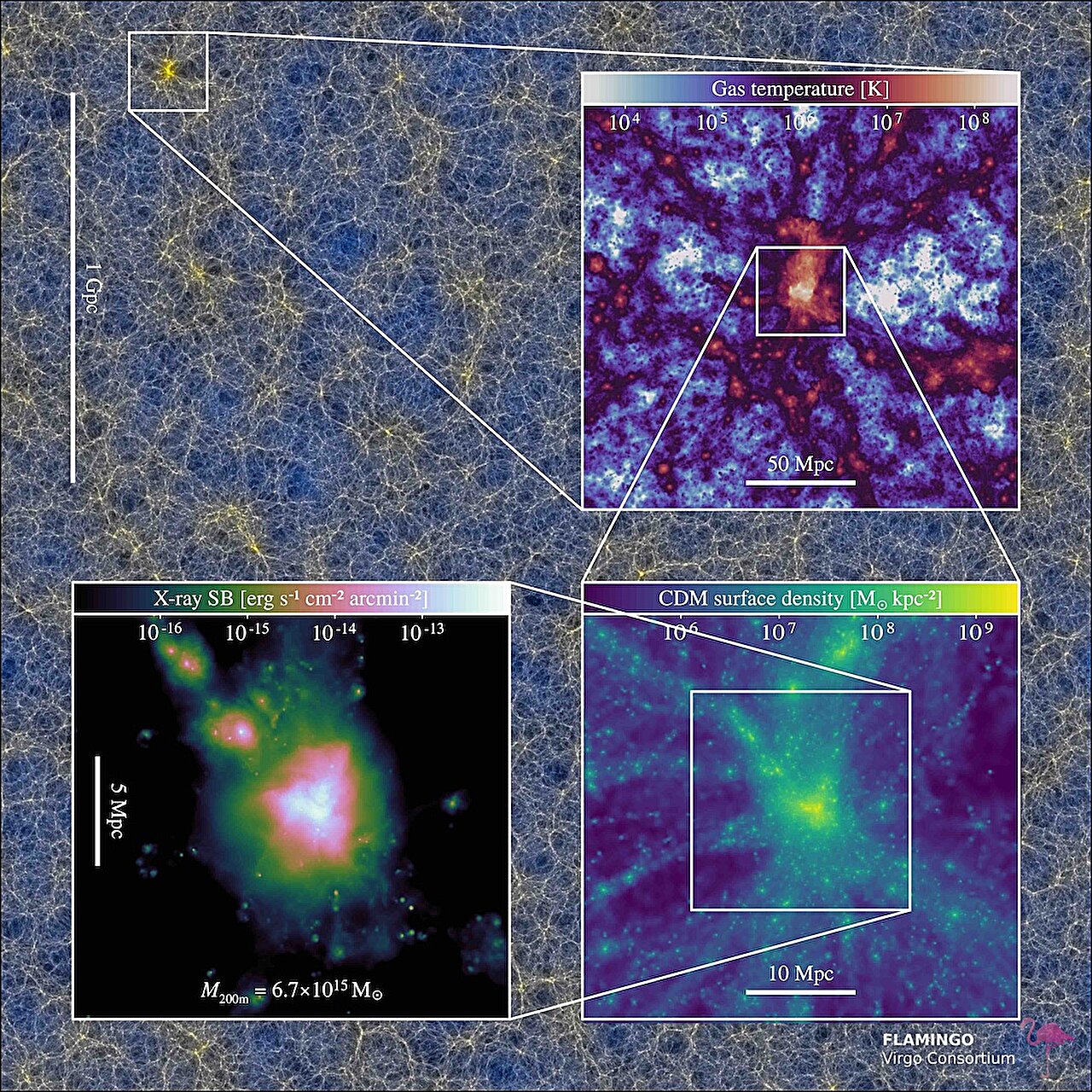
What is FLAMINGO?
Researchers at Leiden University (Netherlands), in collaboration with colleagues from other countries, have been carrying out the FLAMINGO project for several years—a series of large-scale simulations designed to recreate the evolution of the Universe on the largest spatial scales. A description of the new public data release is provided in a preprint submitted to the journal Astronomy & Computing.
Scientists have long known that, on the largest scales, matter in the Universe forms what is known as the cosmic web—a network of filaments and knots along which galaxies are distributed. By comparing simulations with actual observations, researchers are studying the nature of dark matter and dark energy—the invisible components that make up most of the Universe and determine the rate of its expansion.
FLAMINGO covers volumes of space spanning billions of light-years, enabling the analysis not only of individual galaxies but also of their clusters and the large-scale structure as a whole.
Supercomputer and open access
The calculations were performed using the SWIFT code on the COSMA8 supercomputer in the United Kingdom. “Most researchers simply don’t have access to such resources,” notes Carlos Frenk of Durham University.
That is why the team has made the data available to everyone. To make it easier to work with the dataset, the developers created a special online platform: it allows users to download only the specific parts they need, without having to download the entire dataset.
Dozens of studies and new opportunities
Since the simulations were first published in 2023, they have already been used in dozens of scientific papers—including studies on galaxy formation and the distribution of matter in the Universe. The team expects that the full public release will open up even more possibilities.
“Open access to datasets of this scale can significantly accelerate scientific progress,” emphasizes Matthieu Schaller of Leiden University.
According to phys.org

