

NASA has announced that astronauts will be able to fly with smartphones starting with the upcoming SpaceX Crew-12 flights to the ISS and Artemis II, a manned flight around the Moon. According to agency administrator Jared Isaacman, the idea is simple: give crews a modern tool to capture important moments for their families and quickly share photos and videos with their audience on Earth.
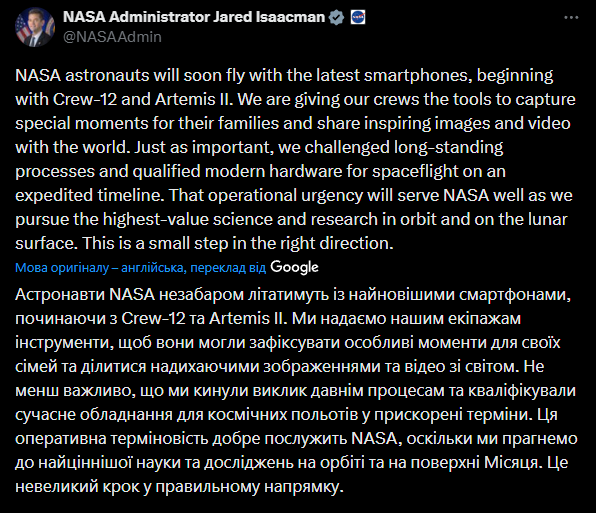
NASA is placing less emphasis on selfies in space and more on the process: Isaacman said the team accelerated the certification of modern spaceflight equipment by revising outdated bureaucratic approaches. It is precisely because of these requirements that certified special cameras (such as DSLRs and action cameras) have been used in orbit for years, while consumer electronics have been used much more cautiously.
At the same time, allowing gadgets into space is not as simple as putting a phone in your pocket: devices are tested for outgassing, electromagnetic compatibility, and potential interference with other systems; sometimes wireless modules may be restricted or disabled. Tablets have been used on board for a long time, but for government missions (especially lunar ones), this step looks like a significant policy change.
This could be of practical use for space research and field astronomy: a smartphone is a compact camera + computing platform for quick technical recording (condition of components, damage, assembly/disassembly), live reports, and educational content. From a scientific point of view, it offers the ability to quickly capture atmospheric phenomena, auroras, and other short-lived events using modern mobile photography modes. NASA has even released materials on how smartphones can be used for astrophotography on Earth, which clearly illustrates the potential of such cameras.

