

NASA’s Curiosity rover, which has been exploring the Red Planet for 13 consecutive years, has taken a new step toward unraveling its main mystery: were conditions on Mars once suitable for life? Although it has already proven that billions of years ago there were lakes and rivers on Mars, the rover continues to find new compelling evidence.
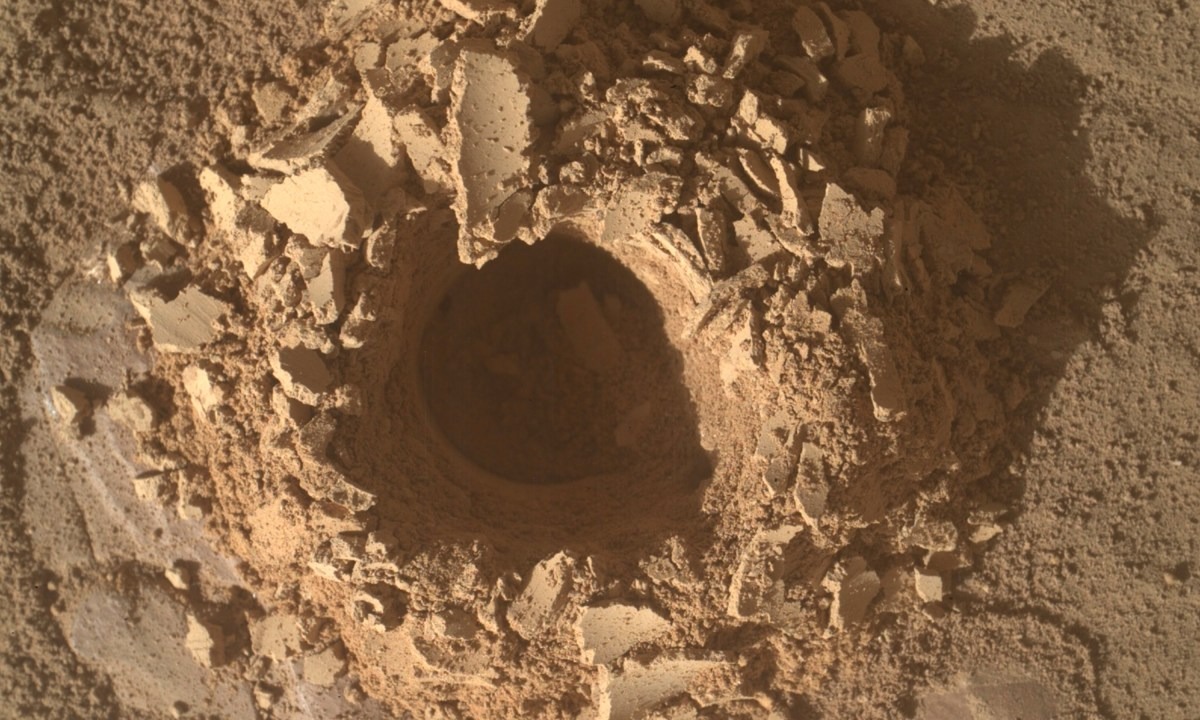
Curiosity recently shared a photo of its latest “achievement” with Earth – a drilling site with the romantic name Altadena. This is already its 43rd well. The extremely high-resolution photograph shows the interior of the rock so closely that it seems as if you could touch it with your hand. A careful look reveals an amazing texture, and the realization that this image is taken 180 million km from Earth is even more striking.
“Meet Altadena,” the rover announced via NASA’s social media accounts. The name of the borehole is associated with the city near its earthly birthplace.
Why is this sample so important? It is a sample of mudstone (silt). This type of sedimentary rock is formed exclusively from very fine particles—silt and clay—that slowly settled at the bottom of ancient water bodies over a long period of time. In fact, these are fossilized fragments of the bottom of ancient Martian lakes. Each such discovery is indisputable geological evidence that Mars had significant reserves of liquid water in the distant past, an essential condition for the potential emergence of life, at least in microbial form.
Curiosity’s impressive achievements
Curiosity is operating on Mount Sharp, a majestic 5.5-kilometer mountain rising in the center of Gale Crater. This mountain is a veritable geological “cake” with many layers that have accumulated over billions of years. By exploring these layers in ascending order, the rover literally reads the history of climate change on Mars, from its wet past to the modern dry and dead desert.
Meet “Altadena,” my 43rd drill hole.
— Curiosity Rover (@MarsCuriosity) June 12, 2025
It’s named after a city near where I was built back on Earth. I’ve got more sampling to do as a I scale Mount Sharp, unraveling its history one rocky layer at a time. pic.twitter.com/qyKyeLCZjO
Curiosity’s initial mission was designed to last only two Earth years. However, the rover’s impressive scientific results and reliability led to its mission being extended several times for an indefinite period. In 2021, it was joined by the latest Mars rover, Perseverance, equipped with even more powerful instruments. It complements Curiosity’s efforts by focusing on the direct search for signs of ancient microbial life and collecting samples for future return to Earth.
Every new well, such as Altadena, and every photograph taken by Curiosity not only expands our knowledge of Mars, but also brings us closer to answering a fundamental question: have we ever been alone in the Universe? The old but incredibly durable rover continues its journey into the Red Planet’s past, layer by layer.
According to Digital Trends

