

An incredible 1.2 billion light-years from Earth, an impressive spectacle is unfolding. Three galaxies engaged in a slow gravitational dance are merging into a single massive system called J1218/1219+1035. But the real sensation is hidden in their hearts.
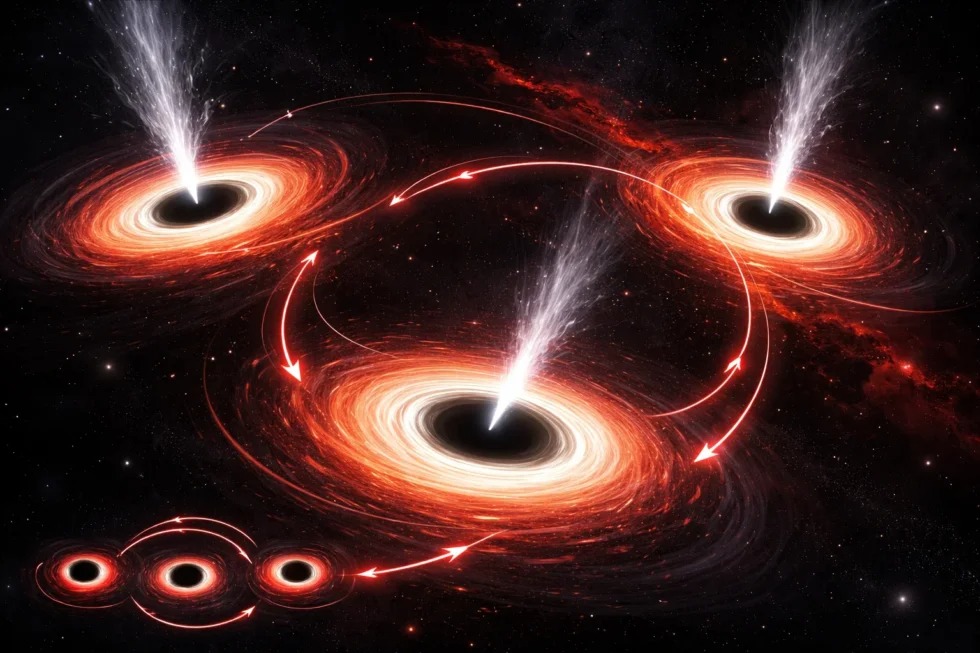
Each of these three galaxies has a supermassive black hole at its center that actively absorbs surrounding matter. Such objects are called active galactic nuclei. However, the J1218 system is special: all three black holes are not only active, but also intensively emit radio waves.
“Such triple systems, which shine brightly in the radio spectrum, are extremely rare. Observing this stage of merging is a unique opportunity to understand how the most massive galaxies and their black holes grow,” explains astrophysicist Emma Schwartzman.
Space oddities
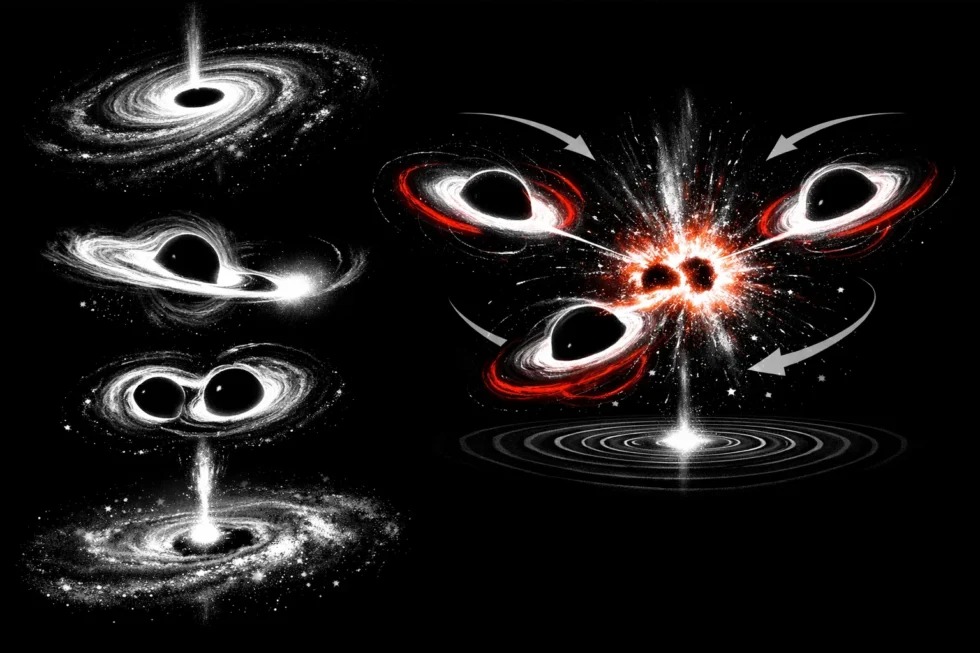
Galaxy mergers are a common occurrence in the Universe. Even our Milky Way has undergone several such collisions. However, triple mergers are much rarer. And systems where all three participants have active cores are truly unique in the cosmos.
J1218 is only the third triple system with active galactic nuclei discovered near us. But it is the first where all three nuclei are powerful sources of radio emission, making it a real cosmic treasure for scientists.
Search for the “triple monster”
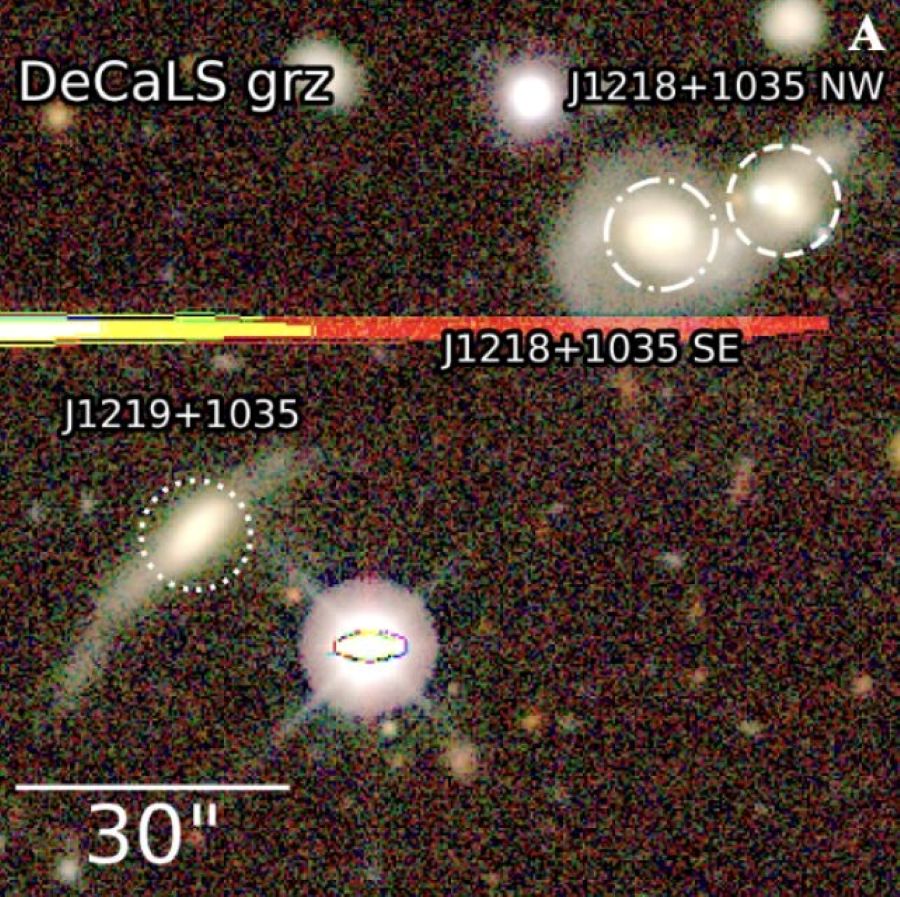
At first, astronomers noticed an object in the WISE space telescope data that resembled a normal collision between two galaxies. Further observations confirmed the presence of two active nuclei only 74,000 light-years apart. But the real discovery was a third galaxy 316,000 light-years away, which also has a bright active nucleus. Evidence of its involvement in the merger was a tail of gas extending toward its neighbors.
Studying rare objects such as J1218 opens up new opportunities for understanding the life cycle of supermassive black holes and the formation of giant galaxies. Research will continue at different wavelengths.
The goal is not only to study this system in detail, but also to develop methods for searching for other hidden “triple monsters” that may be waiting for their discoverers in the vastness of space.
Earlier, we explained the process of galaxy mergers.
According to sci.news

