

If dark matter really exists, then under certain conditions it can accumulate inside substellar mass objects, forming so-called dark dwarfs. And one of the possible places where they can be found is the center of the Milky Way.
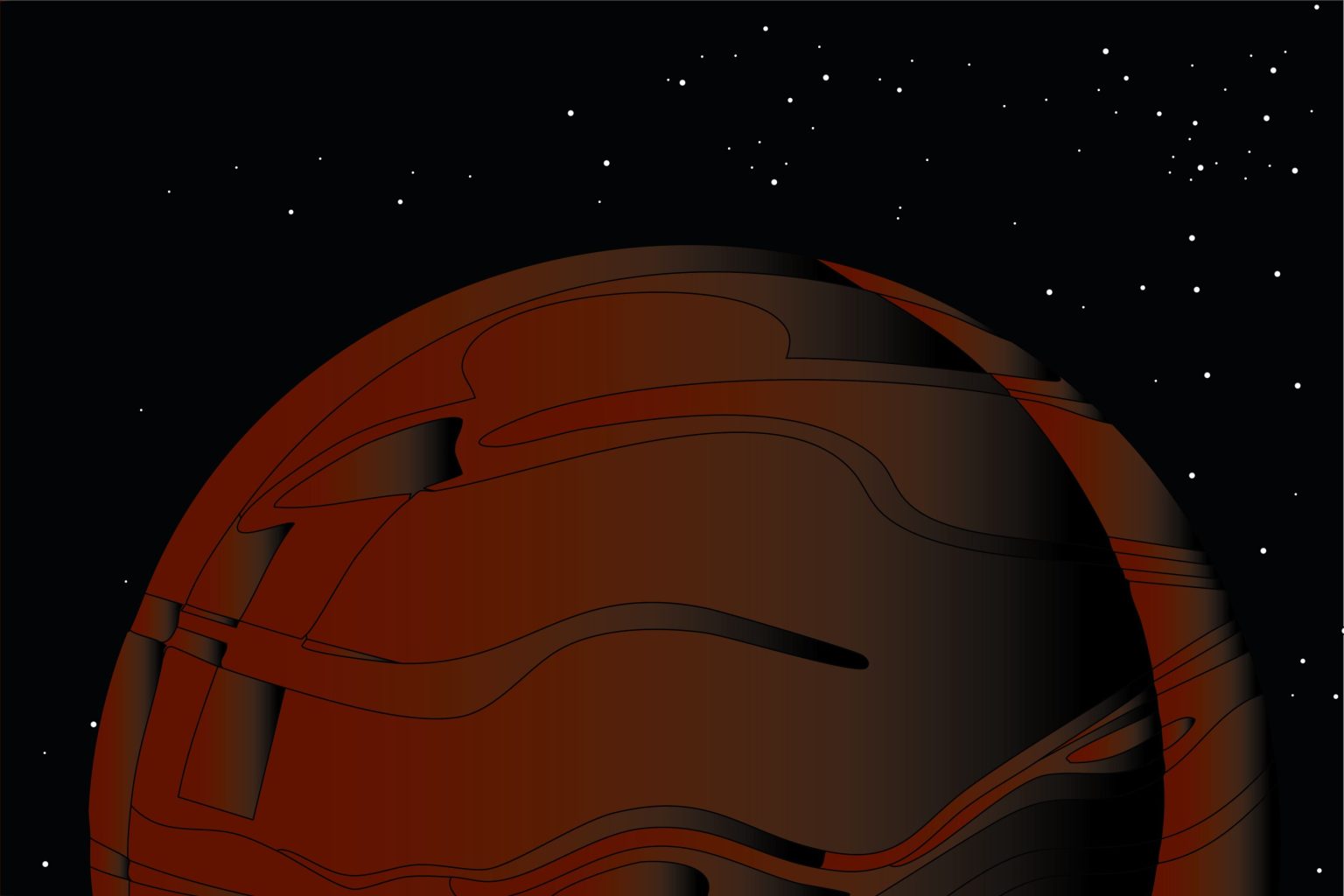
Dark matter condensation
A group of British and American scientists published an article in the Journal of Cosmology and Astroparticle Physics describing a new possibility for finding dark matter. It is quite possible that it forms substellar mass objects that we could potentially see.
There has been debate for many years about whether most of the matter in the Universe should exist in the form of something that does not interact with other matter except through gravitational interaction. Most scientists agree that dark matter exists, but what particles it consists of and how it can be detected are among the biggest questions in modern physics.
The idea of the new study is a development of a topic that has been discussed many times before: the formation of compact objects within galaxies. But this time, we’re not talking about stars or planets, but something in between. At the same time, they have to form where there’s a lot of dark matter — near the center of the Milky Way.
WIMP and dark matter physics
However, all of the above applies only to a specific type of dark matter component – heavy particles that interact weakly with their surroundings – WIMPs. Neither axions, nor sterile neutrinos, nor primordial black holes can manifest themselves in this way.
WIMPs, on the other hand, should accumulate inside any sufficiently large object, such as a star. And there, in sufficient quantities, they can annihilate with the emission of photons of a certain frequency. However, the intensity of this process is significantly weaker than that of thermonuclear reactions.
As a result, any radiation from WIMP annihilation is lost in the overall light flux from the star. However, this problem does not exist when dealing with brown dwarfs. These objects have a mass of about 8% of the Sun’s and either do not support thermonuclear reactions or support them very weakly.
However, WIMPs can accumulate inside them without any problems. And when they gather in sufficient numbers, they may well begin to annihilate each other, significantly increasing the luminosity of a rather dim brown dwarf, turning it into a dark dwarf.
How to find them?
Despite their name, dark dwarfs are not dark. On the contrary, they are brighter than brown dwarfs of similar mass. The problem is how to distinguish them from brighter stars, such as red dwarfs.
However, scientists already have an answer to this question: lithium-7 isotope. Under normal conditions on a star, it quickly enters into thermonuclear reactions and is consumed. But it should be preserved at an object that emits energy due to the annihilation of dark matter.
Therefore, if this isotope is present in sufficient quantities on a star, it is a dark dwarf. And the task of detecting such objects is already well within the capabilities of, for example, the James Webb Space Telescope.
According to phys.org

