

There may be galaxies right next to us that do not contain a single star. According to calculations by Spanish astronomers, there could be up to eight such objects in the immediate vicinity of the Milky Way, and it is entirely possible to detect them using existing instruments.
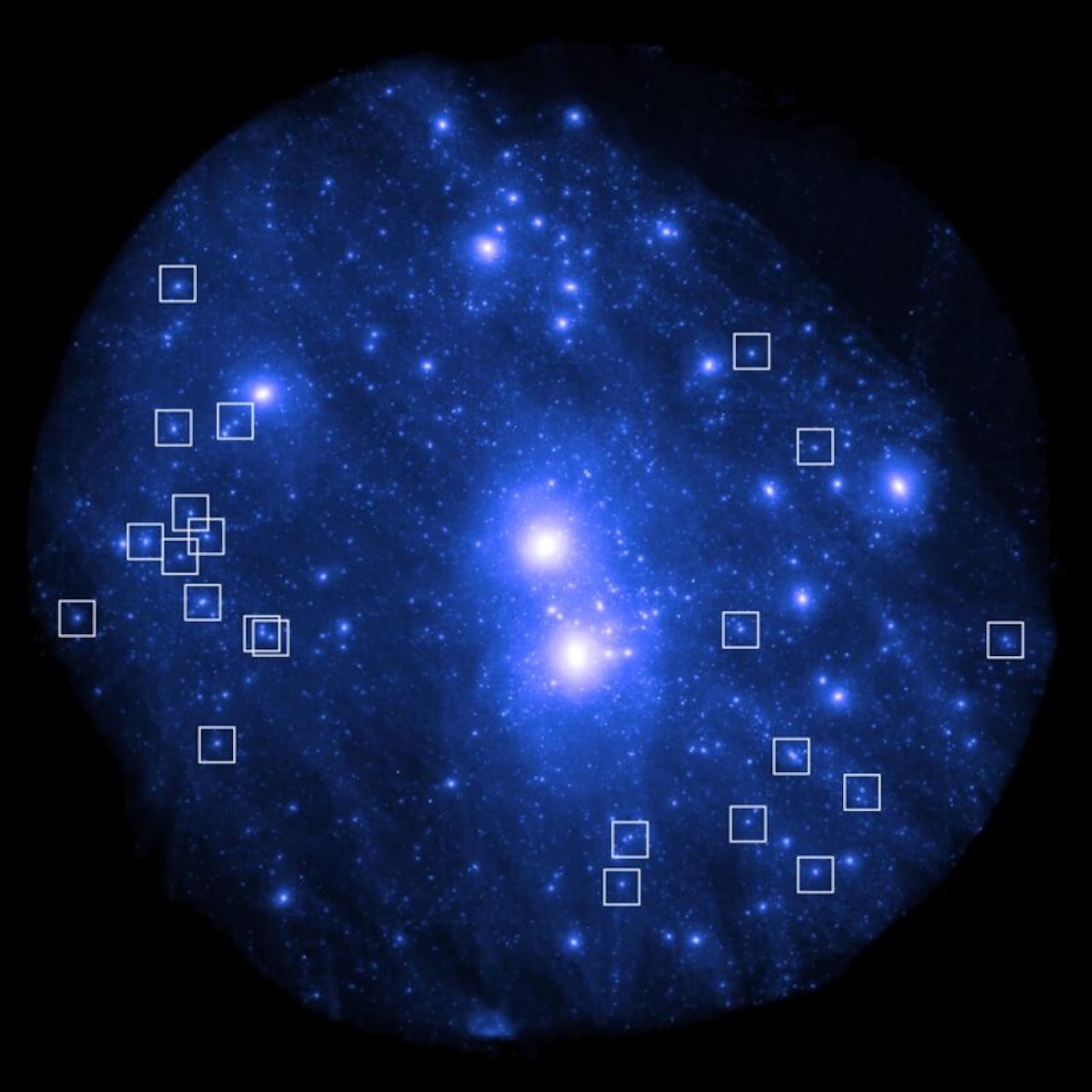
Invisible Neighbors
Scientists from the Institute of Astrophysics of the Canary Islands (IAC) and the University of La Laguna analyzed several modern hydrodynamic computer simulations of the Local Group of galaxies. In every single scenario, dark galaxies exist and form under similar conditions.
They must contain neutral hydrogen and dark matter, but have never formed stars. Guacimara García Bethencourt, a graduate student and the study’s lead author, attributes this to the properties of the dark matter halo, in which the gas density never reached the threshold required for star formation to begin.
Where to find them
Simulations point to a specific region. Dark galaxies are predominantly concentrated on the outskirts of the Local Group, in low-density regions of space. The surrounding environment has consistently been found to be less rich in dark matter and gas compared to that of ordinary galaxies, and therefore they are less likely to collide, merge, or acquire new gas from outside.
According to the authors’ estimates, up to eight dark galaxies should be detectable in the neutral hydrogen line at distances of up to 2.5 megaparsecs from the Milky Way. This corresponds to approximately 8.1 million light-years, and the radius of the search area is more than three times the distance to the Andromeda Galaxy, our nearest neighbor.
Model Verification
The standard cosmological model, the Lambda-Cold Dark Matter (ΛCDM) model, predicts the existence of dark galaxies as a consequence of the evolution of the universe. The results were published in the peer-reviewed journal Astronomy & Astrophysics. Finding even a few of them in our immediate vicinity would provide a direct test of this model in practice.
The first candidate for the dark galaxy Cloud-9 was discovered during observations using the Five-hundred-meter Aperture Spherical Radio Telescope (FAST). Its existence was confirmed by radio observations from the Green Bank Telescope and the Very Large Array (VLA). No traces of stars were detected in the Hubble Space Telescope’s visible-light images.
The Cloud-9 galaxy is located 14 million light-years away and remains the only confirmed object of the reionization-limited neutral hydrogen cloud (RELHIC) class. A new study provides, for the first time, a quantitative estimate of how many such objects are yet to be discovered and exactly where to look for them.
According to earthsky.org

