

Like ordinary matter, dark matter is subject to gravity. This is the conclusion reached by a team of researchers from the University of Geneva.
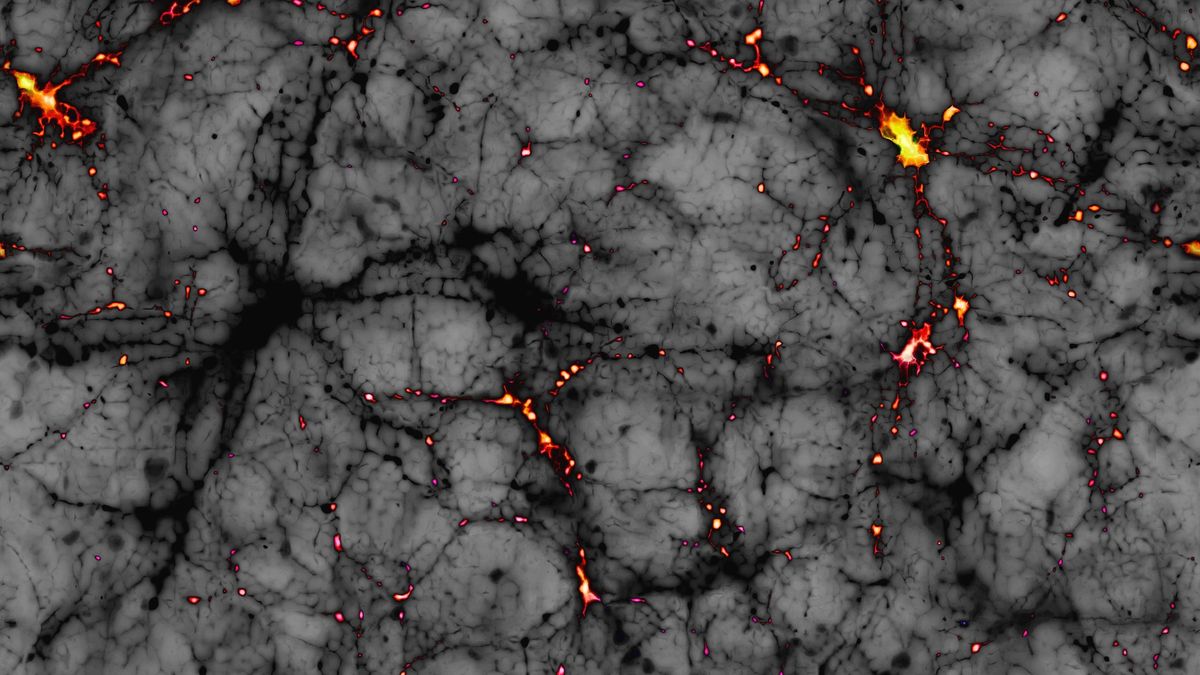
Dark matter is one of the greatest mysteries of modern science. This is the name given to a mysterious form of matter that accounts for over 80% of the total mass of the Universe.
Ordinary matter is subject to four well-known forces: gravity, electromagnetism, and the strong and weak forces at the atomic level. But what about dark matter? Scientists have long sought to answer the question of whether it behaves like ordinary matter on a cosmological scale or whether another, as yet unknown, fifth force is at work here.
A team of researchers from the University of Geneva attempted to find the answer. To do this, the scientists decided to use gravitational wells. Under the influence of massive celestial bodies, the space occupied by our Universe is distorted, creating wells. Ordinary matter — planets, stars, and galaxies — falls into these wells according to well-known laws of physics, including Einstein’s general theory of relativity and Euler’s equations. But what about dark matter?
To answer this question, researchers compared the speeds of galaxies in the Universe with the depth of gravitational wells. If dark matter is not affected by a fifth force, then galaxies, which consist mainly of dark matter, will fall into these wells like ordinary matter, obeying only gravity. On the other hand, if a fifth force acts on dark matter, it will affect the motion of galaxies, which will fall into the wells differently. By comparing the depth of the wells with the velocities of galaxies, scientists can test for the presence of such a force.
Applying this approach to current cosmological data, the research team concluded that dark matter falls into gravitational wells in the same way as ordinary matter, thereby obeying Euler’s equations.
However, according to the researchers, they cannot completely rule out the existence of an unknown force. But if such a fifth force exists, it cannot exceed 7% of the force of gravity — otherwise, it would have already been found during the analyses.
These initial results mark an important step forward in characterizing dark matter. In the future, researchers intend to conduct new experiments using more sensitive instruments capable of detecting forces equivalent to 2% of the force of gravity. These will provide even more insight into the behavior of dark matter.
We previously reported that signals from the Dark Ages of the Universe hold the key to unlocking the mystery of dark matter.
According to Phys.org

