

Scientists have once again attempted to determine the nature of the object known as Ursa Major III. Is this a very small dwarf galaxy that is a satellite of the Milky Way?
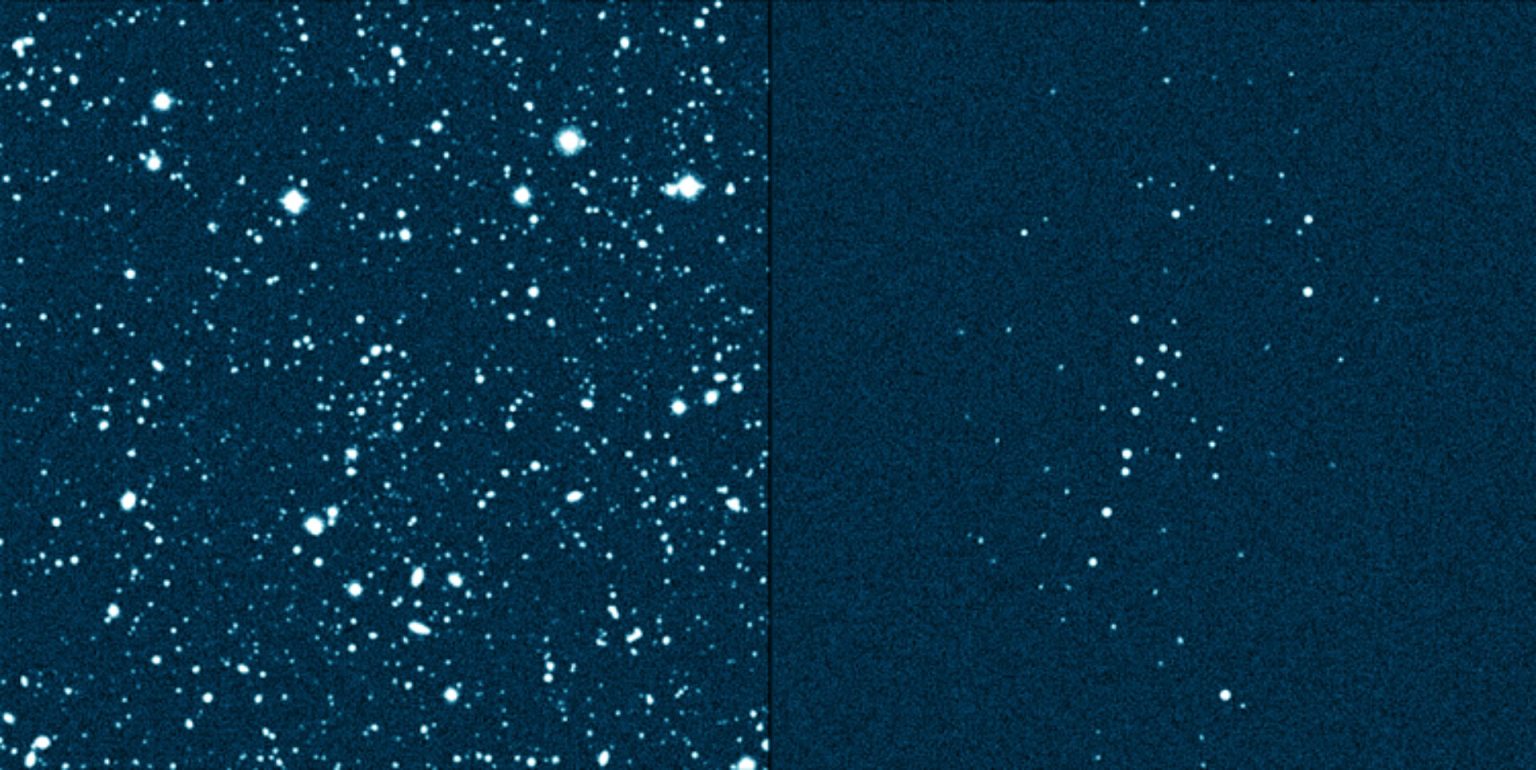
Nature of Ursa Major III
Ursa Major III, the faintest object in our galaxy, orbits the Milky Way at a distance of more than 30,000 light-years. It has been considered a dwarf galaxy consisting mainly of dark matter due to its large mass. However, an international team of astrophysicists from the University of Bonn and the Institute for Advanced Studies in Basic Sciences in Iran has found evidence suggesting that it is actually a compact star cluster with a black hole at its core.
The study focuses on celestial bodies that cannot be clearly classified as star clusters or dwarf galaxies. Although they resemble classic star clusters on the outside, they have unusually high mass-to-light ratios; some of them are hundreds or thousands of times higher than those of ordinary dwarf galaxies. This feature has led to the assumption that they contain large amounts of dark matter.
Neither established dark matter models nor alternative theories have been able to satisfactorily explain the exact causes. Therefore, such intermediate objects are considered a “hot topic” in astrophysics and are the subject of intensive research.
Dark star cluster, not a dwarf galaxy
Ursa Major III is the least known satellite of the Milky Way. These small satellite galaxies orbit the Milky Way and provide important clues about its formation and composition. Previously considered a dark dwarf galaxy — a small galaxy whose mass consists mainly of dark matter — Ursa Major III has now been found to be a dark star cluster. Modeling by the research team now indicates that Ursa Major III may be a compact star cluster whose gravity is held together by a core of black holes and neutron stars, rather than dark matter.
Dark star clusters form when gravitational interactions with the Milky Way over billions of years remove outer stars from the star cluster, explains Professor Dr. Hosein Haghi, who conducts research at the University of Bonn and has ties to the Iranian Institute for Advanced Studies in Basic Sciences in Zanjan. What remains is a dark, massive core that does not emit light. According to the study, this effect was previously misinterpreted as evidence of dark matter.
Simulation testing
To test the hypothesis, the research team simulated the evolution of Ursa Major III on a cosmic timescale. Using specialized N-body simulations that accurately calculate the gravitational interactions of thousands of stars, the team recreated the evolution of the current structure of Ursa Major III over time. These simulations are based on the latest observational data, including the orbital motion of Ursa Major III and its chemical composition. The research team’s calculations show that the observed state of Ursa Major III can be explained by a dense core of black holes holding the residual stars together gravitationally, without the need for dark matter. “Our work shows for the first time that these objects are most likely ordinary star clusters,” says Professor Dr. Pavel Kroupa, member of the Transdisciplinary Research Areas (TRA) Modeling and Matter at the University of Bonn.
Such problems can be effectively solved with the right approach to computer simulations, which may lead to the disappearance of seemingly “exotic components” in astronomy.
The Bonn team considers themselves leaders in this field. Over many years, they have developed numerous specialized methods for detailed modeling of the complex dynamics of such stellar systems. Scientists believe that the current research results provide a new basis for understanding mysterious celestial objects, opening up new perspectives for galaxy research.
According to phys.org

