

Astronomers have published a photograph taken by the Atacama Large Millimeter/submillimeter Array (ALMA). At first glance, it resembles 3D images, which require red and blue paper glasses to view. But in reality, we are facing a dying star.
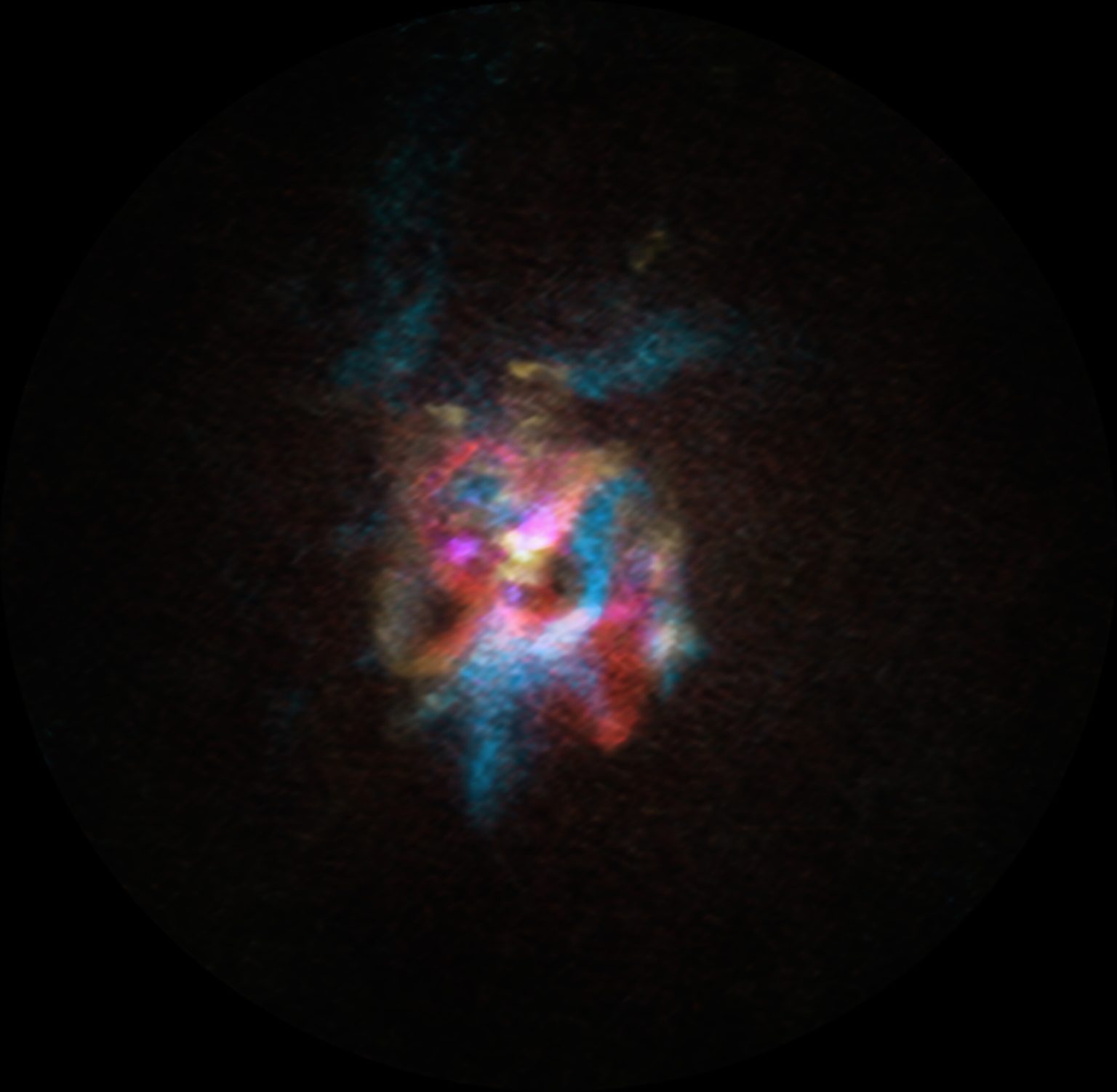
The ALMA photo shows the nebula surrounding the red supergiant Stephenson 2 DFK 52, located 19,000 light-years from Earth. It had long exhausted its hydrogen reserves and began to spew clouds of dust and gas into the surrounding space. Such nebulae are often found around giant stars, but this particular cloud is a mystery to astronomers.
The fact is that DFK 52 is in many ways similar to Betelgeuse, another famous red supergiant. However, if it were as close to us as Betelgeuse, the gas and dust nebula surrounding it would occupy an area in the sky equivalent to one-third of the full moon. The fact is that its diameter is 1.4 light years: that’s a third of the distance between the Sun and its nearest star, Proxima Centauri!
In order to better understand what this amazing object is, astronomers used ALMA. It managed to measure how much matter surrounded the star and how fast it was moving. In the image, the parts moving toward us are highlighted in blue, and the parts moving away are highlighted in red.
The data shows that about 4,000 years ago, the star went through a period of extreme mass loss, and then its speed slowed down to the current one, which is similar to the mass loss speed of Betelgeuse. The current mass of DFK 52 is estimated to be 10-15 times the mass of the Sun. Calculations show that the star has already lost about 5-10% of its original mass.
The answer to the question of what caused the star to eject so much material in such a short period of time remains a mystery. According to one theory, it is all due to interaction with one of the neighboring stars. According to researchers, understanding why DFK 52 has already lost so much mass will help us understand when exactly it will cease to exist and collapse, turning into a supernova.
According to ALMA

