

Astronomers from Macquarie University have confirmed the gradual approach of the massive exoplanet TOI-2109b toward its star. This could end in three different scenarios.
Hotter than many stars
TOI-2109b orbits a yellow-white star of spectral class F, located 870 light-years from Earth. It is a gas giant whose mass is approximately five times that of Jupiter.
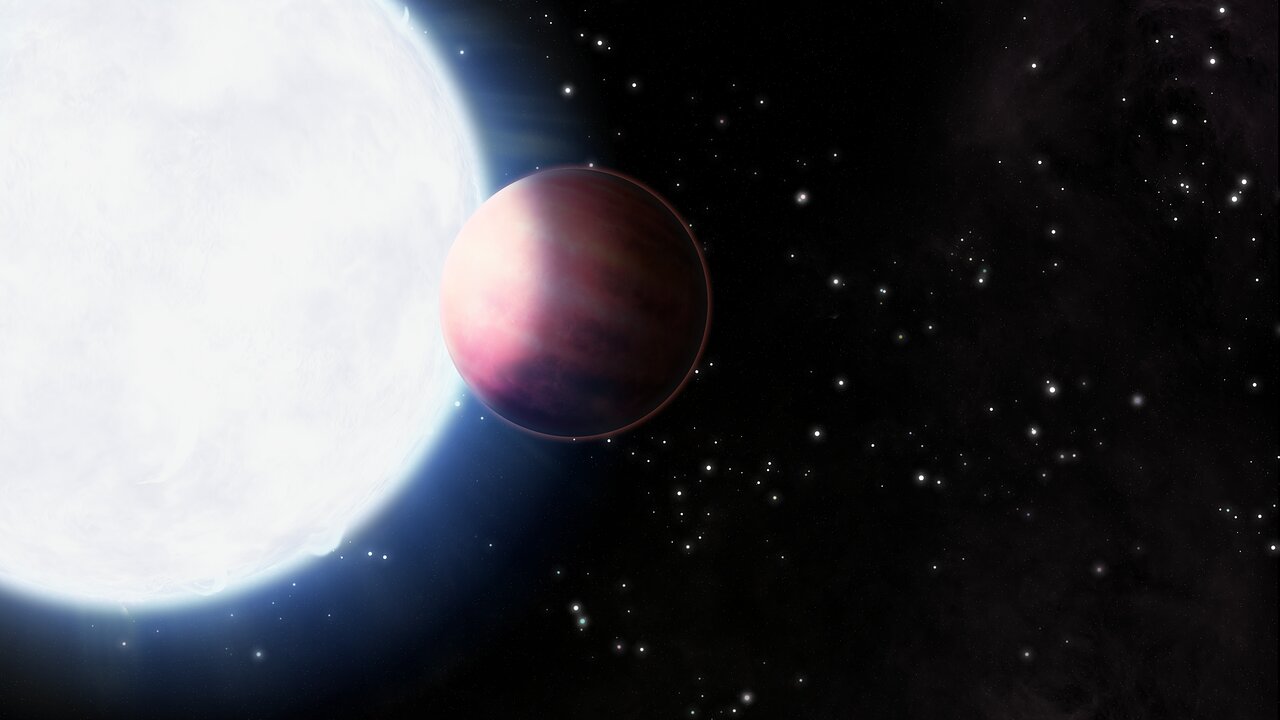
The exoplanet attracted the attention of astronomers due to the extreme characteristics of its orbit. It passes at a distance of only 2.67 million km from the surface of the star. By comparison, Mercury never comes closer than 46 million km to the Sun. TOI-2109b completes one orbit around its star in just 16 hours. To date, this is the shortest orbital period among all known ultra-hot gas giants.
Due to its proximity to the star, the atmosphere of TOI-2109b is heated to extreme temperatures. According to astronomers’ estimates, the temperature on its daytime side reaches 3,360 °C, which is higher than the surface temperature of many stars. The night side of TOI-2109b is approximately a thousand degrees colder.
Three scenarios for the death of the gas giant
Nothing good awaits TOI-2109b in the future. After analyzing data on its transits collected by ground-based telescopes and the TESS and CHEOPS satellites between 2010 and 2014, astronomers discovered slight changes in the exoplanet’s orbit.
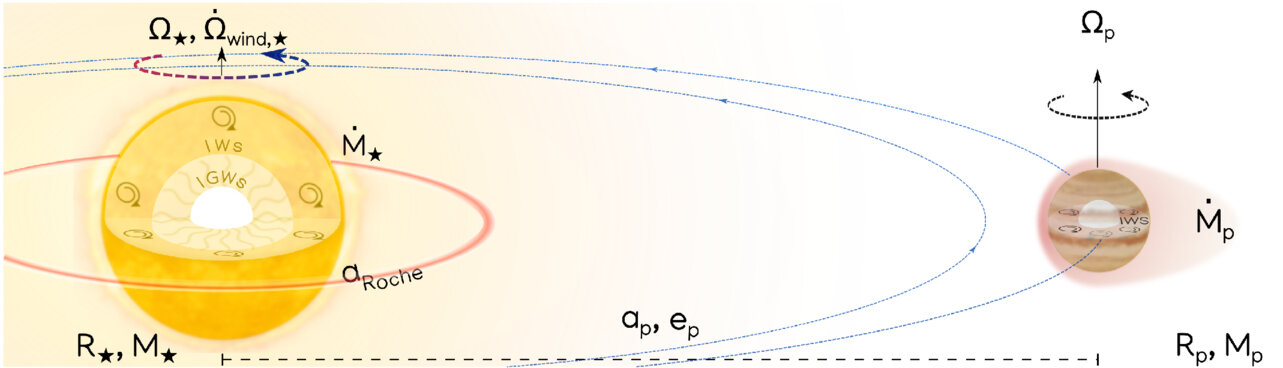
Both theoretical models and observations independently show that the orbital period of TOI-2109b will decrease by at least 10 seconds over the next three years. This confirms the assumption that the exoplanet is gradually approaching its star in a spiral.
Researchers have identified three possible outcomes for TOI-2109b: it could be torn apart by tidal forces, plunge directly into its star, or lose its gas envelope entirely under the influence of intense radiation, leaving only a rocky core. Astronomers suggest that some rocky exoplanets in other star systems may be the stripped cores of former gas giants that underwent a similar process.
In the coming years, astronomers intend to continue observing TOI-2109b to confirm the predicted orbital changes. This may clarify the future fate of a world in agony.
Earlier, we reported on another doomed exoplanet that would be torn apart by its star.
According to Phys.org

