

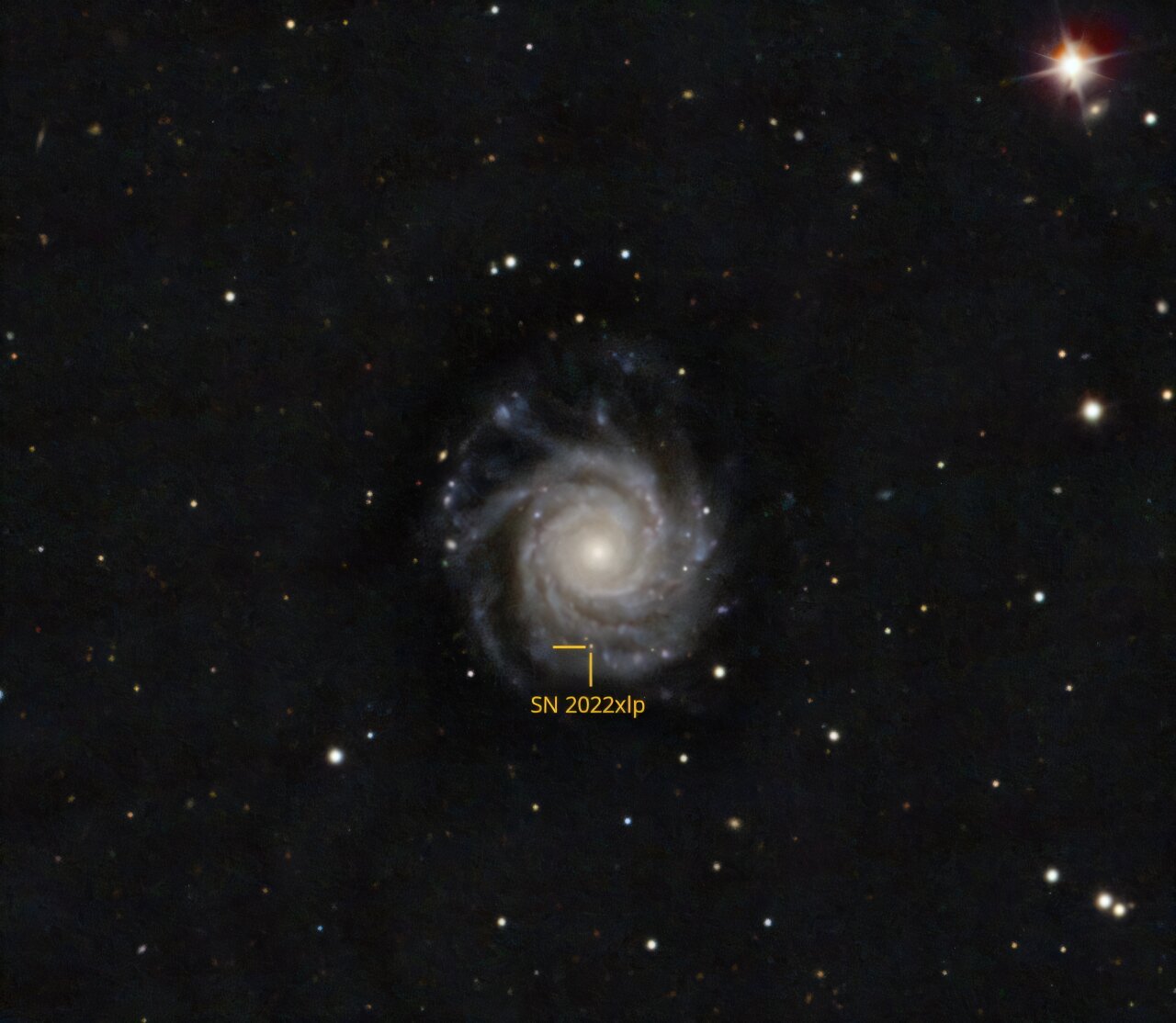
Scientists have discovered a new supernova explosion, SN 2022xlp. It belongs to the rare Iax class. It is characterized by the fact that the star, which is the companion of a white dwarf in a binary system, survives this explosion.
What is a type Iax supernova?
An international group of astronomers conducted detailed multicolor photometric and spectroscopic observations of SN 2022xlp, a type Iax supernova. Type Ia supernovae (SN Ia) are usually found in binary systems in which one of the stars is a white dwarf. Star explosions of this type are important to astronomers because they can provide important clues about the evolution of stars and galaxies.
Type Iax supernovae are a very rare subtype of SN Ia, which leave behind the remains of a star rather than completely dispersing the white dwarf. In general, they are similar to type Ia supernovae, but have a lower ejection velocity and lower luminosity.
SN 2022xlp is a supernova discovered in 2022 that exploded in the galaxy NGC 3938, located about 72.2 million light-years away. Based on the first spectrum obtained for SN 2022xlp, the supernova was classified as a type Iax supernova. SN 2022xlp reached a peak absolute magnitude of −16.04, making it the second identified Iax supernova of medium brightness.
Spectroscopic studies of supernova SN 2022xlp
Given that this is a rare luminosity range for SNe Iax, a group of astronomers led by Dominik Bánhidi from the University of Szeged in Hungary decided to conduct photometry and spectroscopy of this supernova using various ground-based and space telescopes to obtain more information about its properties.
Observations began six days after the explosion and continued for 73 days. The collected images, together with archival data, show a relatively rapid evolution of color due to a decrease in the temperature of the photosphere at an early stage. The change in color indexes amounted to approximately 1.5 mAh between eight days before the explosion and 20 days after it.
By analyzing the light curve properties, color evolution, and spectral features of SN 2022xlp, astronomers found that it was very similar to SN 2019muj, the first known medium-luminosity Iax supernova. Moreover, by comparing the color evolution of different bright SNe Iax, they found that the amplitude of color change was larger for brighter Iax supernovae.
The study also revealed that the estimated bolometric flux of SN 2022xlp peaks at 887 duodecillion erg/s and indicates the formation of approximately 0.02 solar masses of radioactive nickel. The energy of the supernova explosion was calculated to be approximately 20 quindecillion ergs, and the mass of the ejection was estimated at 0.14 solar masses.
According to phys.org

