

An international team of scientists has made a breakthrough in solving one of the main mysteries of modern cosmology—the speed of the expansion of the Universe. Researchers have proven that an innovative modeling method can significantly improve the accuracy of measuring the Hubble constant, a fundamental value that determines the rate of this expansion.
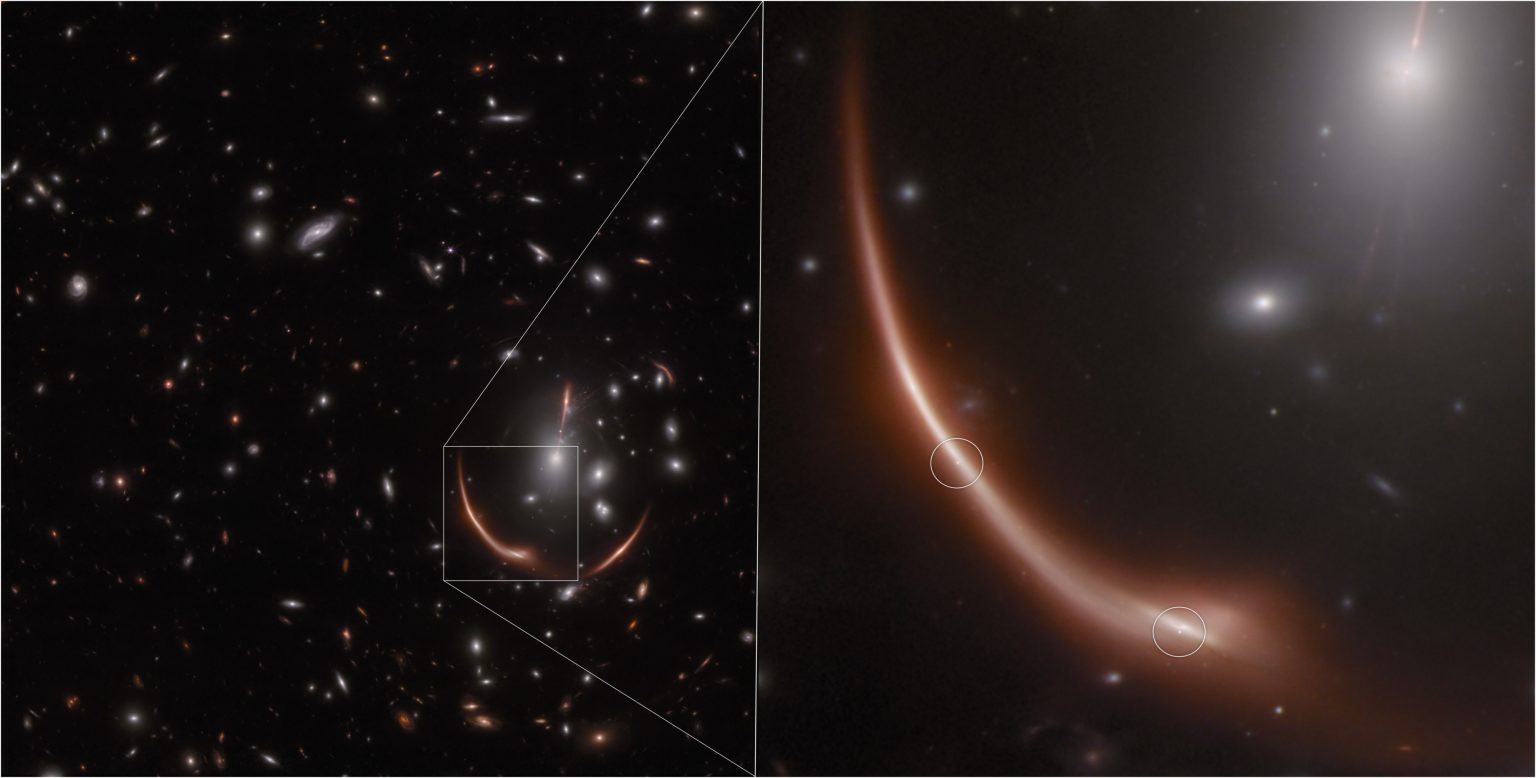
The Hubble constant (H0) is the basis of modern cosmology. It determines how fast galaxies are moving away from each other. However, there is a serious problem: measurements of the expansion rate in the early Universe, based on relic radiation data, and in the modern Universe, based on observations of supernovae, give different results. This contradiction, known as the ‘H0 tension,’ points to the possible need for new physics or more accurate measurement methods.
How can we weigh a galaxy using a telescope?
One of the most promising ways to independently measure H0 is to use the phenomenon of gravitational lensing. Massive clusters of galaxies, like cosmic lenses, bend the light passing through them. If a supernova flares up behind such a cluster, its light can reach us in several different ways, creating multiple images. These images appear with a slight time delay, which directly depends on the Hubble constant.
However, the accuracy of this method is limited by our ability to accurately model the mass distribution in the lensing cluster. It is like trying to determine the shape of a crystal ball by looking only at the distorted images behind it.
Revolution in detail – pixel modelling
Scientists from the Shanghai Astronomical Observatory have proposed a radical solution: pixelated modelling. Traditional methods only analysed the position of supernova images. The new technique uses all the information encoded in the brightness of each pixel on so-called ‘arcs’ – distorted images of the source.
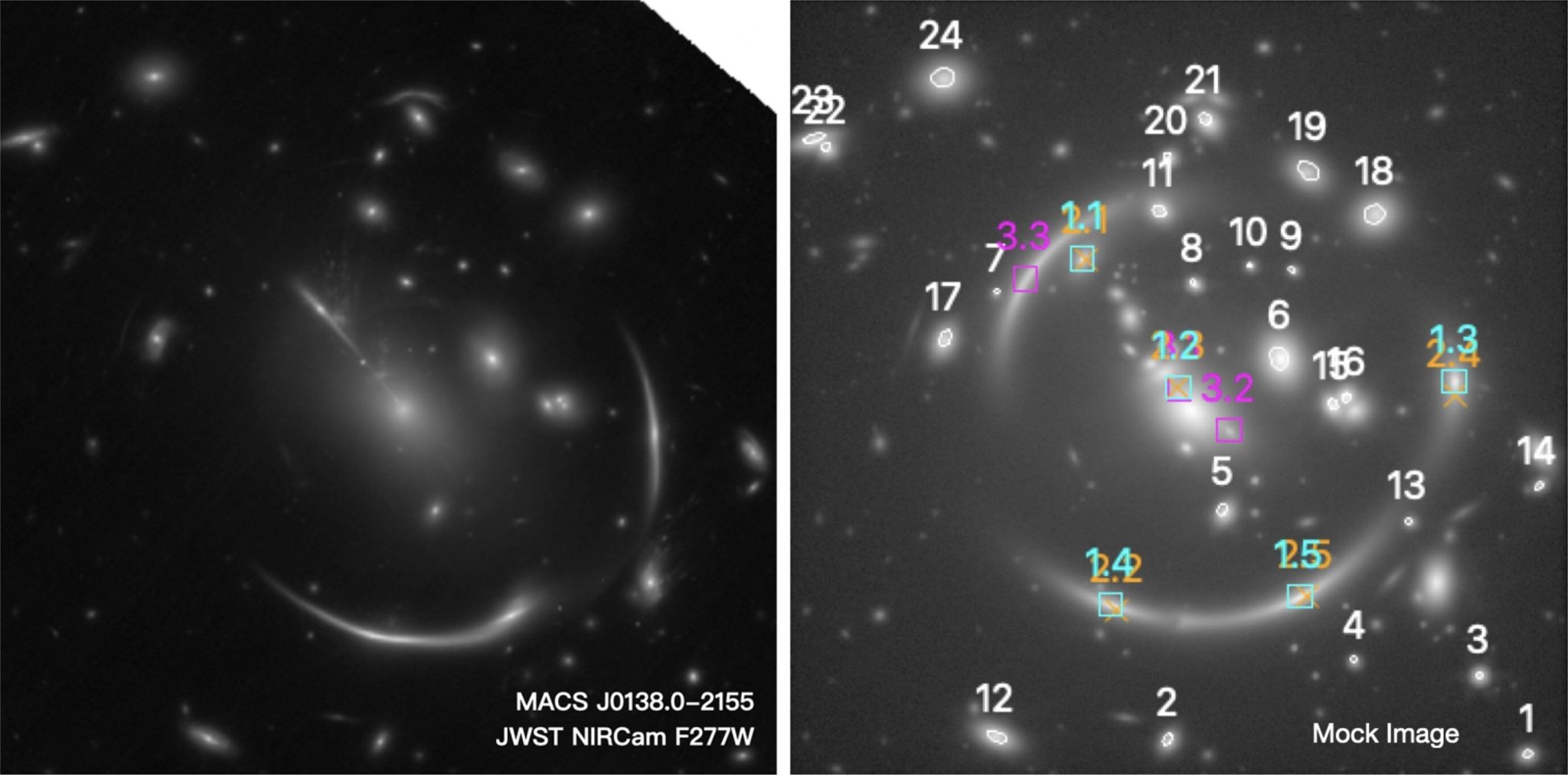
A comparison of methods using the example of the supernova Requiem in the galaxy cluster MACS J0138.0-2155 showed impressive results. While traditional modelling produced significant errors, the pixelated method reduced the uncertainty in determining H0 to just ±0.8 km/s/Mpc, increasing accuracy more than tenfold.
Future of precise space measurements
This work opens a new era in cosmology. With the advent of instruments such as the James Webb Space Telescope (JWST), similar analyses will be possible for dozens of similar systems. Scientists are already modelling future discoveries by the Vera Rubin Observatory and the Chinese Space Telescope CSST. The latter, combined with the new methodology, is theoretically capable of measuring the Hubble constant with incredible accuracy to within 0.1 km/s/Mpc.
Thus, the combination of powerful new telescopes and advanced data analysis methods brings us closer to unravelling a fundamental mystery – the true rate of expansion of our Universe.
Earlier, we reported on how Edwin Hubble discovered the expansion of the Universe.
According to Phys

