

In 2019, the world saw the first real image of the M87* black hole – a revolutionary achievement of the Event Horizon Telescope (EHT) collaboration. This milestone launched a series of new studies aimed at unraveling the mysteries of these cosmic giants. Now, after major upgrades, the EHT network is back with even more sensational news: scientists have found the first-ever evidence of previously unknown dynamic physics at the very edge of a giant black hole. The detailed results of the study are published in the journal Astronomy & Astrophysics.
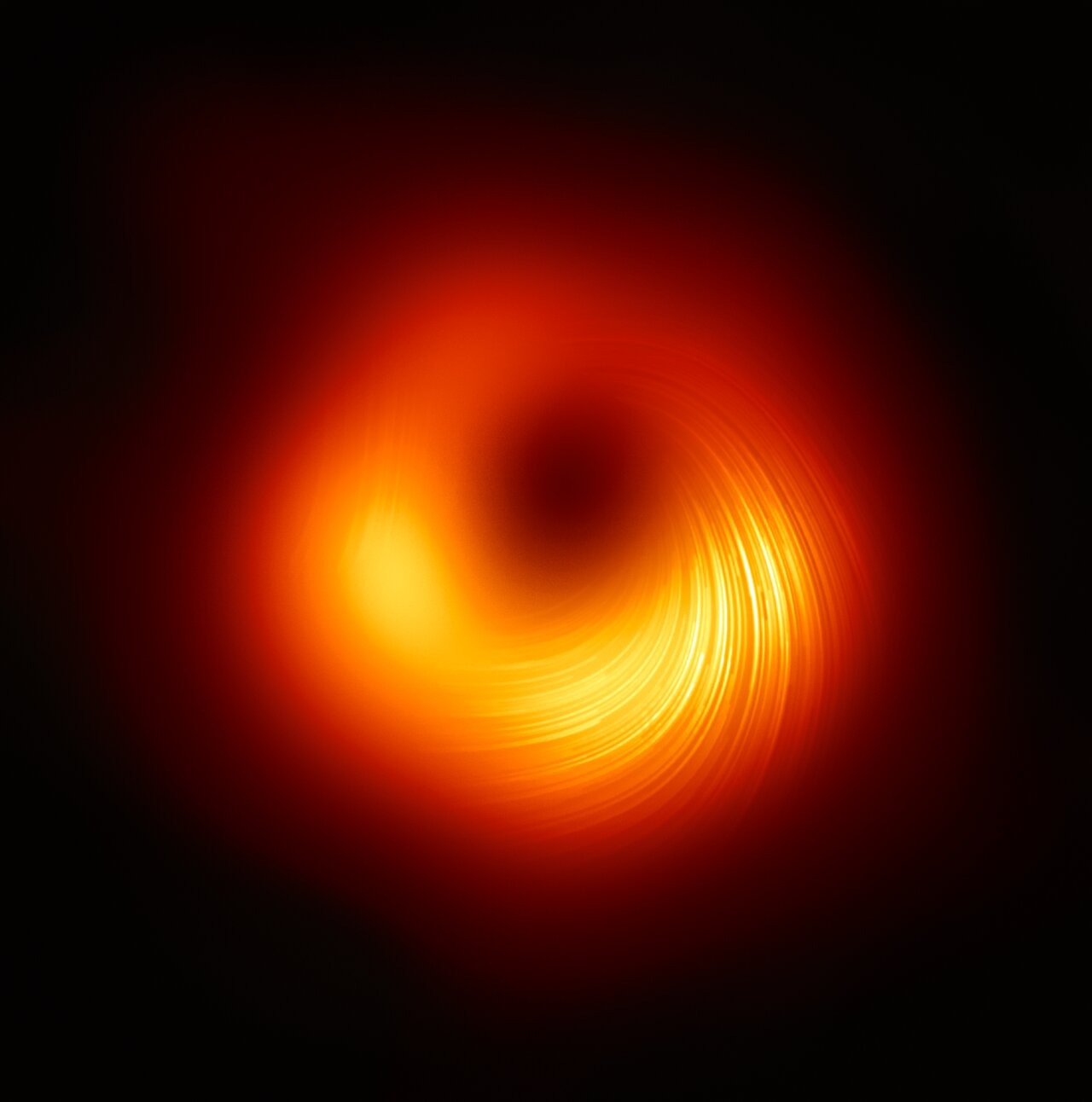
Analyzing a series of images obtained between 2017 and 2021, EHT scientists discovered striking changes. Scientists recorded a dramatic change in polarization – the orientation of light waves that indicates the structure of magnetic fields around M87*. This indicates that the environment around the event horizon is far from static. It is incredibly turbulent and dynamic, with magnetic fields acting as a key regulator: they control how matter falls into the abyss and how enormous energy is released outward in the form of powerful plasma jets.
Challenge to modern science
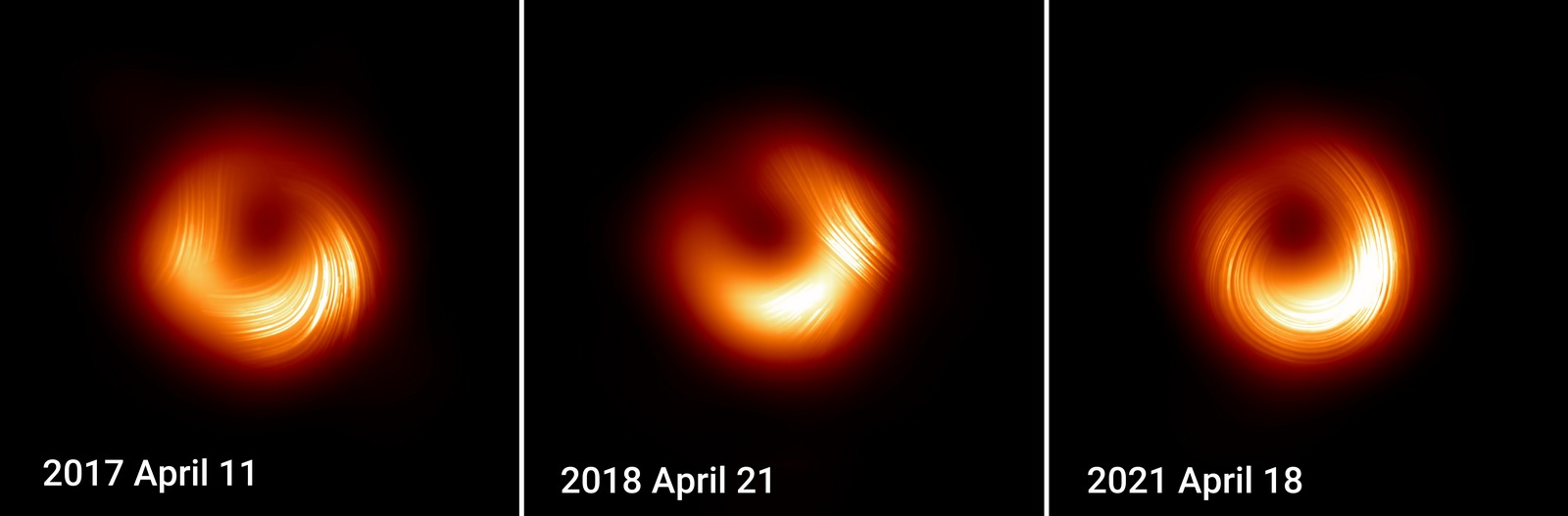
The most surprising thing is that the size of the characteristic bright ring around the black hole’s shadow remained stable, which fully confirms Einstein’s predictions in his General Theory of Relativity. However, the pattern of its polarization showed sharp changes. In 2017, it turned sharply, and by 2021, it had already begun to move in a new direction. This magnetic “carousel” calls into question current theoretical models. As the researchers note, the magnetized plasma near the event horizon is so dynamic and complex that it directly indicates the presence of previously unknown physical processes.
The key to cosmic mysteries
The discovery is of fundamental importance. Extremely massive black holes, such as M87*, which is 6.5 billion times more massive than the Sun, play a crucial role in the evolution of galaxies, influencing star formation and energy distribution in the universe. The powerful relativistic jets that erupt from them serve as unique natural laboratories for studying the most energetic phenomena, including gamma-ray bursts and neutrinos.
The new EHT data provide the most detailed view of these processes to date, offering invaluable clues to understanding our place in the cosmos.
Earlier, we reported on how we obtained the most detailed photograph of a black hole jet.
Provided by: eventhorizontelescope.org

