

Brown dwarfs are objects that occupy an intermediate position between stars and giant planets. They are usually depicted as very similar to the latter. However, recent research shows that their atmospheres may be different from what we know from Jupiter.
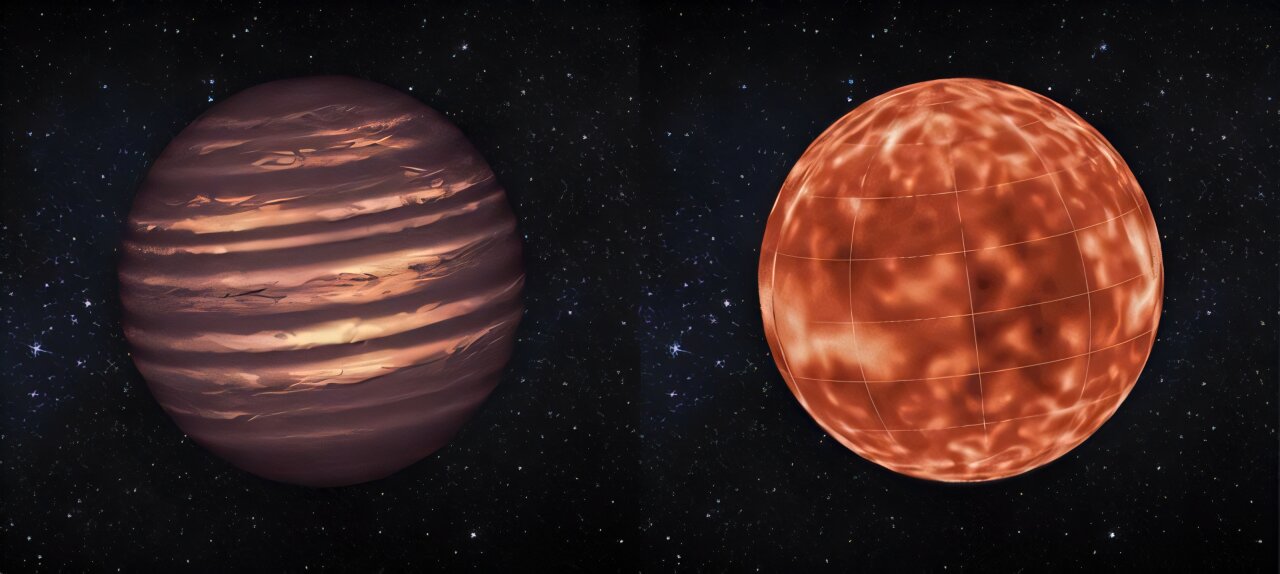
Brown dwarfs
For several decades, scientists imagined brown dwarfs as something similar to Jupiter. However, new research conducted by scientists from Shanghai University may overturn this view. It is based on data from the James Webb Telescope.
It’s all about what brown dwarfs are. They are objects consisting mainly of hydrogen and helium, but they are not massive enough for thermonuclear reactions to occur on them. At least, these reactions occur there for a fairly limited time. The rest of the time, they slowly cool down.
At the same time, brown dwarfs are at least ten times heavier than Jupiter, but not much larger. And since their temperature and chemical composition are also not very different, they are usually depicted in illustrations as something not very different from the largest planet in the Solar System.
And on Jupiter, despite the existence of the Great Red Spot, the main direction of the winds is still determined by the planet’s rotation, meaning that they mainly blow from east to west. This creates the well-known striped pattern.
Dust storms
And now a study has been published that casts doubt on the image of a brown dwarf as a striped ball. The new model suggests that under certain conditions, truly grandiose gas and dust storms can occur in its atmosphere. This means that the overall picture will be very different from what we see on Jupiter.
And this is where the James Webb Space Telescope comes in. This time, it has set its sights on the brown dwarf VHS 1256B. It belongs to the “warm” category, meaning that the temperature in its atmosphere is above zero degrees Celsius.
Long-term observations of this brown dwarf show temporary changes in brightness. At the same time, modeling shows that this pattern may be caused by storms occurring in its atmosphere. Simply put, dust blocks the heat emitted from the brown dwarf, and powerful waves roll from its equator to its poles. Calculations show that this pattern is typical for all sufficiently hot brown dwarfs.
According to phys.org

