

Thanks to the Gemini North telescope, astronomers have solved a thousand-year-old mystery: they have confirmed the existence of Betelgeuse’s previously predicted companion. This discovery provides an answer to the long-standing mystery of the star’s variable brightness and sheds light on the physical mechanisms underlying other variable red supergiants.
Betelgeuse’s elusive companion
Betelgeuse is one of the brightest stars in the night sky and the closest red supergiant to Earth. Despite being only ten million years old, which is not very long in astronomical terms, it is already nearing the end of its life. Betelgeuse has exhausted its hydrogen fuel reserves and expanded. Its radius is now 700 times greater than that of the Sun.
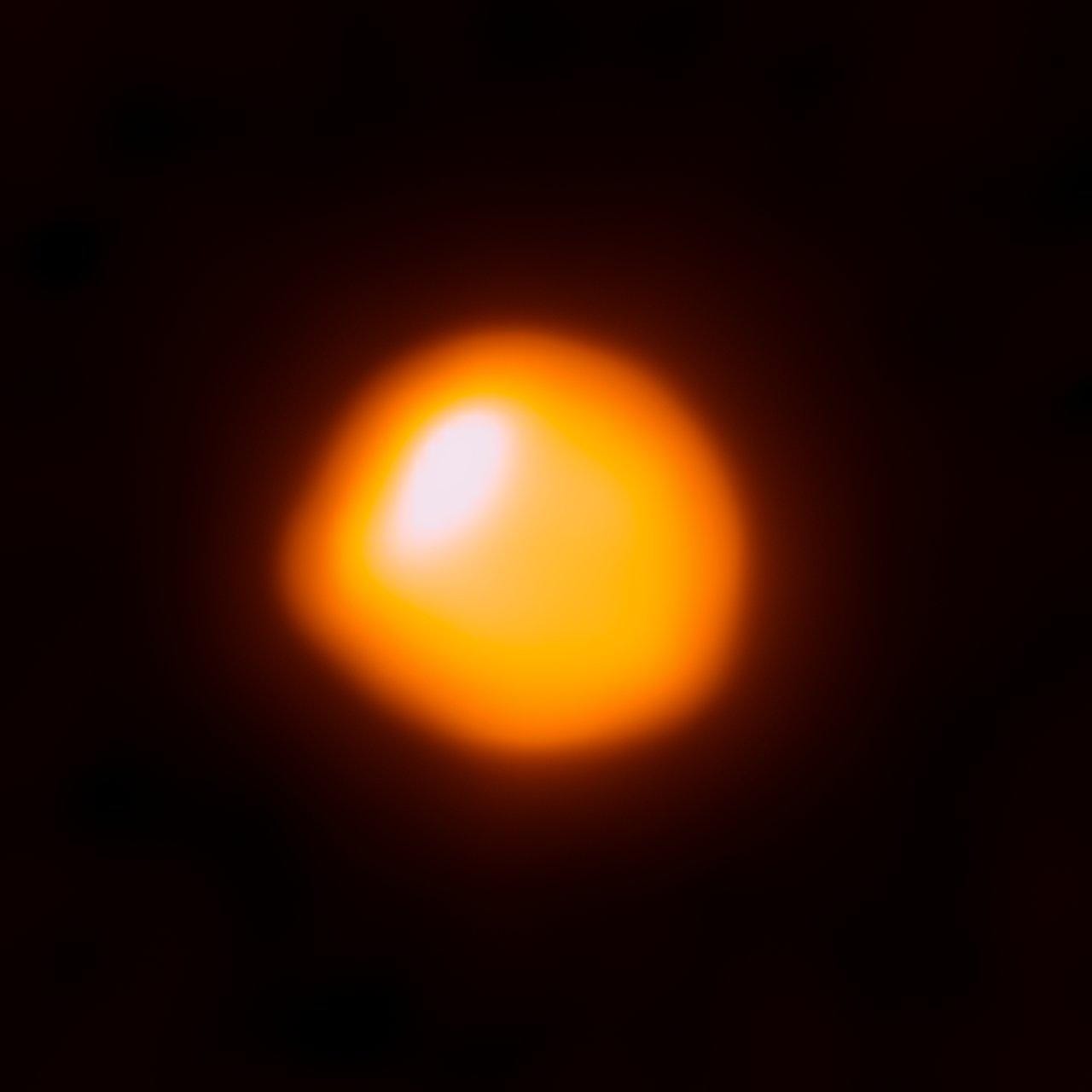
Located in the left “shoulder” of the Orion asterism, Betelgeuse is clearly visible to the naked eye. Over thousands of years of observation, it has been noted that its brightness changes over time. Astronomers have determined that Betelgeuse has a primary period of variability of about 400 days and a longer secondary period of about six years.
In 2019 and 2020, there was a sharp decrease in the brightness of Betelgeuse — an event that became known as the “Great Dimming.” This event led some to believe that the star would soon explode. However, scientists were later able to determine that the dimming was actually caused by a large cloud of dust ejected from Betelgeuse.
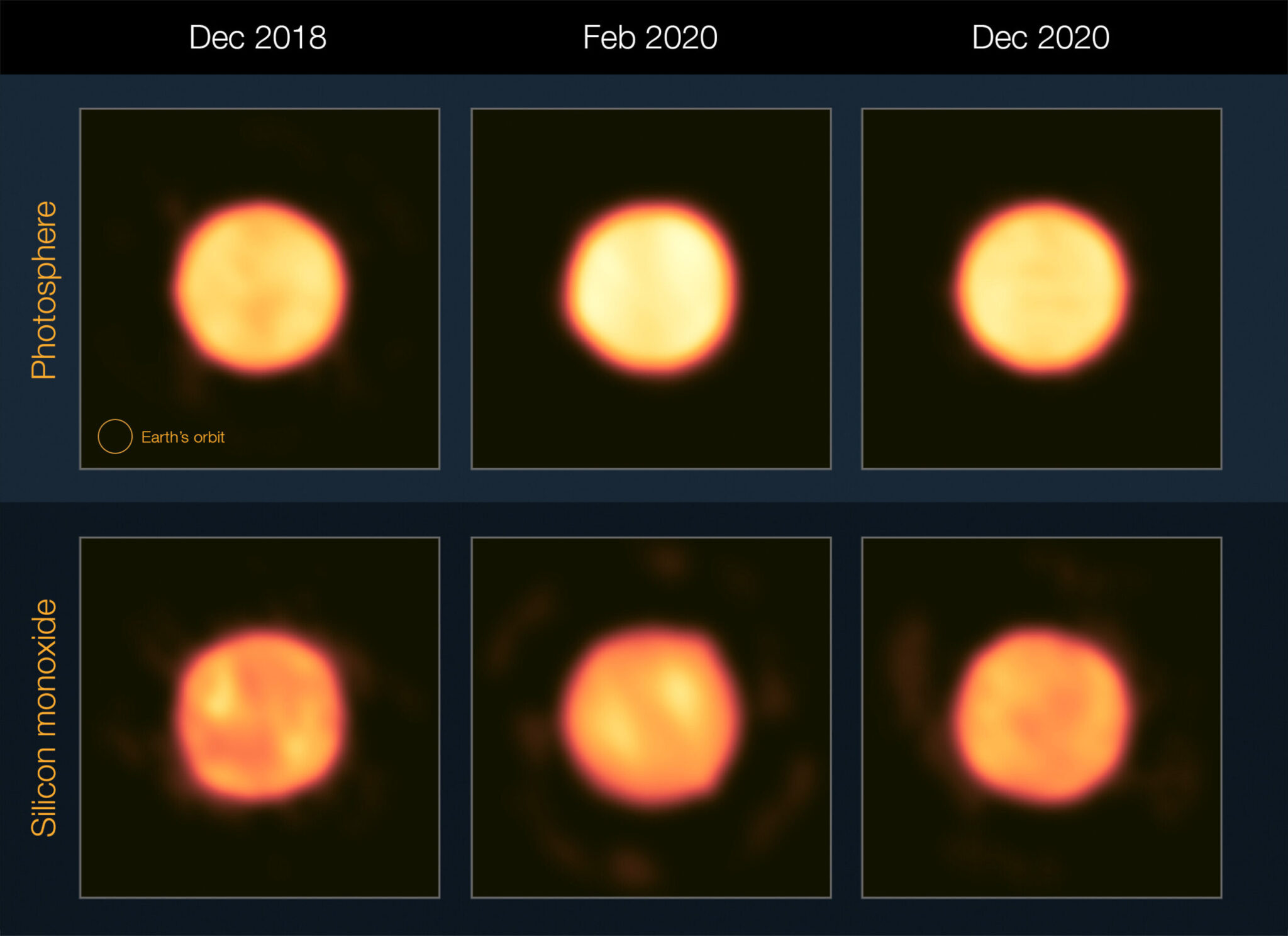
The mystery of the Great Dimming has been solved, but this event sparked renewed interest in studying Betelgeuse, leading to new analyses of archival data on the star. One of them led scientists to conclude that the cause of Betelgeuse’s six-year variability is the presence of a companion star. But when the Hubble Space Telescope and the Chandra X-ray Observatory attempted to detect it, they were unsuccessful.
Doomed Star
The mystery of Betelgeuse’s companion was finally solved with the help of the 8.1-meter Gemini North telescope located in Hawaii. A team of astronomers from NASA’s Ames Research Center conducted a series of observations of the giant star using the Alopeke speckle interferometer mounted on Gemini North.
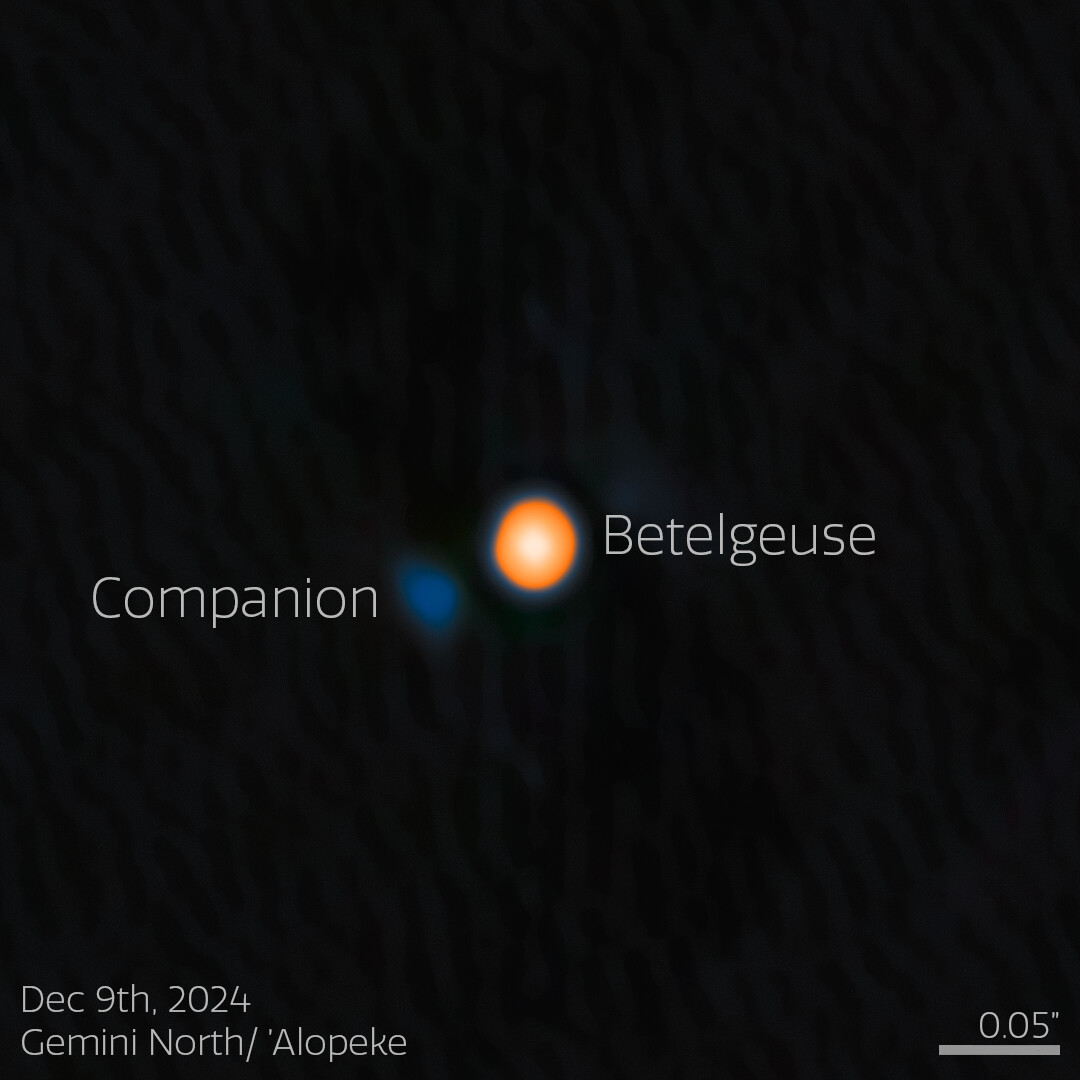
Speckle interferometry is an astronomical imaging technique that uses very short exposure times to “freeze” distortions in images caused by the Earth’s atmosphere. This technique provides high resolution, which, combined with the light-gathering capabilities of Gemini North’s 8.1-meter mirror, made it possible to directly detect Betelgeuse’s faint companion.
Analysis of the light allowed scientists to determine the characteristics of the star. It is six magnitudes fainter than Betelgeuse in the optical wavelength range, and its mass is approximately 1.5 times that of the Sun. Apparently, it is a hot, young, blue-white star, the core of which has not yet begun to burn hydrogen.
The companion’s orbit passes relatively close to the surface of Betelgeuse: approximately four times the distance between Earth and the Sun. It passes through the outer layers of the supergiant’s atmosphere. According to researchers, this is the first time a close stellar companion orbiting such a star has been detected.
The discovery provides a clearer idea of the life and future of this system. Betelgeuse and its companion were probably born at the same time. However, the companion will survive much less than its allotted time. Strong tidal forces cause it to move in a spiral toward Betelgeuse. According to scientists’ estimates, in just 10,000 years, the star will be swallowed up and destroyed. This discovery also helps explain why such red supergiants can periodically change their brightness over many years.
According to NOIRLab

