

Using the James Webb Space Telescope (JWST), astronomers have studied a supernova progenitor star in the mid-infrared range for the first time. Observations showed that it was a red supergiant hidden by a thick layer of dust. This discovery may help solve a mystery that has puzzled astronomers for many years.
Missing red supergiants
Modern models predict that red supergiants should account for the majority of supernovae resulting from core collapse. And since such stars are the brightest and most luminous objects in the sky, theoretically they can be easily detected before they explode. But in reality, this is not the case.
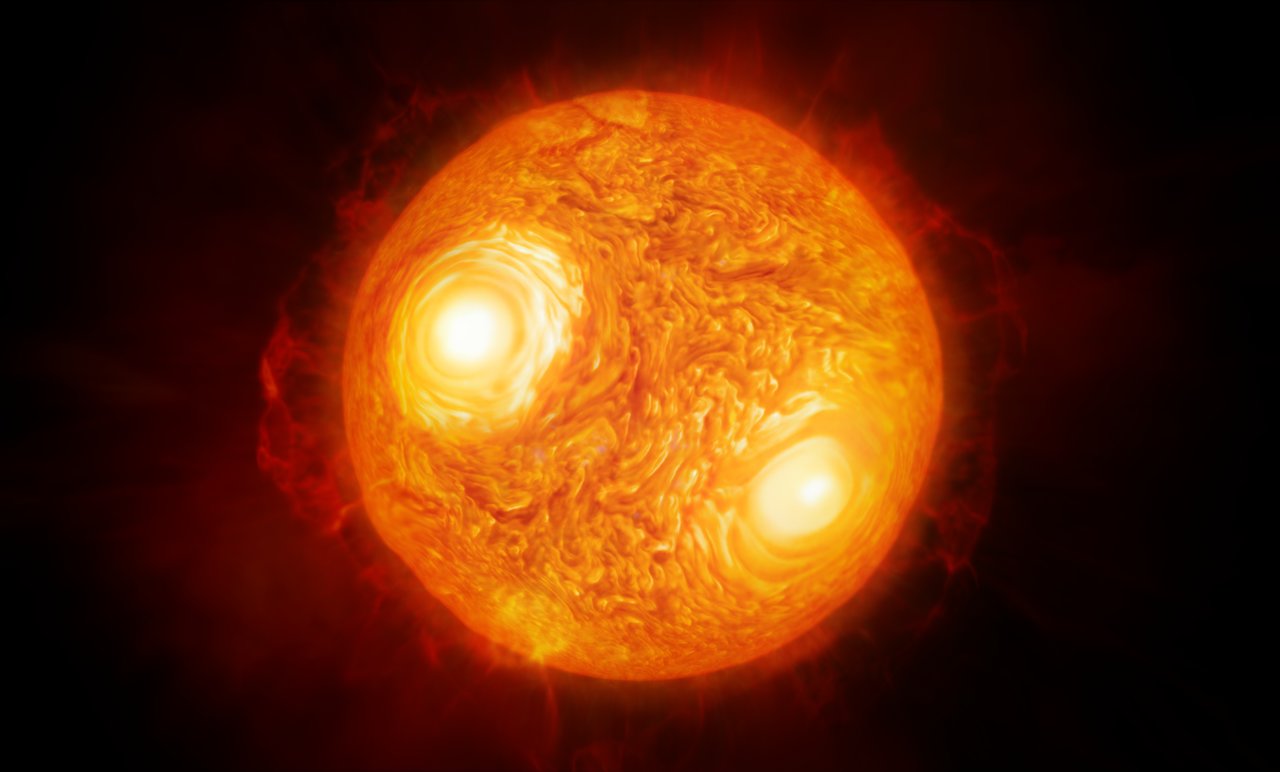
To explain this contradiction, a hypothesis was put forward that the most massive aging stars may also be the dustiest. These thick layers of dust can obscure their light to such an extent that such objects become completely impossible to detect.
The opportunity to test this hypothesis arose after the JWST, an instrument that conducts observations in the infrared range, was put into operation. Unlike visible light, infrared radiation passes through dust clouds much more easily. After launching the telescope, astronomers waited for a supernova explosion in the galaxy, which JWST had already observed.
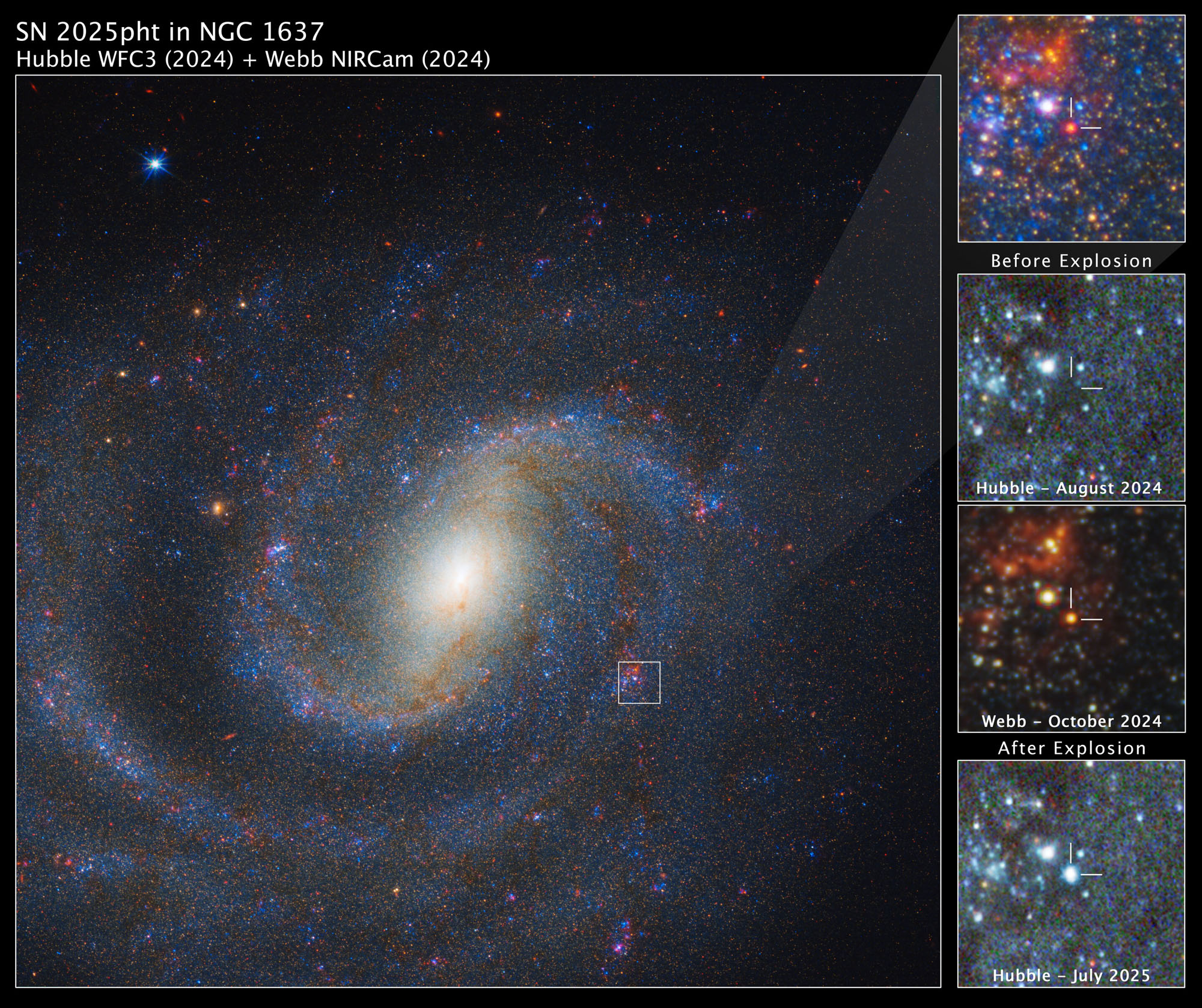
This occurred on June 29, 2025, when a supernova exploded in the galaxy NGC 1637, located 40 million light-years from Earth. It was designated SN2025pht.
Very dusty and very red star
By comparing images of NGC 1637 taken by Hubble and JWST before and after the explosion, scientists discovered the progenitor star of the supernova. It immediately attracted attention, being extremely bright and incredibly red. At the same time, although the star shone about 100,000 times brighter than our Sun, the dust surrounding it blocked most of the light it emitted. The dust curtain was so dense that the star appeared more than 100 times dimmer in visible light than it would have been without the dust. And because the dust blocked shorter, bluer wavelengths of light, the star also appeared surprisingly red.
In addition to the presence of dust, its composition was also surprising. While red supergiants typically produce oxygen-rich silicate dust, the dust from this star turned out to be carbon-rich. This suggests that powerful convection in the final years of the star’s life may have pulled carbon from its interior, enriching its surface and changing the type of dust it produces.
According to researchers, JWST data proves that red supergiants really explode. They are simply hidden from us in thick clouds of dust. In addition, because of this factor, previously observed supernova explosions may have been much brighter than previously thought.
Scientists are now searching for similar red supergiants that could become supernovae in the future. They have high hopes for the new Roman telescope, which NASA plans to launch next year. It will have sufficient resolution, sensitivity, and infrared coverage necessary for observing such stars.
According to Phys.org

