

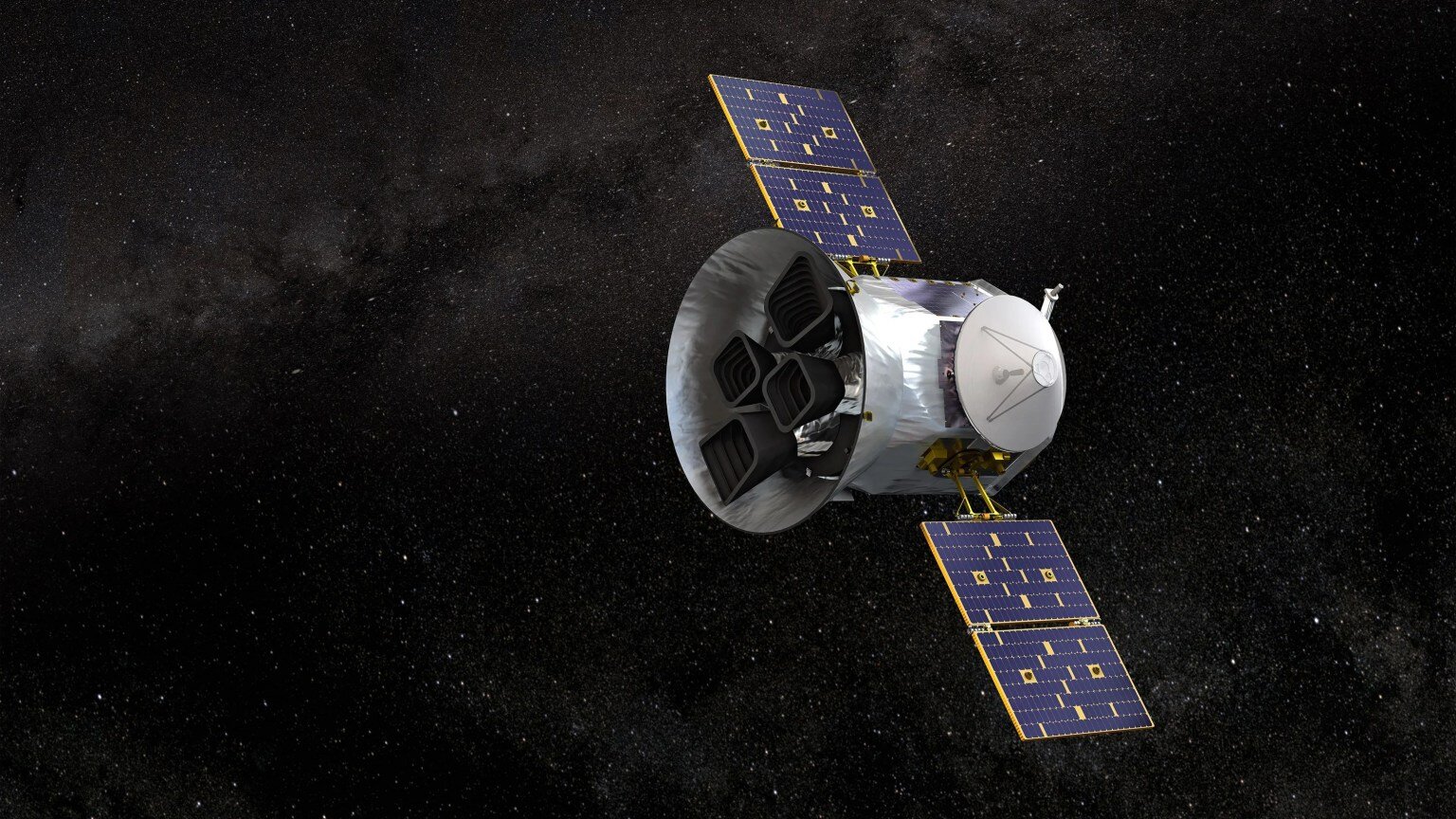
The TESS space telescope has allowed scientists to get a close look at the triple star system TIC 295741342. It turns out that the relative positions of its components allow not only ordinary eclipses but also double eclipses to occur from time to time.
Double eclipses
When two stars of different sizes and luminosities orbit in the same plane as the line of sight from them toward Earth, we can occasionally observe one of them eclipsing the other, causing the system’s luminosity to drop sharply. However, a study recently appeared on the arXiv preprint server describing a system in which double eclipses can occur.
We are talking about the star system TIC 295741342. It was previously known as a binary system, but scientists recently used the TESS space telescope to discover that there is a third component. And it is precisely this that makes double—or, one might say, two-stage—eclipses possible in this system.
Overall, the TIC 295741342 system is as follows: two stars, each of which is roughly the same size, mass, and luminosity as the Sun. They orbit each other with a period of 4.75 days. A third star also orbits around their common center of mass. Its mass is 1.7 times that of the Sun, and it is 10.6 times larger than our star.
The star is located at an average distance of 1.7 AU from the first pair and completes one orbit in 1.13 Earth years. Overall, the system is located 3,080 light-years away from us, and its age is estimated at 1.46 billion years.
Double eclipses
The system TIC 295741342 also experiences ordinary eclipses. These occur when one member of the close binary pair aligns between the other member and Earth. In such cases, scientists observe a sharp decrease in the amount of light from the system: its brightness drops for a certain period of time and then returns to normal levels.
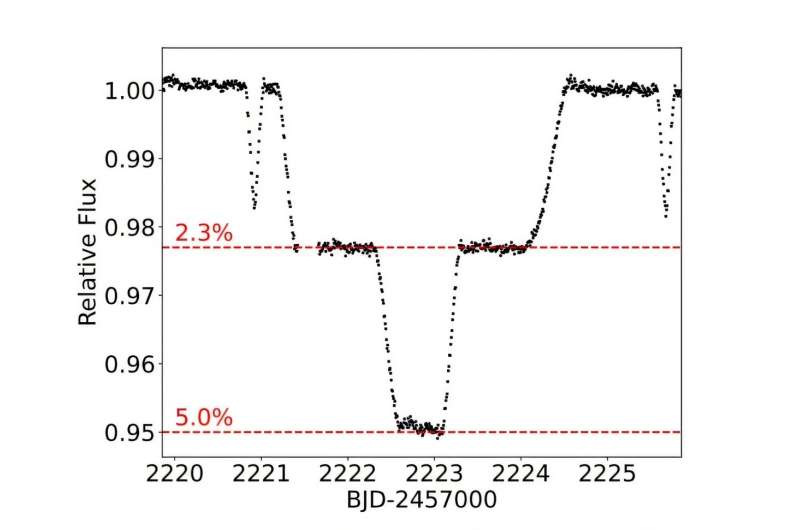
But what happens when a massive, cold star comes between the pair mentioned above and us? Scientists have observed this with their own eyes. First, the first star in the pair is obscured by it, causing a drop in brightness that closely resembles a simple eclipse.
Then the second star disappears as well, and while both stars are eclipsed by the third, there is an even more dramatic drop in brightness. Subsequently, the first star reappears on the other side, which again resembles a single eclipse. Then the second star reappears, after which the brightness returns completely to normal.
Overall, there are quite a few triple star systems in space. So why are such eclipses so rare? Astronomers explain that the reason they are possible in the TIC 295741342 system is that all three components orbit in the same plane, which also contains the line of sight of observers on Earth. It is precisely this that allows the stars to align along it from time to time.
Scientists attribute this feature of the system to the fact that it once formed from a single protoplanetary disk that broke apart into three parts.
According to phys.org

