

When Jupiter was born, the Solar System was still filled with large bodies called planetesimals. Under the influence of its gravity, they collided with each other and the molten rock formed perfectly round spheres called chondrules.
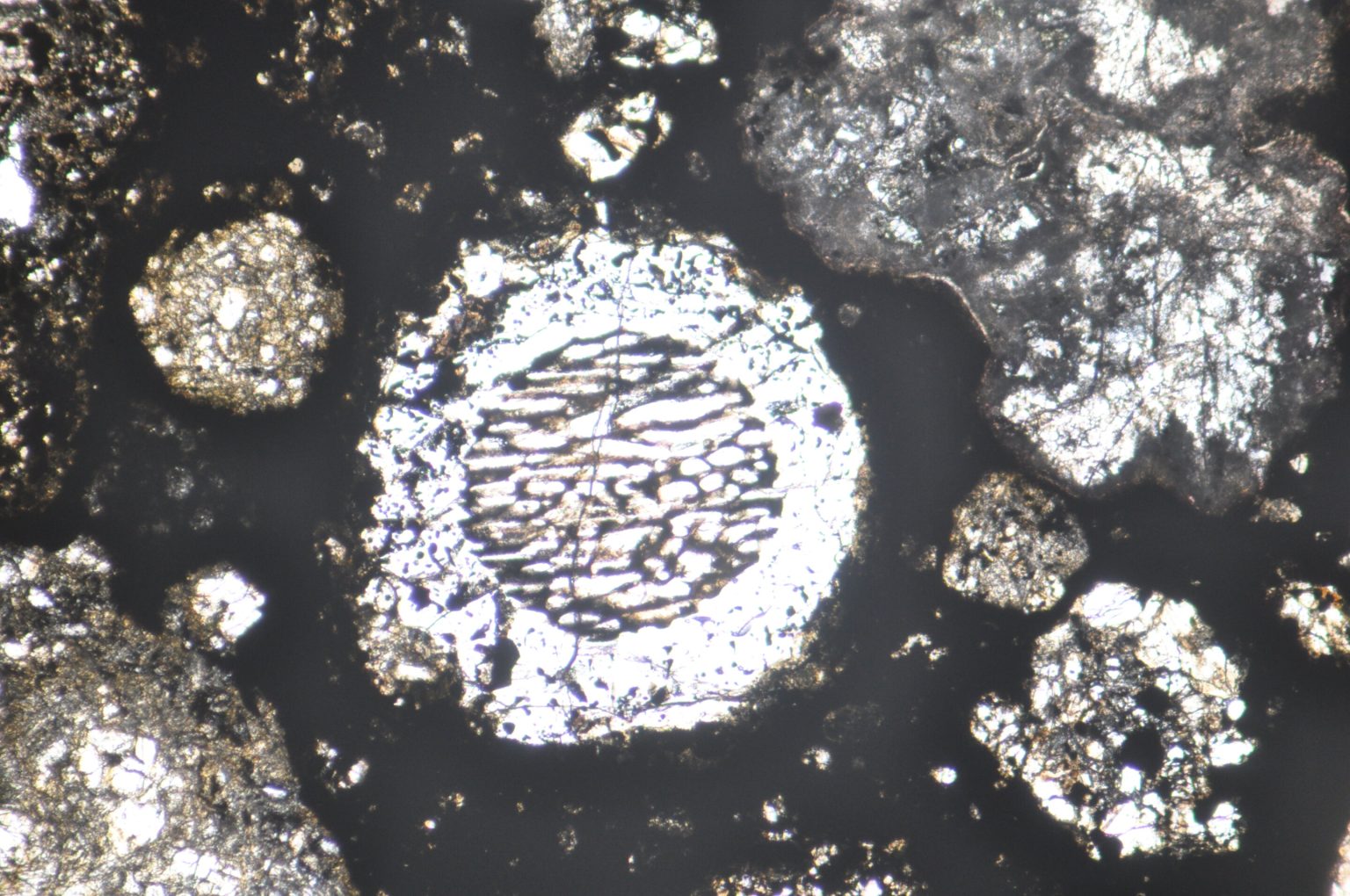
Formation of chondrules in the Solar System
Four and a half billion years ago, Jupiter rapidly grew to its enormous size. Its powerful gravitational force disrupted the orbits of small rocky and icy bodies similar to modern asteroids and comets, called planetesimals. This caused them to collide with each other at such high speeds that the rocks and dust they contained melted during the impact and formed floating droplets of molten rock, or chondrules, which we find today in meteorites.
Now, researchers from Nagoya University in Japan and the Italian National Institute for Astrophysics (INAF) have determined for the first time the formation of these droplets and, based on their findings, have accurately determined the date of Jupiter’s formation.
Their research shows how the characteristics of chondrules, specifically their size and cooling rate in space, are determined by the water contained in impacted planetesimals. This explains what we observe in meteorite samples and proves that the formation of chondrules was a result of planetary formation.
What did chondrules reveal about Jupiter’s age?
Chondrules, small spheres approximately 0.1–2 millimeters in diameter, were part of the asteroids when the Solar System was forming. Billions of years later, fragments of these asteroids broke off and fell to Earth as meteorites. How chondrules acquired their rounded shape remained a mystery to scientists for decades.
“When planetesimals collided with each other, water instantly vaporized into expanding steam. This acted like tiny explosions and broke apart the molten silicate rock into the tiny droplets we see in meteorites today,” explained co-author Professor Sin-iti Sirono of Nagoya University’s Graduate School of Earth and Environmental Sciences. “Previous formation theories couldn’t explain chondrule characteristics without requiring very specific conditions, while this model requires conditions that naturally occurred in the early solar system when Jupiter was born.”
Researchers developed computer models of Jupiter’s growth and tracked how its gravity caused rapid collisions between rocky and water-rich planetesimals in the early Solar System. The model showed that the formation of chondrules coincided with Jupiter’s intense accumulation of gas from the nebula, which allowed it to reach such enormous sizes. Since data on meteorites indicate that the peak of chondrule formation occurred 1.8 million years after the beginning of the Solar System, the same time that Jupiter was born.
A new method for determining the age of planets
This study provides a clearer understanding about the formation of our Solar System. However, the process of chondrule formation, which began with the formation of Jupiter, was too short to explain as to why we find chondrules of all ages in meteorites. The most likely explanation is that other giant planets, such as Saturn, also triggered the formation of chondrules during their birth.
Through studying chondrules of all ages, scientists can follow the order of the birth of planets and understand how our Solar System evolved over time.
The study also suggests that these violent planet-forming processes may occur around other stars and provides insight into how other planetary systems developed.
According to phys.org

