

Planets located within gas and dust disks are very difficult to detect. However, scientists have discovered a pattern that allows them to estimate the planets’ masses. They tested this hypothesis on several known systems.
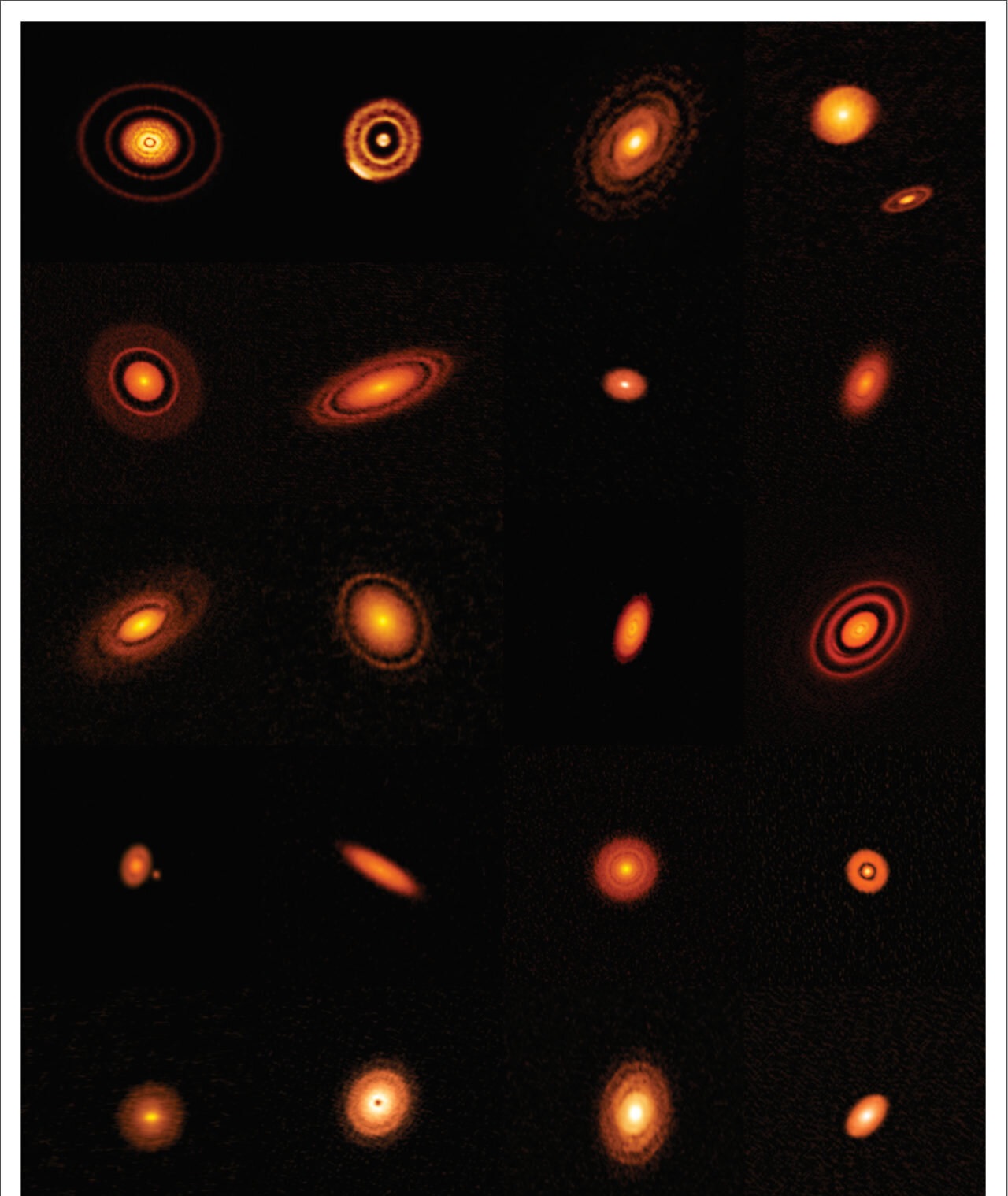
Gas-dust rings. Source: phys.org
Planets within gas and dust disks
Exoplanetary systems are generally well understood. However, there is still some uncertainty regarding the youngest of them—those that have literally just been born. Now, thanks to research conducted by scientists at the University of Warwick in collaboration with researchers from the Massachusetts Institute of Technology and McMaster University, this uncertainty can be resolved.
An article published in The Astrophysical Journal describes a new method for estimating a planet’s mass based on the characteristics of the gas-and-dust rings it generates. This applies to those star systems in which planets have already formed, but the protoplanetary disks still remain, and it is very difficult to make out the points of these newborn worlds amid all this scattered material.
However, scientists have long observed bright rings and arcs in protoplanetary disks and realized that these are dense regions forming at the edges of gaps that “gnaw” through nascent celestial bodies with their gravity. In a new study, scientists confirmed that the way these features are arranged and where their brightness peaks are located is closely linked to the characteristics of the planets.
Testing the theory
The new theory is based on mathematical modeling. Moreover, it relies on a relatively simple relationship between the ring’s brightness and the planet’s mass. However, it works. Scientists have already tested it on several young star systems, images of which were obtained using the ALMA telescope array.
Specifically, the researchers used the PDS 70 system for this purpose. It is one of the few systems where as many as three newborn planets have been directly observed in the disk. The scientists used a new method to calculate their masses, and the results matched what was known from previous studies.
These findings open up new possibilities for observing these disks, which will help confirm the existence of planets suspected to be hidden within them, discover entirely new ones, and shed light on the processes that may have played a role in the formation of our own solar system.
According to phys.org

