

An international research team has discovered supermassive black holes hidden by dust that existed less than a billion years after the Big Bang. This discovery shows that bright quasars were at least twice as common at that time as previously thought.
The mystery of supermassive black holes
In the modern universe, all galaxies have supermassive black holes at their centers, whose mass exceeds that of the Sun by millions or even billions of times. Most of the time, they are in a state of rest. But when they absorb surrounding matter, the accretion disks surrounding them become powerful sources of radiation. Such active black holes are called quasars.
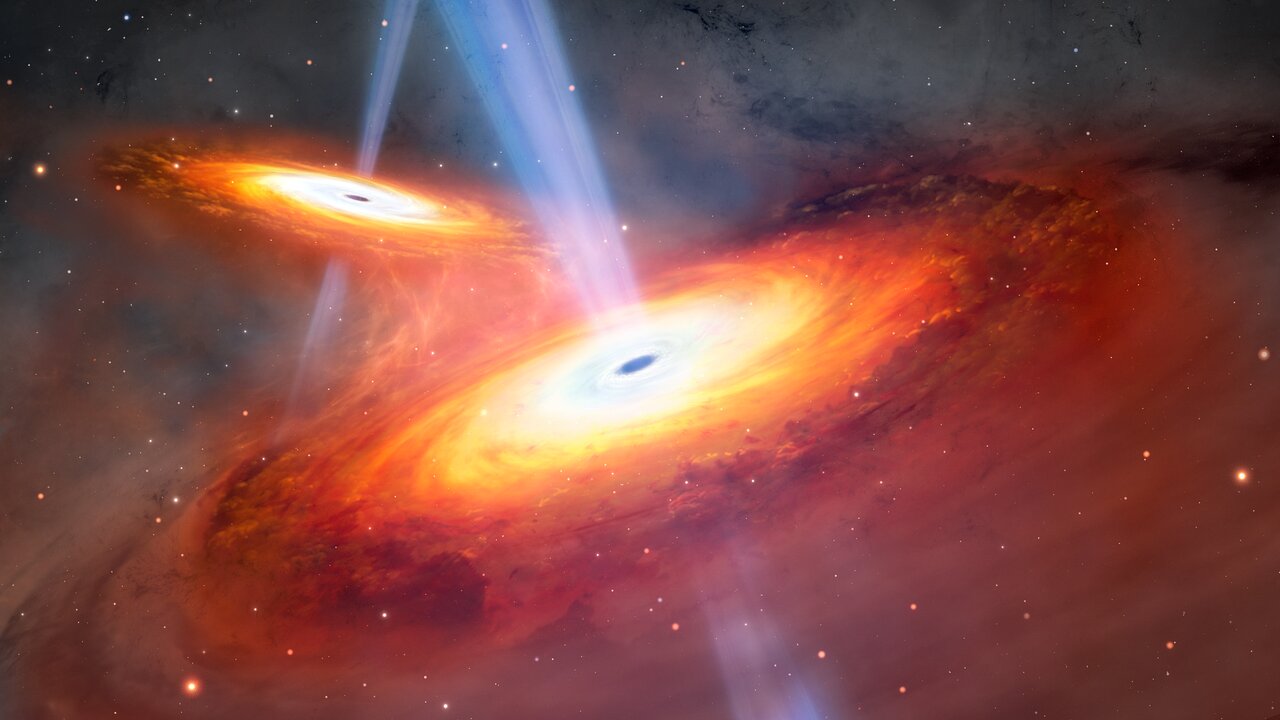
Despite the key role of supermassive black holes in the universe, their origin remains a fundamental mystery. Many supermassive black holes were discovered just 1 billion years after the Big Bang, which means that their formation must have occurred even earlier.
One way to find the answer to the question of the origin of black holes is to calculate the number of quasars per unit volume of space in the early universe. If this number is high, then they probably formed relatively frequently, possibly as remnants of first-generation stars. Conversely, a low numerical density suggests formation under special conditions, such as the direct collapse of massive objects (gas clouds) under the action of their own gravity.
In search of hidden black holes
In the past, scientists have already calculated the number of quasars, finding quite a few such objects. However, the search was hampered by the fact that many galaxies contain significant amounts of dust. When a quasar is located in such a galaxy, its radiation is largely absorbed and does not reach us. This led to the assumption that the quasars discovered in traditional studies represent only a small part of the actual population, while many others are hidden by dust.
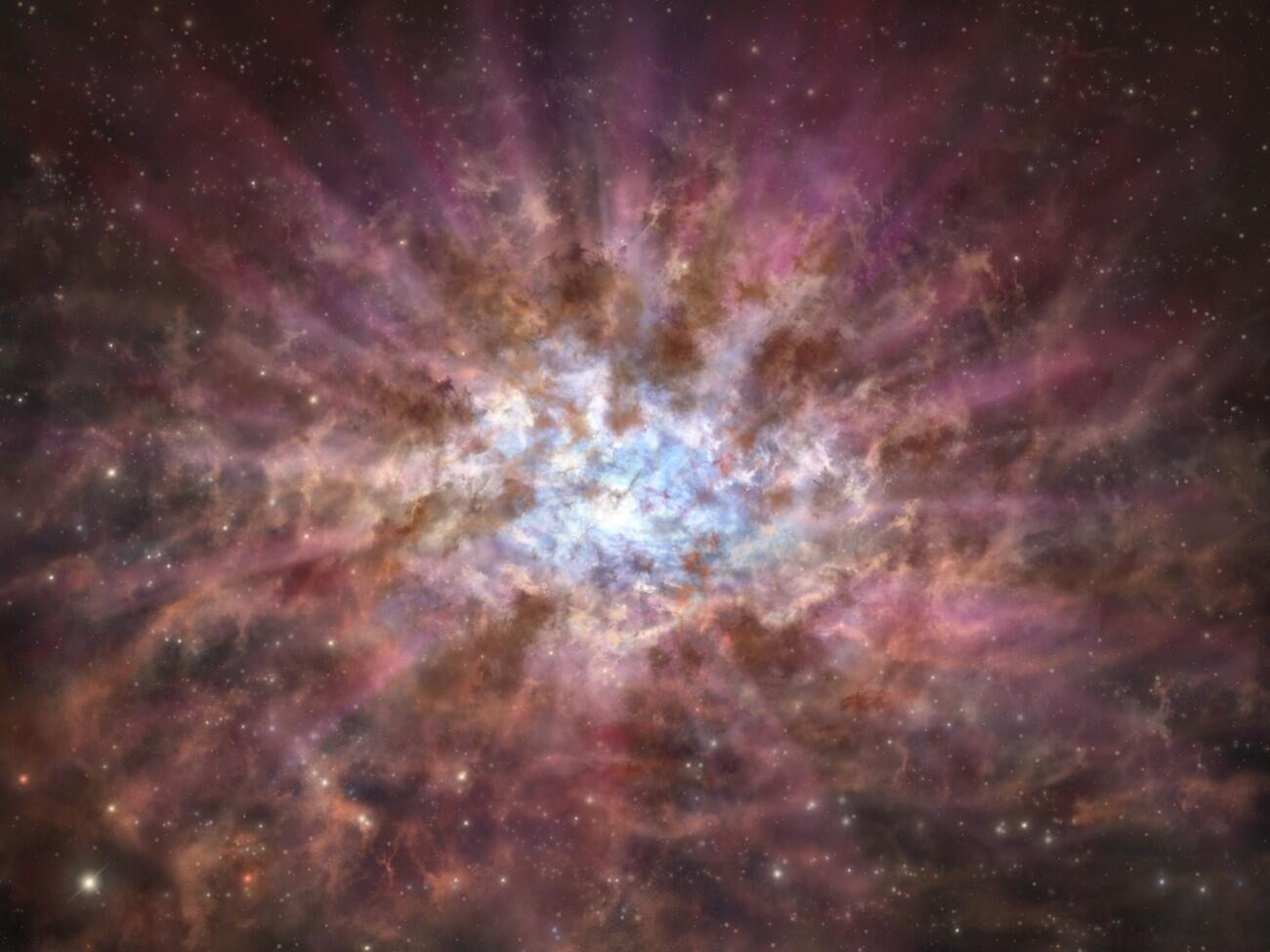
To test this hypothesis, the research team used the Subaru ground-based telescope and the James Webb Space Observatory. It conducts observations at infrared wavelengths, which pass through dust clouds much better.
The search was successful. Scientists were able to confirm the existence of a number of unknown quasars surrounded by dust. It turned out that the dust absorbs about 70% of the visible light and almost all (99.9%) of the ultraviolet light from these quasars. This explains why they were missed in previous studies.
By comparing the density of quasars, the team concluded that quasars hidden by dust occur at least as frequently as previously known normal quasars. This means that the number of bright quasars in the early universe is at least twice as high as previously thought.
Researchers plan to continue their observations to understand whether “dusty” quasars differ from ordinary ones. The team also plans to conduct new searches for black holes to identify the entire population of such objects in the early universe.
Provided by Subarutelescope.org

