

Scientists have discovered that the most common class of planets in the Galaxy appears to have a structure quite different from that of Earth. Instead of the familiar layers consisting of a metallic core and a rocky mantle, their interiors may consist of a homogeneous mixture of iron, silicates, and hydrogen.
Earth as an exception
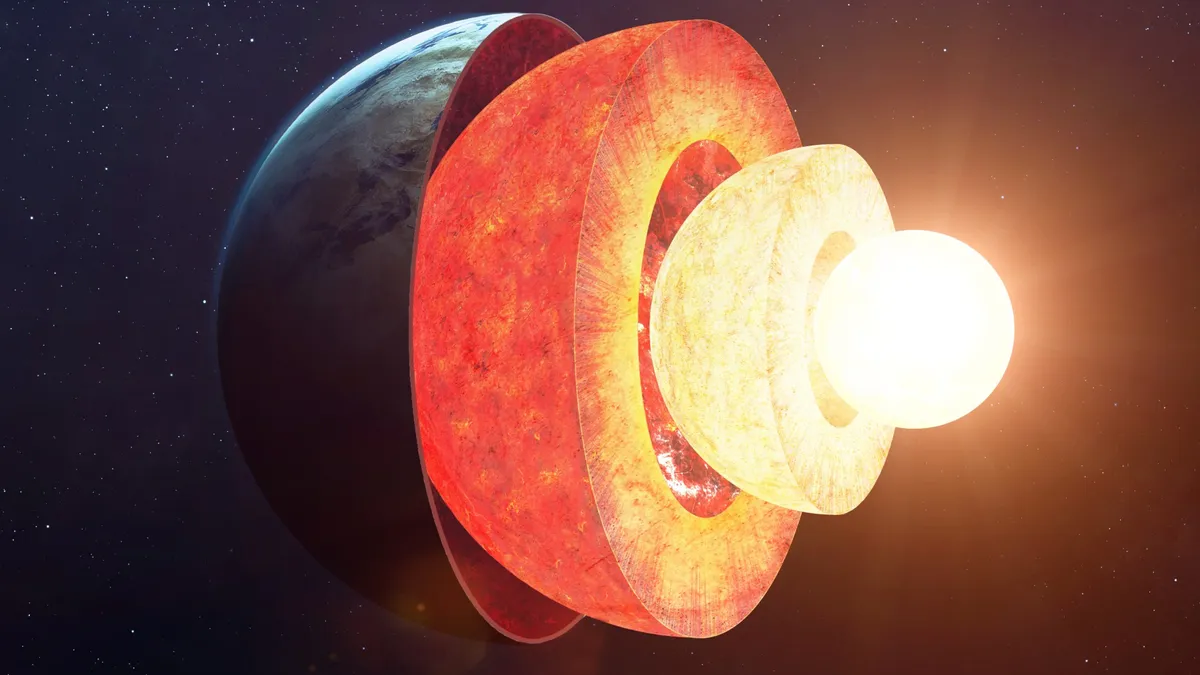
For a long time, planetary scientists believed that all rocky worlds form in roughly the same way. In a molten, young planet, heavy metals are drawn to the center by gravity and form the core, while lighter silicates form the mantle and crust above it, and gases are expelled to form the atmosphere. This model certainly holds true for Earth.
However, a study submitted to the Astrophysical Journal calls this picture into question for most exoplanets. The most common class of worlds orbiting other stars are sub-Neptunes—planets larger than Earth but smaller than Neptune. Their close relatives, super-Earths, are slightly smaller in size and have likely long since lost most of their hydrogen.
What’s happening inside a sub-Neptune
The fact is that, under the pressure and temperature conditions inside a sub-Neptune, substances behave quite differently than they do on the surface of our planet. At just 4,000 degrees Kelvin, hydrogen and molten silicate become completely mixed. They cease to exist separately and form a single liquid.
The authors modeled what this means for the internal structure of such planets. It turned out that, with enough hydrogen, the entire interior becomes a homogeneous mixture of iron, silicates, and hydrogen—with no core and no mantle.
Why is this important?
A planet’s internal structure determines how it cools, retains its atmosphere, and changes in radius over time. New simulations explain several features that previous models could not account for. Among these is the so-called radius gap—that is, a noticeable shortage of planets with sizes between super-Earths and sub-Neptunes—observed by the James Webb and Kepler telescopes.
Another key feature is the dependence of the radius on the orbital period. Both phenomena naturally follow from the model if we assume that young sub-Neptunes retain a significant fraction of hydrogen within their mixed interiors and then slowly release it outward over hundreds of millions of years as they cool.
How to check this
If hydrogen is indeed gradually escaping from the interior into the atmosphere, young sub-Neptunes should contract more slowly than standard models predict. They would appear slightly larger than they should be for their age. Astronomers are already beginning to discover sub-Neptunes orbiting very young stars that are only tens of millions of years old. The James Webb Space Telescope and a new generation of transit surveys will be able to measure this.
The authors acknowledge the limitations of their work. The model relies on theoretical extrapolations of the behavior of hydrogen, silicates, and iron under conditions that cannot yet be replicated in the laboratory, although experiments involving ultra-high pressures are gradually approaching the required parameters.
According to space.com

