

Elon Musk, known for his obsession with Mars, seems to be temporarily changing course. Whereas he previously referred to flights to the Moon as a distraction from the “big goal,” the Earth’s natural satellite has now become a key stage in the creation of a global empire of artificial intelligence.
During an internal meeting with employees of the recently acquired company xAI, he announced an ambitious plan that sounds more like the plot of a science fiction novel than a real engineering challenge.
Satellite “cannon”
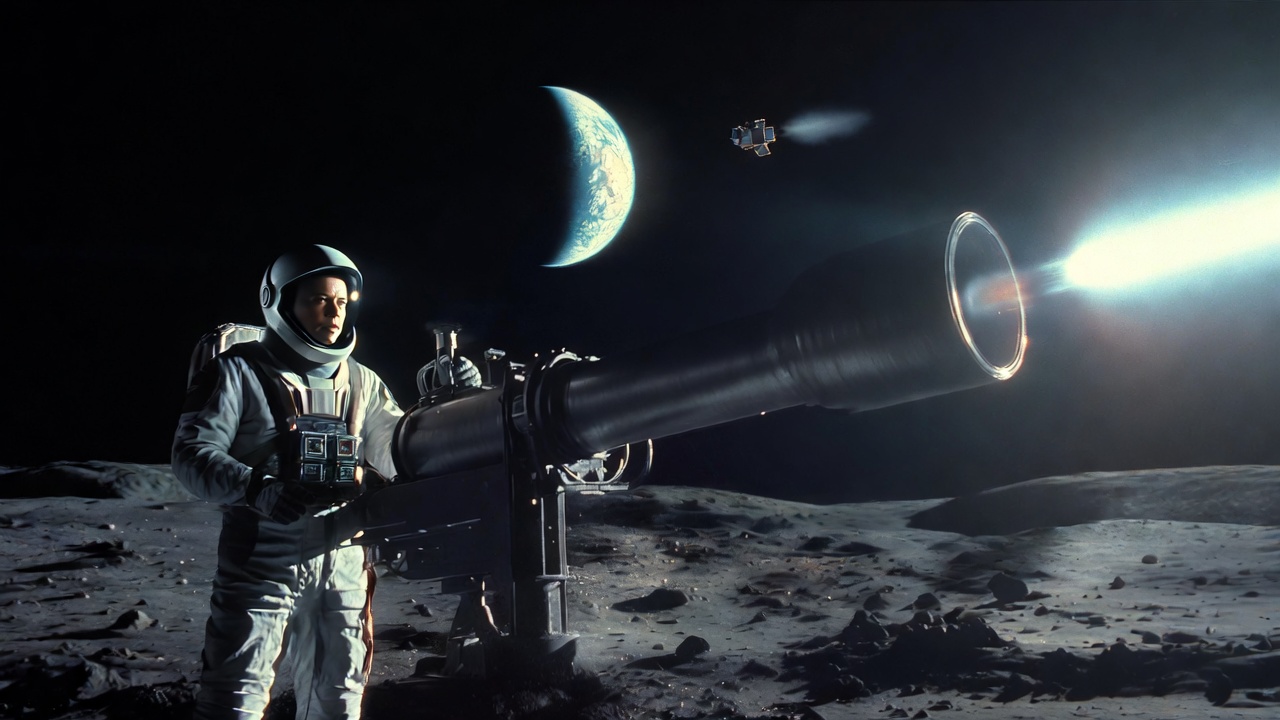
According to Musk, a factory for producing satellites equipped with artificial intelligence needs to be built on the Moon. But the most interesting detail is how they will be launched into space. A billionaire proposes building a huge “electromagnetic catapult.” Of course, it should not be a medieval weapon, but a Gauss cannon, which will use a magnetic field to accelerate objects to extremely high speeds. Instead of shells, the installation will launch ready-made satellites that will enter lunar orbit, overcoming gravity with kinetic momentum.
This technology will save fuel and reduce logistics costs, as the Moon has significantly weaker gravity than Earth. For Musk, this is not just a technical challenge, but a necessary step in scaling his AI empire.
“You have to go to the moon,” he told the xAI team. “It’s difficult to imagine what an intelligence of that scale would think about, but it’s going to be incredibly exciting to see it happen.”
Why has Musk suddenly become so fond of the Moon?
For years, Musk ridiculed lunar programs, considering them a dead end. His slogan is “to make humanity an interplanetary species,” and his main goal is the Red Planet. He even made optimistic predictions: in 2017, he promised the first flight to Mars in 2022 and the landing of astronauts in 2025.
Now his rhetoric has changed, but with one caveat: Musk insists that he is not giving up on Mars. Instead, he is proposing a new roadmap. According to him, humanity first needs to establish a permanent colony on the Moon, and this can be done in less than ten years. And only then, based on this experience, move forward.
For those unaware, SpaceX has already shifted focus to building a self-growing city on the Moon, as we can potentially achieve that in less than 10 years, whereas Mars would take 20+ years.
— Elon Musk (@elonmusk) February 8, 2026
The mission of SpaceX remains the same: extend consciousness and life as we know it to…
“The moon is part of the journey to Mars,” he explained his position to employees, adding that creating a similar city on the Red Planet would take more than twenty years.
Catalyst for change
The acquisition of xAI, which Musk called “historic,” became a catalyst for changing his ideas. He is convinced that the future of artificial intelligence is impossible without space exploration. In his opinion, Earth’s resources are limited, whereas virtually inexhaustible solar energy can be obtained in orbit. In this hierarchy, the Moon becomes an ideal logistics and production hub from which these systems can be powered and deployed.
Despite the change in focus, the ultimate goal remains the same: expanding humanity’s presence in the universe. Now, Musk is simply betting on what he believes will be a faster result. By building a lunar factory for the production of satellites and an electromagnetic catapult for their launch, he seeks not only to create a “backup copy” of civilization, but also to ensure the energy and computing dominance of his artificial intelligence empire. And Mars, as promised, will have to wait.
Earlier, we reported on how Elon Musk mocked Davos with dark jokes about death on Mars.
According to The New York Times

