

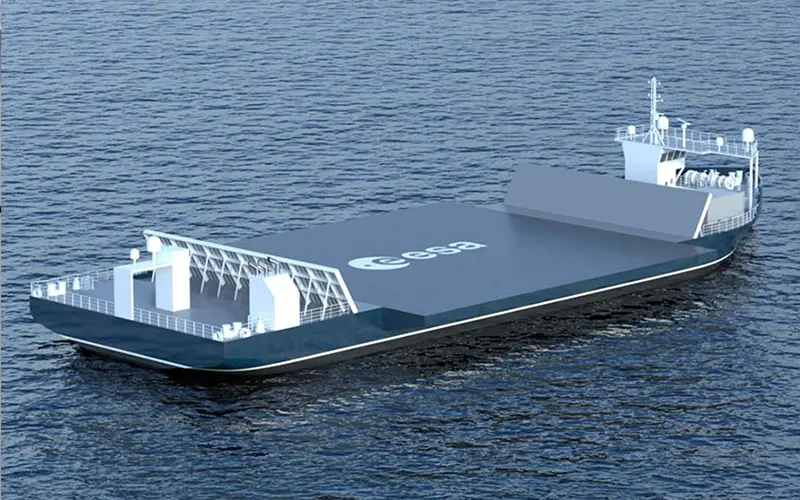
The European Space Agency (ESA) has signed a contract with Italian aerospace and defense company Ingegneria Dei Sistemi (IDS) to design a vessel for returning reusable rocket stages. It is part of a broader agreement with Italian rocket manufacturer Avio to develop a reusable upper stage.
At the end of September, ESA signed a €40 million contract with Avio for the design of a reusable upper stage for rockets. The project includes preliminary design work, including the definition of system requirements and technological solutions for both the launch system and the ground segment. According to officials, it has a number of potential applications, including as an upgrade to Avio’s Vega family of rockets.
On October 15, IDS announced that it had been awarded a contract to design a stage landing vessel, which is part of the ground segment of the system. The company has engaged Italian consulting firm Cetena, which specializes in naval systems, and Norwegian shipbuilder Vard as subcontractors to assist with the project.
The reusable upper stage project led by Avio is not the first ESA-funded initiative to develop reusable rockets in which IDS is involved. In December 2024, the company announced that it had also participated in the development of the vessel as part of a “pilot project” aimed at designing a fully reusable rocket capable of delivering up to 60 tons to low Earth orbit.
In addition to working on the design of a reusable upper stage for rockets, Avio has also received funding from the Italian government under the PNRR program to design a reusable first stage. The companies have allocated €181.6 million to develop two demonstration models as part of the Space Transportation System initiative. The project aims to test new-generation rocket engines powered by methane-oxygen fuel and serves as a means of improving reusable rocket technologies, which could potentially pave the way for the development of the Vega family or the introduction of a new medium-lift orbital system.
For more details on how Europe is trying to catch up with the US in the space race, check out our article.
According to Europeanspaceflight

