

The European Space Agency (ESA) has published an image taken by the Euclid space telescope. It photographed a cluster of dust and gas in the Orion constellation.
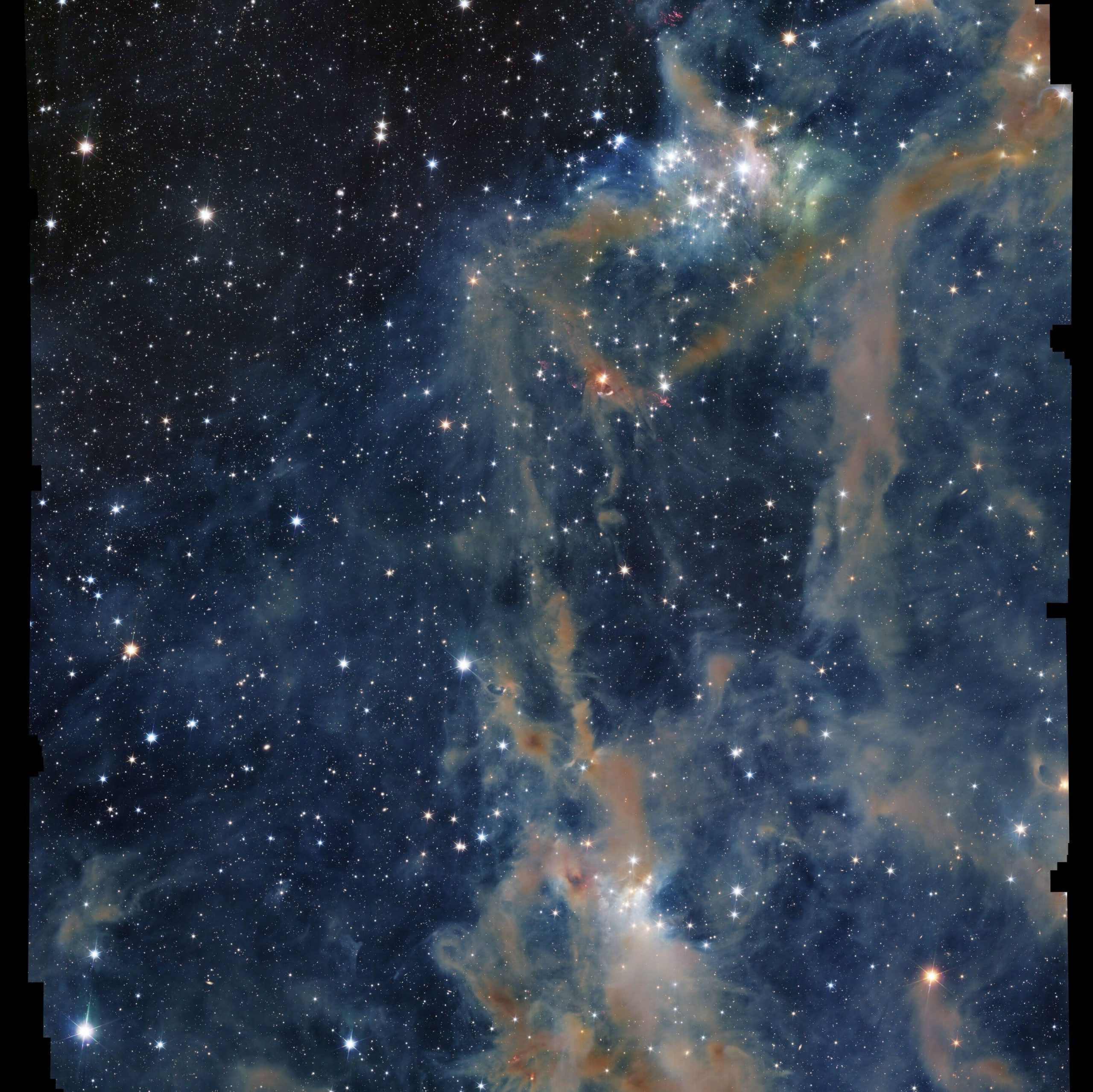
The nebula captured in the photo is part of the dark cloud LDN 1641. It is located about 1,300 light-years from Earth and is part of a vast complex of gas and dust clouds where new stars are being born right now.
In visible light, this area of the sky appears mostly dark, with a few stars scattered across what seems to be an empty background. But when photographed in the infrared range, everything changes and we see a multitude of stars whose light shines through the dust. This is because dust particles are very effective at blocking visible light, but much less effective at attenuating near-infrared radiation.
The nebula is full of very young stars. Some objects, surrounded by dust cocoons, emit jets — a sign of star formation. When the image is enlarged, they look like pinkish-red spots and spirals. In the upper left corner, the concentration of dust decreases, revealing a view of the Universe — not only the stars of the Milky Way, but also much more distant galaxies.
Euclid observed this area of the sky in September 2023 to calibrate its instruments and test its guidance system. For the tests, engineers needed an area of the sky where only a few stars would be visible in visible light. This part of LDN 1641 proved to be the most suitable. The data for the image, which covers an area of 0.64 square degrees (more than three times the area of the full moon in the sky), was collected in less than five hours of observation.
Euclid is surveying the sky to create the most comprehensive 3D map of the Universe in history. It will enable scientists to unlock the secrets of mysterious dark matter and dark energy.
According to ESA

